
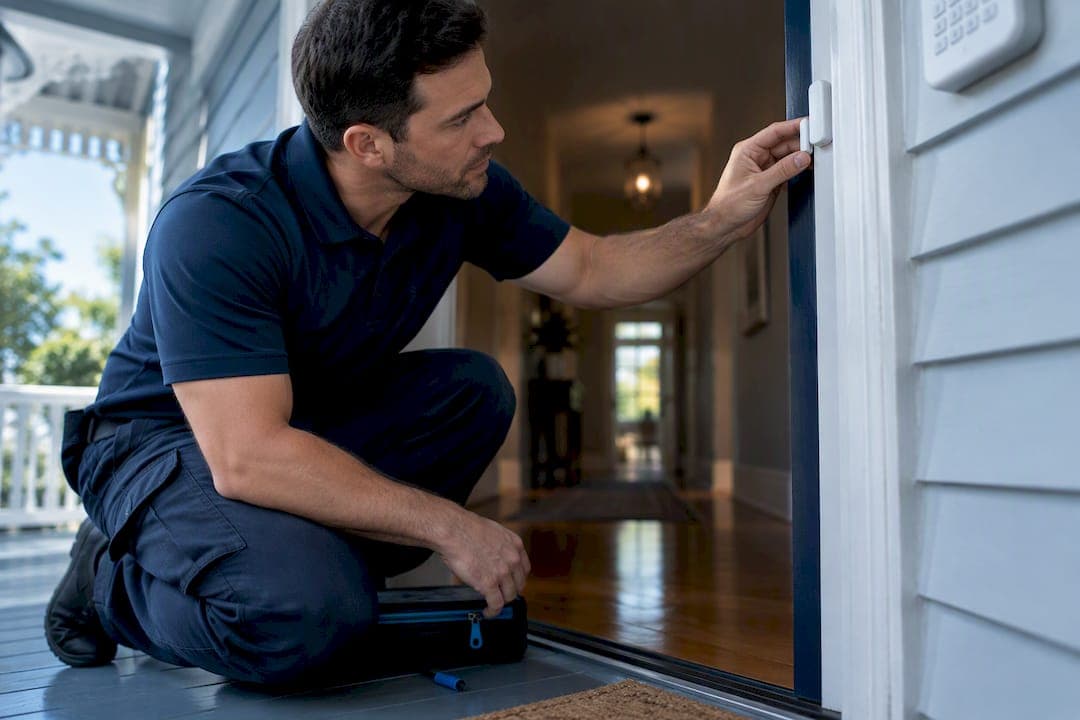
A supplied and installed home alarm system in Australia typically runs $900 to $5,000, depending on scope. A basic wireless kit for an apartment lands around $900 to $1,500, a typical six to eight zone suburban house system runs $1,800 to $3,200, and a comprehensive setup with cameras and dual-path monitoring can reach $5,000 or more. Professional monitoring adds $30 to $60 a month on top, though your final number depends heavily on site conditions and whether the installer meets Australian compliance standards.
TL;DR:
- The cost for a basic wireless alarm system in Australia can be as low as $500 to $1,500 for apartments, but larger or more complex setups may reach $8,000 or more.
- Device costs vary between $80 and $250 per sensor or device, with larger property types and complex installations increasing labor and overall expenses.
- Proper installation by licensed professionals, including a commissioning certificate and clear itemized quotes, reduces long-term risks and avoids hidden costs.
- Monitoring fees range from $30 to $80+ per month, with advanced features like dual-path communication and video verification justifying higher prices.
- Safety and compliance depend on using licensed installers, especially in Queensland, where unlicensed work voids insurance and risks non-standard setup or maintenance issues.
Table of Contents
- Alarm System Cost Australia: Prices at a Glance
- What Actually Drives Your Alarm System Quote?
- Comparing System Types and What Each Costs Installed
- Monitoring Costs, Contracts, and the Real Five-Year Price Tag
- Licensing, Standards, and the Compliance Checklist
- Getting an Accurate Quote Without Overpaying
- An Installer's View: How Licensing Prevents Hidden Costs
- Are There Government Rebates for Alarm Systems in Australia?
- Why the Cheapest Quote Almost Never Wins Long Term
- Get a Site Survey and a Quote That Actually Matches Your Property
- Sources
- FAQ
Alarm System Cost Australia: Prices at a Glance
Before you call an installer, it helps to know roughly where you should land. The table below summarizes common price ranges from various pricing surveys and industry monitoring guides, to help you check any quote you receive.
| System category | Typical installed cost (incl. GST) | Monthly monitoring |
|---|---|---|
| Basic wireless kit (apartment, 2 to 4 sensors) | $500 to $1,500 | $0 (self-monitored) or $30+ |
| Standard suburban house | $1,200 to $3,200 | $30 to $60 | | Comprehensive system (cameras, dual-path, video verification) | $3,000 to $8,000 | $60 to $80+ | | Small commercial (multiple zones, access control) | $4,000 to $12,000+ | $60 to $150+ |
These ranges come from a combination of GoingRate's national alarm system cost data and pricing breakdowns published by WhatCosts, and both note the figures already include GST. Treat them as a national average rather than a fixed quote. Regional labour rates, the number of storeys on your property, and how far the installer has to travel all push individual jobs up or down from these bands.
One number worth remembering when you're comparing quotes line by line: per-device installed cost typically sits around $80 to $250 per sensor or device, according to WhatCosts' pricing breakdown, depending on the device type and how much cabling or configuration it needs. A basic door contact costs far less to fit than a PIR sensor mounted in a hard-to-reach ceiling corner, and that gap is often where quotes quietly diverge.
Pro Tip: Ask every installer to break their quote down by device count and zone, not just a single bottom-line figure. A quote that only shows one total number is much harder to compare fairly against a competitor's itemized breakdown.
If you're budgeting for a rural property or an older Queenslander with limited existing cabling, expect to sit toward the top of each range. Multi-storey homes and properties with brick or heritage walls add labour hours that a single-storey brick veneer simply doesn't need. The averages above assume reasonably straightforward access, which is not every property in South East Queensland.
It's also worth noting that "basic" and "comprehensive" aren't just about zone count. A basic kit might cover entry points only, while a comprehensive system extends coverage to internal movement, glass break detection, and perimeter cameras working off the same panel. The jump in price reflects a genuinely different level of coverage, not just more hardware for the sake of it.

What Actually Drives Your Alarm System Quote?
Two quotes for what looks like "the same system" can land $1,500 apart, and the gap almost always comes down to five factors: device count, panel features, wiring method, site complexity, and connectivity.
Device count and type is the biggest single lever. A door/window contact might cost $80 to $120 installed, a standard PIR motion sensor sits around $100 to $180, and a glass break detector or smart siren can push past $200 once you factor in wiring and calibration. Add six sensors instead of four and you've added real dollars, not just a line item.
Panel features matter more than most buyers realize. A base panel with standard cellular backup costs less than one with:
- Dual-path communication (cellular plus IP, so a cut phone line or internet outage doesn't disable monitoring)
- Video verification, which lets the monitoring centre confirm an intrusion visually before dispatching
- App-based control with real-time push notifications
- Battery testing that runs automatically rather than requiring a manual check
Panels like the Australian-made Ness D8XCEL, for example, include dynamic battery testing and 4G communicators as standard features, which is worth knowing when you're comparing what's actually inside a quoted panel rather than just its brand name.
Wired versus wireless installation changes labour cost significantly. Wireless sensors mount faster, often in under 20 minutes each, because there's no cable run required. Hardwired sensors need cable pulled through walls and ceilings, which is where an installer's day rate starts to matter more than the hardware itself.
Site complexity is where quotes blow out unexpectedly. A double-brick or heritage-listed home makes cable runs harder and sometimes impossible without visible conduit, which not everyone wants. Multi-storey properties add time for ladder work and vertical cable runs between floors. If your property has already been renovated with concealed cabling in mind, ask your installer directly. Structured, concealed cabling from the original build stage saves a fortune compared to retrofitting it later.
Connectivity and backup power round out the list. Most alarm panels now run on a SIM-based 4G communicator rather than a landline, which is more reliable but not free. If your property has patchy mobile coverage, some installers will pair the panel with an NBN or Starlink connection for the monitoring link, which adds setup complexity but also reliability, especially useful for rural properties where mobile signal drops out during storms.
Comparing System Types and What Each Costs Installed
Most Australian buyers fall into one of four categories, and each one carries a different cost profile and a different set of trade-offs.
-
Basic self-monitored kits. These typically run $500 to $1,500 installed, covering a handful of door and window sensors, a base station, and a smartphone app for alerts. There's no monthly monitoring fee because you're the one who responds to alerts, which suits renters, small apartments, or anyone testing the waters before committing to a full system. The trade-off is obvious: if you miss a notification or you're asleep, nobody else is watching.
-
Professionally installed wireless packages. This is the most common choice for suburban homes, typically landing between $1,800 and $3,200 for a six to eight zone system. Installation includes proper sensor placement (not just wherever's convenient), a commissioning check, and setup of the monitoring connection. You get the speed advantage of wireless without sacrificing the professional oversight that catches blind spots a DIY install would miss.
-
Hardwired or hybrid systems. These cost more upfront, often $2,500 to $5,000-plus depending on cable runs, but they tend to be cheaper to own over time. Industry pricing notes suggest wired and hybrid setups avoid the repeated sensor replacement and battery changes that cheaper wireless sensors accumulate over several years. If you're building new or doing a major renovation,, running structured cabling during that window is far cheaper than retrofitting a wired system into finished walls later.
-
Commercial systems. Offices, retail spaces, and warehouses typically need more zones, access control integration, and compliance documentation for insurance purposes. Costs commonly start around $4,000 and climb well past $12,000 for larger sites with multiple access points, camera integration, and commissioning certificates required for insurance or lease conditions. Monitoring for commercial accounts also tends to start higher, often $60 to $150 or more per month, reflecting the faster response times commercial contracts usually demand.
The right category for you depends less on budget and more on how much of the decision you want to hand off. A basic kit asks a lot of you as the ongoing monitor. A professional package, wired or wireless, hands that responsibility to a monitoring centre, which is where the monthly fee actually goes.
Monitoring Costs, Contracts, and the Real Five-Year Price Tag

The upfront hardware cost is only half the budgeting picture. Monitoring is a subscription, and subscriptions compound.
Standard 24/7 back-to-base monitoring in Australia typically costs $30 to $60 a month for residential customers. Premium tiers, which usually bundle video verification and dual-path communication, can climb to $80 or more monthly, and commercial monitoring frequently starts even higher.
The gap between a $30 plan and an $80 plan isn't just price. Video verification and dual-path monitoring materially reduce false dispatches, and some insurers specifically ask for these features before offering a premium discount on your policy.
Contracts are where hidden cost usually hides. Many installers offer discounted or "free" hardware upfront, then recover that cost through a 24 to 36 month monitoring contract. That's not necessarily a bad deal, but you need to know what you're signing. Ask specifically:
- What's the contract length, and what's the early termination fee if you move or switch providers?
- Does the panel remain your property, or does the monitoring company retain ownership if you cancel?
- Is there a price increase built in after an initial promotional period?
That second point trips up more people than you'd expect. Providers who supply "free" hardware often retain ownership of the panel, which means switching monitoring companies later can mean paying an exit fee or buying new equipment outright, even though the box on your wall looks like yours.
Here's how three common scenarios stack up over five years:
- DIY self-monitored: $1,200 hardware, $0 monthly fee. Five-year total: roughly $1,200, plus occasional battery and sensor replacement.
- Professionally installed, standard monitoring: $2,400 hardware and install, $45/month average. Five-year total: roughly $5,100.
- Professionally installed, premium monitoring with video verification: $3,800 hardware and install, $70/month average. Five-year total: roughly $8,000.
The self-monitored option looks cheapest on paper, and it is, but it also puts the entire response burden on you every single time the alarm triggers. The gap between standard and premium monitoring over five years is nearly $3,000, which is worth weighing against how much that video verification and faster dispatch response actually matters for your property and your insurance policy.
Licensing, Standards, and the Compliance Checklist
An alarm system installed by an unlicensed operator isn't just a compliance headache. It can void your insurance claim entirely if something goes wrong.
Queensland requires anyone installing security equipment to hold a security equipment installer licence under the Security Providers Act. This isn't optional paperwork. Licensing checks are one of the fastest and most effective safeguards against a poor-quality install or an insurance dispute down the track, and it takes about thirty seconds to ask for a licence number.
Before you sign anything, run through this list:
- Ask for the installer's security equipment installer licence number and confirm it against the relevant state register.
- Confirm the installation will meet AS/NZS 2201, the Australian and New Zealand standard covering design, installation, commissioning and maintenance of intruder alarm systems.
- Request a commissioning certificate once the job is finished. This is your proof the system was tested and meets the standard, and it's often required if you ever need to make an insurance claim.
- Check whether the monitoring centre holds industry accreditation (ASIAL or an equivalent body), since this affects response reliability and, in some cases, insurance discount eligibility.
- Get warranty terms, panel ownership, and the commissioning report in writing before final payment, not verbally promised on installation day.
If you want a deeper breakdown of exactly what documentation to request, DJC Engineering's guide on checking a licensed security installer walks through the specific questions worth asking before you sign a contract.
Getting an Accurate Quote Without Overpaying
The single biggest driver of quote accuracy is how much information you give the installer before they arrive. A vague "I want an alarm" callout gets a vague quote back.
- Sketch your property first. Mark every entry point, the rooms you consider priority (main bedroom, home office, anywhere valuables are stored), and any areas with existing cabling from a previous renovation.
- Request an itemized quote, not a single total. It should list device count by type, installation labour separately from hardware, and the monitoring tier included in the price.
- Compare contract terms side by side, specifically length, early exit fees, and whether the panel becomes your property or stays with the monitoring provider.
- Ask about phased installation. You can often install core zones now (entry points, main living areas) and add perimeter sensors or cameras in a second phase once budget allows.
Pro Tip: When comparing quotes, ask installers to price by zone and list devices per zone, such as the front entry path, ground-floor living area, stairwell, and external perimeter. A quote that only shows one lump total often hides whether dual-path communication or video verification is even included.
If your budget is genuinely tight, prioritize perimeter and entry-point sensors over internal motion detection first. Most break-ins start at a door or ground-floor window, so covering those points properly buys most of the protection for a fraction of a full-system cost. You can always add internal zones and cameras in a second phase once the core coverage is in place.
An Installer's View: How Licensing Prevents Hidden Costs
Most of the "hidden costs" homeowners run into with alarm systems aren't really hidden. They're the result of skipping a licence check or accepting a quote that never specified device counts.
No subcontractors are used on any job, which matters more than it sounds. It means the person scoping your quote is the same person installing it, so there's no gap between what was promised and what actually gets fitted.
That matters most in the details that don't show up on a basic quote. Structured, concealed cabling done properly the first time avoids the retrofit costs discussed earlier. PoE (Power over Ethernet) network installation for cameras cuts down on separate power runs. Dynamic battery testing on the panel and a proper commissioning report at handover protect you if you ever need to make an insurance claim down the track.
Paying more upfront for a licensed, single-team installation isn't about brand loyalty. It's a hedge against the two costs that actually blow out an alarm system budget: a callback for a fault that should have been caught the first time, and a compliance gap that surfaces exactly when you need your insurance to hold up.
Are There Government Rebates for Alarm Systems in Australia?
There is currently no dedicated federal rebate scheme for residential or small business alarm system installation in Australia. Unlike solar or energy efficiency upgrades, which have had targeted incentive programs over the years, security system installation is generally treated as a standard home improvement cost, not one with a specific subsidy attached.
Some indirect financial benefits do exist, though they come from your insurer rather than a government program. Many home and contents insurers offer premium discounts for properties with a monitored alarm system, particularly if it includes back-to-base monitoring with a compliant commissioning certificate. The size of the discount varies by insurer and policy, so it's worth calling your provider directly and asking what documentation they need to apply it.
Small business owners installing security systems as part of broader security upgrades may be able to claim the cost as a business expense or depreciate the asset, depending on how the purchase is structured. That's a conversation for your accountant rather than your installer, since eligibility depends on your specific business structure and the ATO's current depreciation rules for the relevant financial year.
Why the Cheapest Quote Almost Never Wins Long Term
The conventional advice to "get three quotes and pick the middle one" misses the point entirely. Price alone tells you almost nothing about what you're buying, because two quotes at the same dollar figure can represent completely different levels of coverage, panel quality, and compliance.
What the research actually supports is this: the cheapest quote is usually cheap because it's missing something, most often dual-path communication, a commissioning certificate, or an itemized device breakdown that lets you check what you're paying for. The five-year cost comparisons above show the real gap isn't between "cheap" and "expensive" systems. It's between systems that were properly scoped once and systems that need fixing, upgrading, or replacing within two years.
If you take one thing from this guide, prioritize the licence check and the itemized quote before you even look at the bottom-line number. That single habit filters out most of the quotes that would have cost you more in the long run.
— Dylan
Get a Site Survey and a Quote That Actually Matches Your Property
DJC Engineering is the alternative to piecing together a system from a big-box hardware kit or gambling on an unlicensed installer's word: every job is scoped, quoted, and installed by the same licensed team, with no subcontractors handing your project off partway through.
A DJC site survey covers exactly the factors this guide walks through, device placement against your actual floor plan, cabling routes for hardwired or hybrid setups, connectivity checks for dual-path monitoring, and whether Starlink or NBN backup makes sense for your property. That's what a proper quote should include from the start rather than a single number with no breakdown behind it. DJC's NYX camera and Ajax alarm system installations cover both standalone alarm work and integrated setups that pair monitoring with CCTV and access control, and the team serves homes, businesses, and rural properties across South East Queensland.
If you're in Brisbane or the Gold Coast and want a back-to-base alarm system scoped properly the first time, book a site survey through DJC's alarm system installation page and get an itemized quote before you commit to anything.
Sources
The pricing and compliance guidance above draws on a mix of government regulation, the national installation standard, and independent Australian pricing surveys.
- Alarm System Cost Calculator (Australia 2026) | Going Rate
- How Much Should Security Monitoring Cost - Castle Security
- Queensland Government — apply for a security equipment installer licence
FAQ
What Is the Average Cost of an Alarm System in Australia?
A supplied and installed system typically costs $900 to $5,000, depending on zone count and features. A typical suburban house with six to eight zones lands around $1,800 to $3,200, plus $30 to $60 a month for professional monitoring.
How Much Does a Full Alarm System Cost With Monitoring?
A full system with monitoring includes the upfront install, generally $1,800 to $3,200 for a standard house, plus an ongoing monthly fee. Standard monitoring runs $30 to $60 a month, while premium tiers with video verification can reach $80 or more.
What Is the Best Home Alarm System in Australia?
There's no single "best" system, since the right choice depends on your property type, budget, and whether you want wired, wireless, or hybrid coverage. A professionally installed system from a licensed installer, like DJC Engineering's Ajax alarm installations in South East Queensland, gives you a properly scoped setup with a commissioning certificate rather than a generic off-the-shelf kit.
What Is the Best and Cheapest Alarm System?
The cheapest option is a basic self-monitored wireless kit, typically $500 to $1,500 installed with no monthly fee. It suits apartments and renters, but you take on the monitoring responsibility yourself, so weigh that trade-off against a professionally monitored system before deciding based on price alone.
Do I Need a Licensed Installer for an Alarm System in Australia?
Yes. Queensland and other states require anyone installing security equipment to hold a security equipment installer licence. Using an unlicensed installer can create problems with insurance claims and compliance under AS/NZS 2201.