
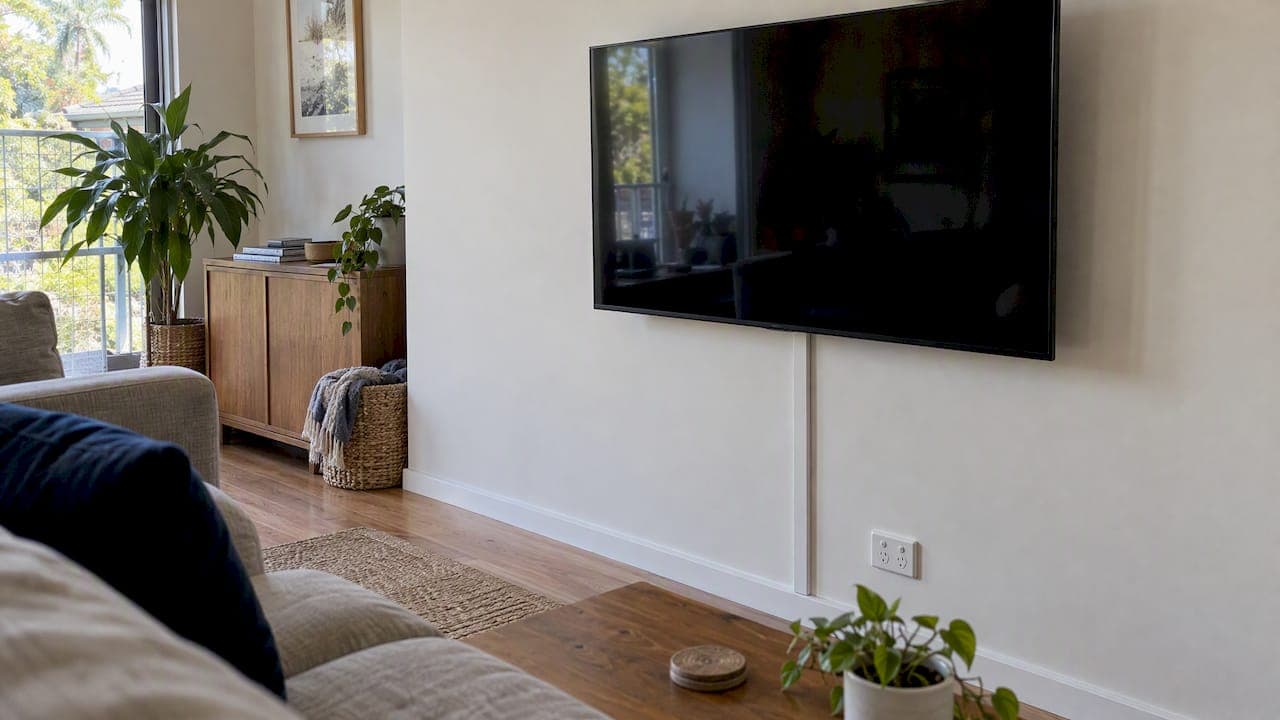
The three practical routes to concealed TV wiring are permanent in-wall routing with grommets or cable kits, surface adhesive trunking for renters or quick jobs, and a professional install when the project touches mains power or masonry. Building codes and fire-stopping rules limit what you can safely cut into a wall yourself, and any new power point needs a licensed electrician. Pick the permanent route for a long-term setup, trunking for a rental, and a pro for anything involving recessed power.
TL;DR:
- Renters should choose removable adhesive trunking, while owners with plasterboard and nearby power can fish low voltage cables through grommets for a permanent finish.
- Before cutting plasterboard, locate studs and check for wiring, pipes, and ducts; a new, recessed, or relocated power point requires a licensed electrician.
- The National Construction Code generally caps a single cable penetration at 2,000 square millimeters with gaps up to 15 millimeters, or 500 square millimeters otherwise.
- Fire stop every gap and keep openings 50 millimeters from other services; for brick walls, use surface trunking, an adjoining cavity, or a shallow frame.
- Choose fire rated trunking with 20 to 30% spare internal space, then let its adhesive set for the manufacturer's recommended time before adding cables.
Table of Contents
- Which concealment method fits your situation
- Installing an in-wall grommet or HDMI kit yourself
- Surface solutions that work for renters
- Handling brick, masonry, and fireplace installations
- Safety rules and red flags you should not ignore
- Tools, materials, and what to buy or rent
- Why some jobs are better left to a professional
- What actually matters when you plan a concealed TV setup
- Book a concealed wiring install with DJC Engineering
- FAQ
- Sources
Which concealment method fits your situation
Before picking up a drill, match the method to your wall, your lease, and how permanent you want the result. Each option trades off cost, finish quality, and how much wall access you need.
Permanent in-wall routing gives the cleanest finish and suits owners planning to stay put. It usually means cutting two holes and fishing cable between them, and it pairs well with recessed power if you want the TV to look like it floats with no visible cord at all.
Surface trunking and adhesive cable covers are the fastest fix and the only sensible choice for renters. They paint to match the wall, cost little, and peel off without damage when you move.
A media wall or custom cabinetry combines storage with built-in cable channels, but it needs planning for airflow around anything that generates heat, like a games console or amplifier.
When deciding, run through a short checklist:
- Wall type: plasterboard allows fishing cable, while brick or concrete does not.
- Power access: an existing outlet nearby keeps the job simple, while a new one means hiring an electrician.
- Cooling needs: enclosed cabinetry needs vents if gear sits behind the TV.
- Tenancy status: renters should default to removable trunking, not drilled holes.
Installing an in-wall grommet or HDMI kit yourself
This is the standard DIY approach for a plasterboard wall with power already nearby. It takes an afternoon with the right tools and a bit of patience.
Start with the pre-checks. Run a stud detector across the area to confirm you are cutting between studs, not through one, and check for existing wiring, pipes, or ducting before you drill. Confirm where the power outlet sits relative to the TV mounting point.
Gather your tools and parts: a stud finder, a cordless drill, a holesaw matched to your grommet size, fish tape, cable ties, silicone sealant, and an in-wall HDMI or grommet kit. Bunnings' DIY guide to hiding TV cables walks through a near-identical version of this process, including the use of grommets and fish tape to move cables between wall points, and the Wiremold In-Wall HDMI Grommet Kit bundles the holesaw and fish tape you need into one kit.
- Mark the entry hole behind the TV and the exit hole above the skirting or near the outlet.
- Cut both holes with the holesaw, checking depth so you only go through the plasterboard.
- Feed the fish tape from one hole to the other, attach your cables, and pull them through.
- Insert the grommets, seal gaps with silicone, and tidy cable ends with ties.
- Test every connected device before closing up with trim or a wall plate.
Pro Tip: Label each cable at both ends before you fish it through. It saves real frustration if you ever need to trace one later.
Stop here if the job needs a new power point or moving existing wiring. That work calls for a licensed electrician, not a weekend project.
Surface solutions that work for renters
Adhesive trunking is the go-to fix when drilling into a wall is not an option, and it still looks tidy when installed carefully.
Pick trunking sized to your cable bundle, not just the TV cable alone, since you may add a streaming box or soundbar cable later. Check for a fire-retardant rating such as BS EN 50085-1 or UL94 V-0, which D-Line's adhesive cable management covers list on their packaging.
Preparation matters more than the install itself:
- Clean the wall surface thoroughly so the adhesive strip actually bonds.
- Measure the run and cut trunking to length before peeling any backing.
- Use a spirit level to keep vertical drops straight.
- Let the adhesive set for the manufacturer's recommended time before loading cables in.
Paint the trunking to match your wall for a near-invisible finish, run it behind furniture where you can, and leave a small service loop at each end in case you add a device later.
Handling brick, masonry, and fireplace installations
Solid masonry rules out fishing cable the way you would through plasterboard, since there is no cavity to run it through. You have three realistic options: route cable to a nearby stud cavity, disguise slim surface trunking as a trim piece, or build a shallow stud-frame over the brick to create a hidden channel.
Chasing a channel into brick or concrete is possible but it is typically a trade job. It generates significant dust, raises structural questions depending on the wall's role, and near a fireplace it introduces heat exposure that needs careful material choices.
- Nearby cavity: extend cable through a stud wall adjoining the masonry rather than chasing the brick itself.
- Disguised trunking: paint or finish surface trunking to blend with existing trim.
- Stud-frame build-out: adds a shallow false wall that hides cable and gives you a mounting surface.
Safety rules and red flags you should not ignore
Wall penetrations are not a free-for-all, even for a simple cable hole. The National Construction Code sets limits on openings that pass through walls, floors, or ceilings: a single cable penetration is generally capped at 2,000 square millimeters with a gap no larger than 15 millimeters, or 500 square millimeters otherwise, and any gap needs fire-stopping. Openings also need to sit at least 50 millimeters from other services.

A single cable hole that breaches these limits can create a fire-safety gap, which is why it pays to keep penetrations small, isolated from other services, and properly sealed, as outlined in the National Construction Code's penetration rules.
AS/NZS 3000 covers how conductors should be sized, enclosed, and installed, and it underpins why mains wiring work sits outside DIY territory. Treat any of the following as a signal to call a licensed electrician or installer rather than finish the job yourself: moving or adding power points, working near cables you suspect are live, cutting penetrations close to existing services, or running cable near combustible cabinetry materials.
Tools, materials, and what to buy or rent
A short, well-chosen kit list saves a second trip to the hardware store. You need a stud finder, a cordless drill, a holesaw sized to match your grommet's outer diameter, fish tape (a 10-meter length covers most single-story runs), cable ties, and silicone sealant.
For the in-wall route, kits like the Wiremold In-Wall HDMI Grommet Kit bundle the grommets, holesaw, and fish tape together. For surface runs, D-Line's adhesive trunking comes in multiple widths and depths, and smaller mini trunking suits a single thin cable run.
- Match holesaw diameter to your grommet's outer edge, not the cable bundle.
- Check trunking's flame-retardant rating before buying, especially for living areas.
- Buy fish tape long enough for your full run plus slack.
- If you are also tidying a comms rack or patch panel, CommsBuyer's cabinet and cabling range is a useful reference for small home setups.
Measure your cable bundle's diameter and buy trunking with 20 to 30% extra internal space, since adding a streaming stick or extra HDMI lead later is common.
Why some jobs are better left to a professional
Compliance, integration, and recessed power are where a professional installation earns its cost back. We design and install audio-visual systems and concealed cabling as part of fully engineered jobs, not an afterthought bolted onto a TV mount.
A typical professional deliverable includes engineered cable routes, proper fire-stopping at every penetration, a tidy comms rack where networking gear lives, recessed power installed by a licensed electrician, and a tested handover before anyone leaves the property.
Masonry chasing, PoE camera integration alongside a TV cabling run, or ventilation planning for a packed media wall are exactly the scenarios where paying once for a professional avoids a second, more expensive fix later.
What actually matters when you plan a concealed TV setup
Most guidance on this topic treats concealment as a purely cosmetic problem, as if the only decision is grommet versus trunking. That undersells the real risk, which sits in the penetration rules and the mains wiring, not the visible cable run. A beautifully hidden cable behind a wall that breaches fire-stopping requirements is a worse outcome than a visible cord run neatly along a baseboard.

The conventional advice also overstates how often you need to chase masonry or build elaborate media walls. For most homes, a stud cavity sits close enough to route cable through without touching brick at all, and that option gets skipped too quickly in favor of more dramatic builds.
If you take one thing from this, prioritize the boring part first: confirm your wall type, check what is already inside it, and decide honestly whether the job needs a licensed electrician before you decide how pretty the finish will be. Permanence and compliance matter more than which trunking color you pick.
— Dylan
Book a concealed wiring install with DJC Engineering
A clean cable run behind your TV takes more than a holesaw and a prayer, especially once recessed power or network cabling enters the picture. We offer concealed TV wiring, recessed power, and integrated AV as part of a fixed-scope installation, performed by a professional team from start to finish.

- Request an on-site survey to assess your wall type and cable routes.
- Get a fixed-scope quote before any work begins.
- Book a phone consultation if you are still deciding between DIY and a professional install.
Our audio-visual and TV wall mounting service includes recessed power and concealed cabling as part of a single coordinated job to ensure smooth installation and finish.
FAQ
How do you conceal TV wires?
You can route cables inside the wall using a grommet or in-wall HDMI kit, or cover them on the surface with adhesive trunking. Bunnings' DIY guide walks through both methods, including drilling, fishing cable, and finishing with grommets or paintable covers.
Can I hide TV cables in a wall if I'm renting?
Renters should stick to removable adhesive trunking rather than cutting into the wall, since it leaves no permanent damage. D-Line's adhesive cable covers are paintable and peel off cleanly when you move out.
What products can I buy to hide TV cables?
A Wiremold In-Wall HDMI Grommet Kit bundles the grommets, holesaw, and fish tape needed for a permanent install, while D-Line trunking covers the surface-mount route. Both are available through major hardware retailers and suit different walls and tenancy situations.
Do I need an electrician to conceal TV wires?
You need a licensed electrician only when the job involves a new power point, recessed power, or moving existing wiring, since this work falls under AS/NZS 3000. Simple low-voltage cable routing for HDMI or speaker wire does not require an electrician, but penetrations still need to follow fire-stopping rules.
What wall penetration rules apply to concealed TV cabling?
The National Construction Code limits penetration size and requires fire-stopping around any gap, with openings kept at least 50 millimeters from other services. Following these limits matters even for a single cable hole, since a non-compliant penetration can undermine the wall's fire resistance.