
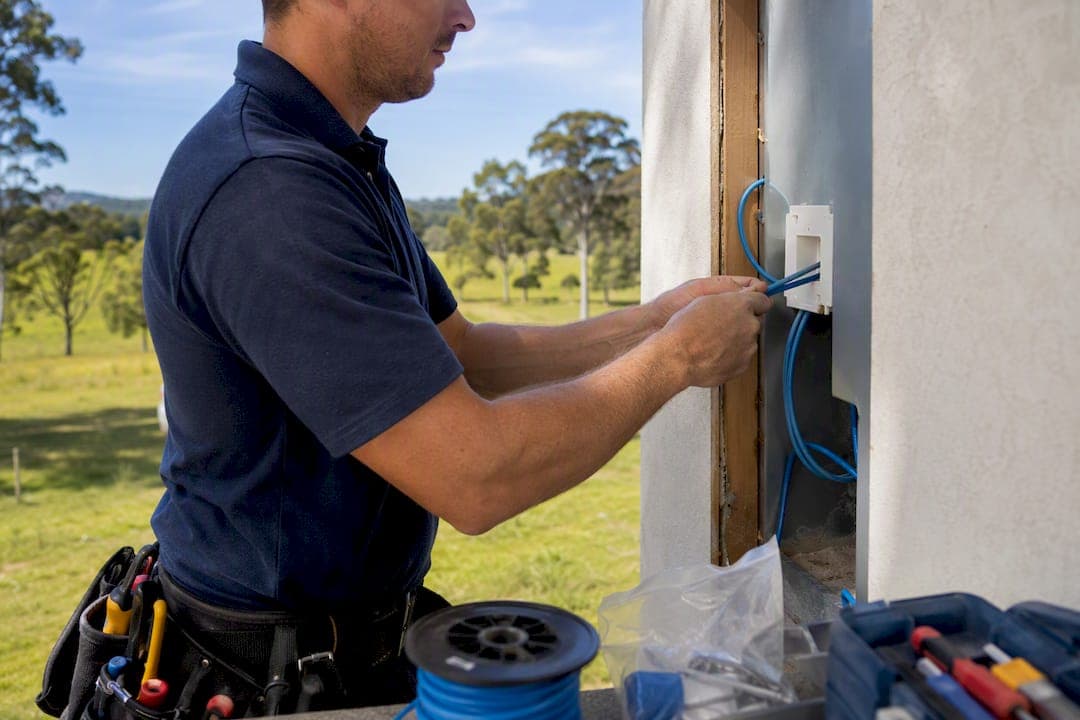
Yes, for almost all NBN, data, security, and telecommunications cabling in Australia, the law requires a registered cabler. ACMA guidance confirms that anyone installing, connecting, or repairing customer cabling must hold current registration or work under someone who does. Before anyone touches a wall plate or comms rack, ask:
- Can you show me your registration card and registration number?
- Which registrar issued it, and is it still current?
- Will I get a signed compliance statement after the job?
For homes and businesses in South East Queensland, Djcengineering is a compliant, local option that handles this paperwork as a matter of course.
Key Takeaways
Hiring a registered cabler in Australia isn't a formality. It's a legal requirement backed by ACMA that protects your safety, your insurance coverage, and the wider telecommunications network.
| Point | Details |
|---|---|
| Registration is mandatory | ACMA requires all customer cabling work to be performed or supervised by a registered cabler. |
| Match the category to the job | Open covers most home and office work; Lift and specialist competencies apply to niche jobs like fibre. |
| Verify before you sign | Check the registration number against ACRS, ASIAL, FPA Australia, or TITAB before work starts. |
| BRCA no longer active | BRCA withdrew as a registrar in March 2025; any card citing it needs rechecking elsewhere. |
| Local expertise matters | Djcengineering delivers compliant, tested installs with a very high first-visit fix rate across South East Queensland. |
Table of Contents
- What Is a Licensed Cabler in Australia, and Why Does Registration Matter?
- Which Registration Category Covers Your Job?
- How Do You Verify a Cabler's Registration Number?
- What Happens if You Hire an Unregistered Cabler?
- How Do You Hire the Right Registered Cabler?
- What Does a Compliant Installation Actually Look Like on Site?
- Do Licensing Requirements Differ Between States?
- What Should Cabling Work Cost in Australia?
- When Should You Call a Local Cabler Instead of a Big Firm?
- How Djcengineering Handles Compliant Cabling Installs
- Sources
What Is a Licensed Cabler in Australia, and Why Does Registration Matter?
A registered cabler is someone who has met ACMA's training, testing, and experience benchmarks to legally connect equipment to Australia's telecommunications network. This is not optional paperwork. It is baked into the Telecommunications (Cabling Provider) Rules, which set the training and experience thresholds every cabler must clear before they can legally work unsupervised.
The number that matters here: 360. ACRS registration guidance lists 360 hours of documented work experience as a typical benchmark for Open registration, on top of a formal training and cabling regulations test.
Once someone is registered, their work still has to meet a technical benchmark, not just a legal one. The Australian/New Zealand Wiring Rules (AS/CA S009) govern how cabling is run, terminated, and separated from electrical wiring. Registration proves someone is legally allowed to do the work. AS/CA S009 compliance proves they did it properly.
Which Registration Category Covers Your Job?
ACMA splits cabling registration into three categories, and matching the right one to your job matters more than most homeowners realize. According to ACMA's category breakdown, the three are:
- Open registration covers general cabling work, including most home and office data points, phone lines, and NBN connections.
- Restricted registration covers a narrower scope, often tied to specific premises or simpler jobs, and doesn't authorize the full range of Open work.
- Lift registration is a specialist category for cabling inside lift shafts, a genuinely different risk environment from a home office wall.
Beyond the three core categories, ACMA also recognizes additional competencies for specialized work like optical fibre splicing or structured cabling in large buildings. A straightforward NBN socket move or a run of Cat6 to a home office usually just needs Open registration. But if you're wiring a commercial floor with a structured cabling backbone, or your project involves fibre termination, ask specifically whether the cabler holds those extra competency endorsements. Don't assume Open registration automatically covers it.
How Do You Verify a Cabler's Registration Number?
Checking registration takes about five minutes if you know where to look, and skipping it is the single most common mistake homeowners make when hiring.
- Ask to see the physical card. Registrar guidance notes that card designs vary between registrars, so don't rely on the card's look alone.
- Record the registration number and issuing registrar.
- Search that number through the Australian Registered Cablers tool, or the specific registrar's own database.
- Check the expiry date, not just whether the number exists. A lapsed registration is functionally the same as no registration.
- Keep the signed TCA1 or TCA2 compliance statement once the job wraps up. This document certifies the work meets the Wiring Rules, and insurers will want it on file if you ever make a claim tied to cabling or connected equipment.
Four ACMA-accredited registrars currently operate: ACRS, ASIAL, FPA Australia, and TITAB. A fifth, BRCA, withdrew from the registrar market in March 2025, so any card referencing BRCA needs a fresh check against one of the four active registrars.
What Happens if You Hire an Unregistered Cabler?
An electrical license does not cover telecommunications cabling. That's a distinct qualification, and plenty of unregistered operators either don't know that or hope you don't. The risks aren't abstract:
- Insurance gaps. If cabling work causes damage or a fire and the installer wasn't registered, your insurer may deny the claim outright.
- Network interference. Poorly terminated cabling can create bridge taps, crosstalk, and signal loss that disrupts not just your connection but potentially your neighbor's.
- No compliance paperwork. Without a signed TCA1/TCA2 statement, you have no proof the work meets the Wiring Rules, which becomes a problem the moment you sell the property or file a claim.
Watch for red flags during quoting: no registration card offered without being asked, vague answers about which registrar they're with, or a refusal to provide a compliance statement after the job. Genuine professionals produce this evidence without hesitation.
Pro Tip: If a quote seems unusually cheap, ask directly whether the price includes the post-job compliance statement. Cablers cutting corners on paperwork are often cutting corners elsewhere too.
How Do You Hire the Right Registered Cabler?
Vetting a cabler before signing anything takes fifteen minutes and saves you from the far longer headache of a redo. Work through this checklist before any tools come out of the van:
- Verify the registration number against the relevant registrar's database, not just the card.
- Ask for proof of insurance, specifically public liability and professional indemnity.
- Confirm they'll provide a TCA1 or TCA2 statement on completion, in writing, before the job starts.
- Ask which competencies they hold if your job involves fibre, structured cabling, or anything beyond a basic data point.
- Request examples of recent, similar work, ideally with photos of finished cable management, not just the "before."
When you interview a prospective cabler, ask direct questions: "What's your registration number and which registrar issued it?" "Can I see a sample compliance statement from a past job?" "Do you subcontract any part of this work, and if so, is that person also registered?" That last question matters more than most people realize. Under the ACMA cabling provider rules, if a registered cabler uses an unregistered trainee on-site, the registered cabler must take full responsibility and still certify the work themselves.
A fair quote for a small residential job, like adding two or three data points or relocating an NBN socket, should itemize labor, materials, and testing separately, and should state the compliance statement is included, not an add-on. Most straightforward residential jobs are completed in a single visit lasting two to four hours. If a quote is vague about scope or silent on paperwork, that's worth a follow-up question before you sign.
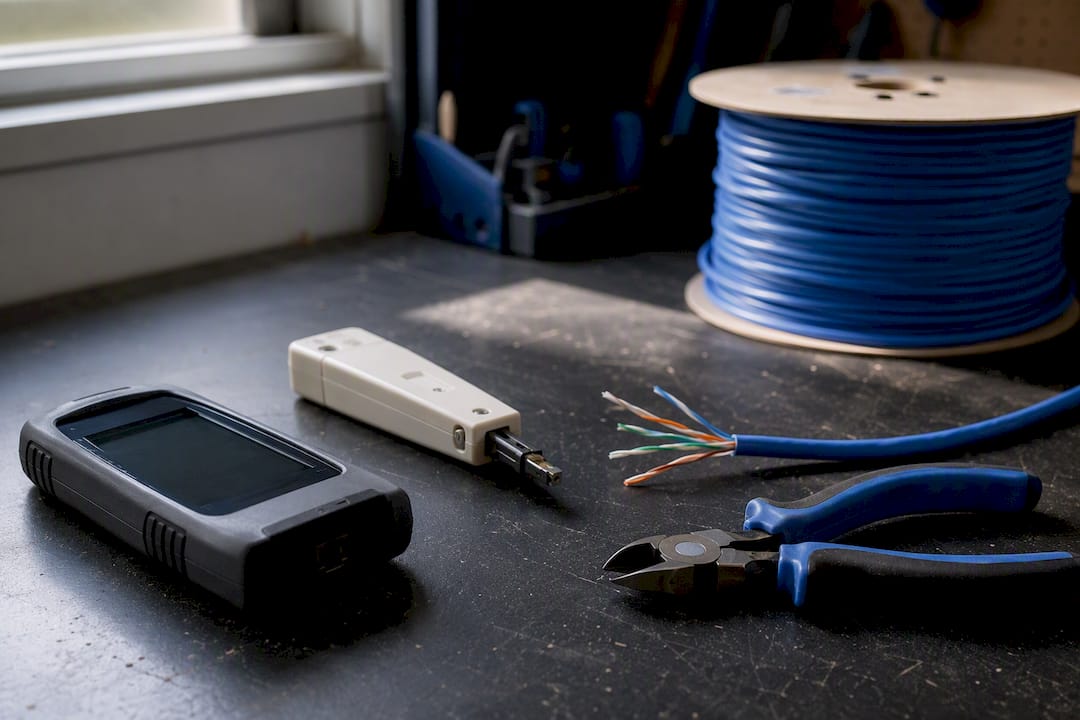
Pro Tip: Ask for the compliance statement template before work begins, not after. A cabler who has one ready to go has done this properly before.
What Does a Compliant Installation Actually Look Like on Site?
Paperwork tells you someone is legally allowed to do the work. What happens on site tells you whether they're good at it. A properly run job includes a pre-installation site survey, rack-mounted and labeled comms infrastructure rather than a tangle behind a cupboard door, and documented test results for every Cat6 or fibre run before the installer packs up.
Djcengineering completes installations with a 98% first-visit fix rate, using its own qualified team rather than subcontractors, across structured network cabling, mesh WiFi, Starlink and NBN connectivity, and CCTV and security systems.
What that looks like in practice:
- A site survey before quoting, so the scope matches the property, not a generic estimate.
- Engineered, tested backbone cabling with documented results, not a "she'll be right" termination.
- A signed compliance statement and test records handed over at job completion, every time.
Do Licensing Requirements Differ Between States?
Cabling registration itself doesn't vary by state or territory. It's a federal system administered under ACMA's Telecommunications (Cabling Provider) Rules, so a cabler registered through ACRS, ASIAL, FPA Australia, or TITAB can legally work anywhere in the country. That's genuinely useful if you're comparing quotes from a Brisbane-based installer versus someone driving up from Northern New South Wales. Registration status doesn't reset at the border.
Where things do differ is in overlapping trade licenses that sometimes apply to the same job. Electrical work adjacent to cabling, like running new power to a comms cabinet, falls under state-based electrical licensing schemes, and those rules vary by jurisdiction. Queensland, New South Wales, and Victoria each run their own electrical licensing bodies with separate registers and separate rules about who can legally do what. A cabler who is also doing electrical work on your property needs both credentials, cabling registration for the data side and a state electrical license for the power side, and they're not interchangeable.
Building codes and access requirements can also shift by council area, particularly for jobs in shared buildings, strata properties, or rural properties on larger blocks with longer cable runs. None of that changes who's allowed to touch your data cabling. It just means it's worth asking a local installer whether anything site-specific, like access to a shared switch room or a rural property's distance from the nearest NBN node, affects scope or timeline.
What Should Cabling Work Cost in Australia?
Pricing for cabling work in Australia depends on scope, access, and the number of trips required, more than on a flat per-point rate you can quote in the abstract. A single data point added to an existing wall cavity with easy roof access costs far less than the same point in a double-brick wall with no ceiling access, where the installer has to core-drill and patch.
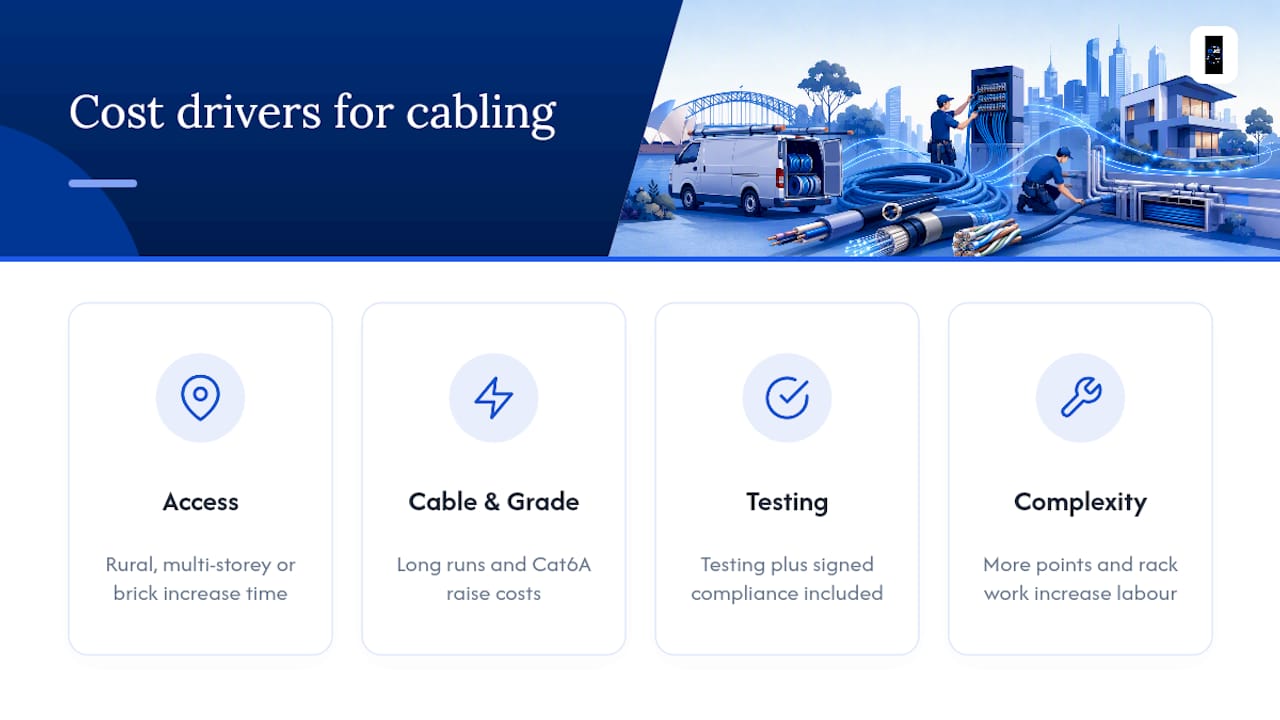
Several factors consistently drive the price up or down:
Access and building type. Rural properties, multi-story buildings, and older homes with plaster or brick walls take longer to cable than a modern build with accessible roof space.
Cable run length and category. Longer runs, and higher-grade cable like Cat6A for future-proofing, cost more in materials and labor than a short Cat6 run.
Testing and certification. A compliant job includes cable testing and the signed compliance statement as part of the price. That's not an optional extra, it's part of what you're paying a registered cabler for over an unregistered one.
Number of points and complexity. A single relocated NBN socket is a different job from wiring six data points across a home office and a rack-mounted comms cabinet.
Because these variables shift so much between properties, the only reliable way to get an accurate figure is a site-specific quote rather than a published price list. Ask for an itemized quote that separates labor, materials, and compliance documentation, so you can compare apples to apples between installers.
When Should You Call a Local Cabler Instead of a Big Firm?
Local specialists earn their keep on the jobs that don't fit a template: rural properties needing Starlink integration, concealed cabling runs through heritage walls, or a one-off NBN relocation where a national call center just adds friction. Once a project spans multiple sites or needs a large crew fast, scaling up to a bigger team starts to make more sense.
— Dylan
How Djcengineering Handles Compliant Cabling Installs
If you've made it this far, you already know what separates a compliant install from a corner-cut one: registration, testing, and paperwork you can actually hand to an insurer. Djcengineering runs every project that way as standard, not as an upsell, across South East Queensland homes, businesses, and rural properties.
Services cover structured data cabling and networking, site-surveyed mesh WiFi, Starlink and NBN connectivity, and CCTV, alarms, and access control. Before requesting a quote, have your property type, approximate number of data points or cameras, and any known access constraints (roof space, brick walls, rural distance) ready. That information lets the team scope the job accurately on the first visit instead of guessing over the phone.
To get started, visit Djcengineering and request a quote. A registered, local team will confirm scope, timeline, and compliance documentation before any work begins.