
Yes, you need a licensed security installer in Australia — and the rules are state-specific, so the first thing to do is check your state's public register before you sign anything. In Queensland, anyone who installs, repairs, services, or maintains CCTV, alarms, or access control must hold a security equipment installer licence issued by the Queensland Government. Other states and territories run their own schemes with their own registers, so the verification step is the same regardless of where you live.
Act on these three steps before you hire anyone:
- Check the public register for your state and confirm the licence number is current
- Ask the installer for their licence number, expiry date, and proof of public liability insurance
- Confirm that fingerprinting and criminal-history checks have been completed as required by your jurisdiction
Queensland licence processing takes 4–6 weeks when the application is complete and fees are correct. If you're hiring someone who claims to be in the process of applying, that is not the same as holding a licence — do not let work begin without a current, verified licence number.
Table of Contents
- Who needs a security installer licence in Australia?
- What does Queensland's security equipment installer licence require?
- How to verify a qualified security installer before you hire
- What does a professional installation actually involve?
- How security installation quotes are usually structured
- Why hiring a licensed local installer protects you legally and financially
- How Djcengineering delivers licensed security installation across SEQ
- Key Takeaways
- The standard most installers don't talk about
- Djcengineering: licensed site surveys and fixed-scope quotes for SEQ
- Useful sources for licence verification and further reading
Who needs a security installer licence in Australia?
The licensing obligation falls on anyone who physically installs, repairs, services, or maintains electronic security equipment as part of their work. That covers independent contractors, employees of security companies, and sole traders. The scope is broader than most people expect.
What the licence does NOT automatically guarantee is deep technical training. Queensland, for example, focuses its eligibility criteria on public-safety suitability rather than formal coursework. That is why licensing and qualification requirements vary significantly by jurisdiction — some states treat security installers similarly to electricians and require low-voltage or apprenticeship qualifications on top of the security licence. When you're hiring, ask about both.
What does Queensland's security equipment installer licence require?
Queensland is the clearest model to follow because its requirements are publicly documented and specific. The security equipment installer licence authorizes the holder to install, repair, service, and maintain CCTV systems, intruder alarms, access control devices, and related electronic security equipment.
Eligibility requires:
- Proof of identity meeting the 100-point identification standard
- Fingerprinting at an approved Queensland Police Service location
- A criminal-history check — recorded convictions for certain offences within the past 10 years are disqualifying; unrecorded findings of guilt within the past 5 years are assessed case-by-case
- Payment of the prescribed application fee
Processing time: 4–6 weeks when the application is complete. Incomplete documentation or outstanding criminal-history disclosures are the most common causes of delays.
Before you ask a candidate for proof, prepare your own checklist: the licence number, the expiry date, and the specific category of work it covers. A general electrical licence is not a substitute for a security technical licence in Queensland — a qualified electrician without the security-specific credential cannot legally perform this work.
How to verify a qualified security installer before you hire
Verification takes about ten minutes and protects you from voided insurance, noncompliant installations, and real legal exposure. Here is what to request and check:
| Verification item | What to ask for | Red flag |
|---|---|---|
| Licence status | Licence number and expiry date; check the state public register | Refuses to provide the number or number doesn't appear on register |
| Criminal-history compliance | Confirmation that fingerprinting was completed as part of the application | Vague answer or claims it "wasn't required" |
| Public liability insurance | Certificate of currency with policy number and insured amount | Expired certificate or no documentation |
| Professional indemnity | Separate indemnity certificate covering installation errors | Absent for commercial jobs |
| Experience and portfolio | Photos of comparable residential or commercial installs | Stock images or no local examples |
| Industry membership | ASIAL membership or equivalent; vendor-specific training certificates | No affiliations and no training records |
| Written quote | Itemized scope: hardware, cabling, rack work, labour, commissioning, warranty | Verbal quote only or lump-sum with no breakdown |
Industry benchmarks from CANASA suggest that competent security installation technicians typically bring one to two years of hands-on experience or a technical diploma, along with the ability to read wiring schematics and configure networked systems. Use that as a baseline when reviewing portfolios.
Credentials like the ESA Certified Alarm Technician (CAT) Level 1 — a widely recognized foundational qualification that requires renewal every two years with continuing education — are worth requesting as evidence of ongoing technical development, even when your state regulator doesn't mandate them.
What does a professional installation actually involve?
A proper security installation follows a defined sequence. Skipping any stage is usually where problems start.
Site survey and design come first. The installer maps cable routes, identifies camera coverage zones, locates the comms rack position, and runs a WiFi signal survey if IP cameras are part of the scope. Skipping this step is the single most common cause of dead spots and unreliable camera feeds — particularly in South East Queensland properties with brick construction or large open sites.
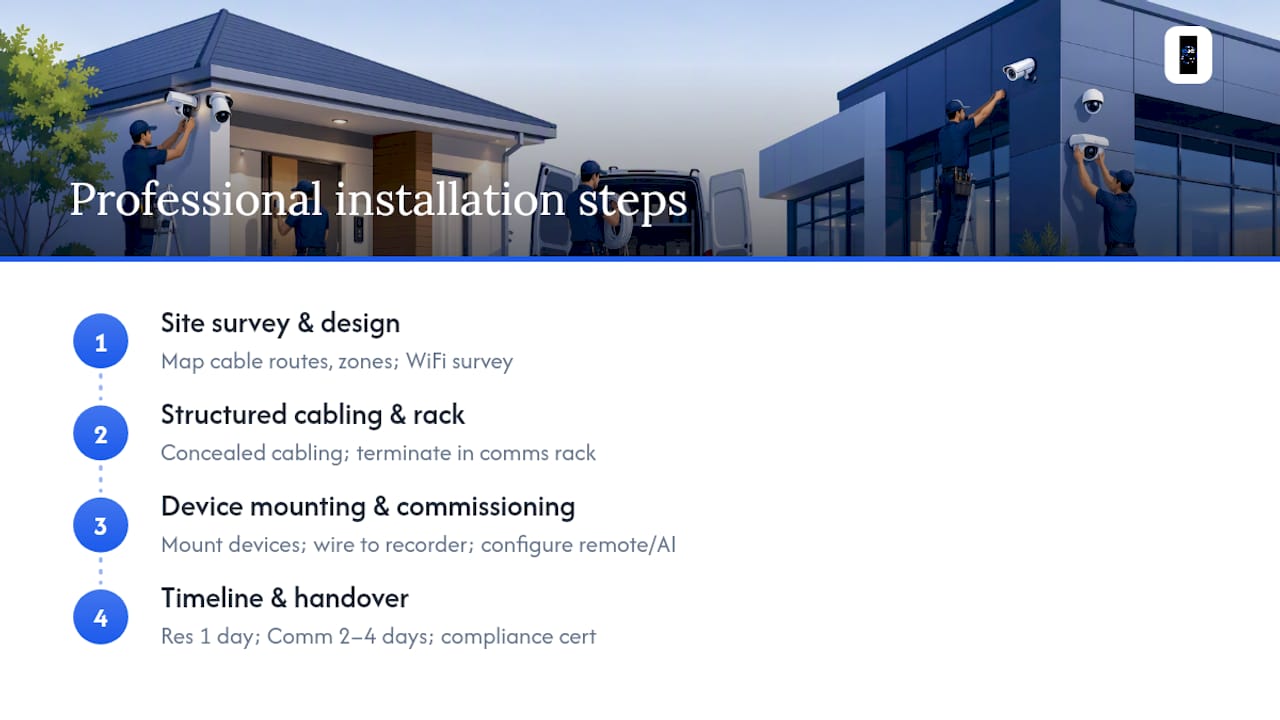
Structured cabling and rack setup follow. Pro-grade installations use concealed cabling routed through walls and ceiling cavities, terminated in a dedicated comms rack. This is what separates a professional job from a DIY clip-on-cable run. For a deeper look at what this involves for Brisbane properties, the CCTV installation guide for Brisbane covers the technical specifics.
Device mounting, wiring, and commissioning complete the physical work. The installer mounts cameras, sensors, and control panels; connects everything to the NVR or cloud recorder; configures remote access and AI analytics where applicable; and hands over with a written compliance certificate.
Realistic timelines: a straightforward residential job with four to eight cameras typically takes one full day. A commercial fit-out with access control, structured cabling, and network integration can run two to four days depending on site access and permitting.
Pro Tip: Ask your installer to include a site-surveyed WiFi and comms rack design in the scope before any hardware is ordered. Retrofitting network infrastructure after cameras are mounted costs significantly more than doing it right the first time.
How security installation quotes are usually structured
Quotes for home security installation and commercial security services should be itemized, not lump-sum. Expect to see separate line items for:
- Site survey fee (sometimes waived on confirmed jobs)
- Hardware: cameras, NVR/DVR or cloud recorder, sensors, control panels
- Structured cabling and comms rack materials and labour
- Device mounting and wiring labour
- System commissioning and client handover
- Ongoing monitoring or maintenance agreement (annual or monthly)
When comparing quotes, verify that each one covers the same scope. A quote that omits network integration or WiFi work looks cheaper but often isn't once those items are added later. For CCTV cost context from comparable markets, this Alberta installation cost guide provides useful budgeting benchmarks, though Australian pricing will differ.
Maintenance options to ask about: annual service visits, remote health monitoring, firmware and software updates, and warranty coverage duration. Clarify what the warranty excludes — storm damage, accidental damage, and consumables are commonly excluded.
Why hiring a licensed local installer protects you legally and financially
The benefits of using a licensed installer go beyond legal compliance. Public-register accountability means the licence holder's credentials are verifiable by anyone. Criminal-history checks provide a baseline of personal suitability that a handshake agreement cannot replicate. Local support means someone who knows your site can respond when something fails.
The risks of unlicensed work are concrete: noncompliant system configuration, no professional indemnity cover if the installation causes damage, unreliable remote access and AI analytics, and potential penalties under state security industry legislation. Other jurisdictions maintain public registers with two-year licence terms and renewal requirements — the principle of public accountability is consistent across licensing schemes worldwide.
Trust signals to look for: a current public register entry, ASIAL membership, vendor-specific training certificates, and certificates of currency for both public liability and professional indemnity insurance.
How Djcengineering delivers licensed security installation across SEQ
Djcengineering operates as a licensed security installer across South East Queensland, covering residential, commercial, and rural properties. Services include:
- Licensed CCTV installation (4K with AI analytics and remote monitoring)
- Intruder alarm systems and access control
- Structured cabling and professional comms rack setup
- Site-surveyed WiFi and mesh network design
- Starlink and NBN integration for remote and rural sites
Key proof points: 98% first-visit fix rate, no subcontractors, pro-grade cabling and comms racks on every job, and written compliance certification at handover. For a full overview of licensed security services in SEQ, the service page covers scope, capabilities, and how to request a fixed-scope quote.
Key Takeaways
Hiring a licensed security installer in Australia requires verifying the state public register, confirming insurance, and requesting a written scope — not just taking a contractor's word for it.
| Point | Details |
|---|---|
| Licensing is mandatory | Anyone installing, repairing, or maintaining security equipment in Australia must hold a state-issued licence. |
| Queensland processing time | Expect 4–6 weeks for a Queensland security equipment installer licence when the application is complete. |
| Criminal-history checks apply | Queensland disqualifies applicants with recorded convictions within 10 years; unrecorded findings within 5 years are assessed case-by-case. |
| Always verify the public register | Check the licence number on your state's public register before any work begins — a verbal claim is not enough. |
| Djcengineering is a licensed SEQ option | Djcengineering delivers licensed CCTV, alarms, and access control across South East Queensland with a 98% first-visit fix rate and no subcontractors. |
The standard most installers don't talk about
Most of the conversation around security licensing focuses on the licence itself — does the person have one, is it current. That matters, but it's the floor, not the ceiling.
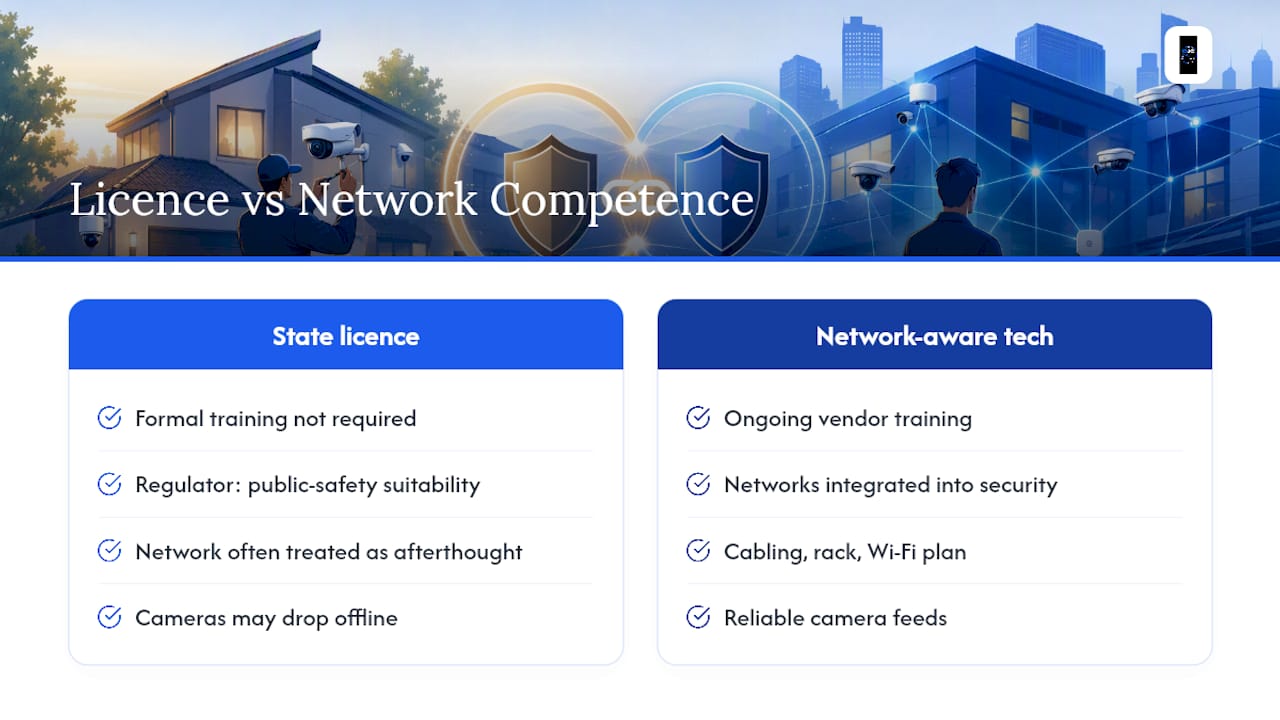
Queensland's licensing framework is explicit that formal training is not required to hold the licence. The regulator cares about public-safety suitability, not whether the technician has ever configured a managed switch or mapped a WiFi coverage zone. That gap is where most installation problems actually live. A licensed installer who has never done a proper site survey will pass every compliance check and still leave you with cameras that drop offline whenever someone runs the microwave.
What actually separates a reliable installation from a frustrating one is whether the installer treats the network as part of the security system — not an afterthought. IP cameras, AI analytics, and remote monitoring all depend on structured cabling, a properly configured comms rack, and a site-surveyed WiFi plan. When those elements are missing, the licence on the wall means nothing to the camera feed that freezes at 2 AM.
The credential worth asking about, beyond the state licence, is evidence of ongoing vendor training and industry engagement. ESA's CAT Level 1 requires renewal every two years with continuing education — that renewal cycle is a reasonable proxy for whether a technician keeps current with the systems they're installing.
Djcengineering: licensed site surveys and fixed-scope quotes for SEQ
Djcengineering offers licensed security installation across South East Queensland, with fixed-scope quoting so you know exactly what you're getting before work begins. No subcontractors, no surprise line items, and a written compliance certificate at handover.
For homeowners and business owners ready to move forward, the starting point is a site survey. Djcengineering's team assesses your property, maps cable routes and WiFi coverage, and returns a written quote with full scope detail. Contact Djcengineering through the main website or go directly to the security services page to request a survey or quote. Response times are typically within one business day for SEQ inquiries.
Useful sources for licence verification and further reading
| Resource | What it covers |
|---|---|
| Queensland Government — Apply for a security equipment installer licence | Official application process, eligibility, fees, and processing times for Queensland |
| Queensland Government — Disqualifying offences | Criminal-history check requirements and disqualifying offence categories for Queensland applicants |
| ASIAL — Australian Security Industry Association Limited | Industry body for the Australian security sector; membership directory and training resources |
| ESA — Certified Alarm Technician (CAT) Level 1 | Foundational technician credential; useful benchmark for ongoing technical competence |
| CANASA — Security Installation Technician | International industry benchmark for installer competencies and typical qualifications |
| New York State — Security or Fire Alarm Installer | Example of a public-register licensing model with two-year terms and licence search functionality |
This article provides general information about security installer licensing in Australia. Licensing rules, fees, and eligibility criteria change — confirm current requirements with your state or territory regulator or a qualified legal professional before making hiring decisions.