
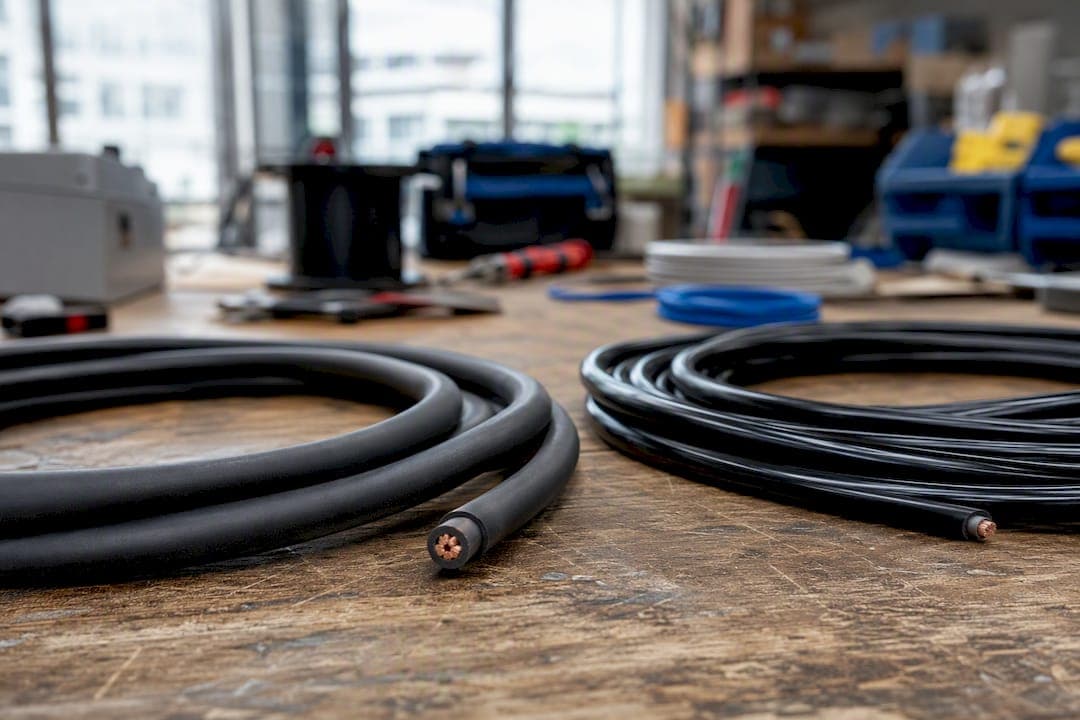
Choose LSZH for any enclosed, occupied, or equipment-dense space because it burns cleaner: far less smoke, no corrosive halogen acids. Keep PVC for outdoor, buried, or heavily mechanical runs where cost and toughness matter more than combustion behavior. That's the whole decision in one line, but the reasons behind it separate people who get it right the first time from people who get a callback.
Before you order a reel of either, weigh these factors:
- Smoke and toxicity: LSZH releases minimal smoke and no halogen acid gas; PVC releases hydrogen chloride and dense black smoke when it burns.
- Standards compliance: LSZH claims should be backed by IEC 60754, IEC 61034, and IEC 60332 test data, not just a marketing label.
- Handling and cost: PVC is cheaper, more flexible, and more abrasion-resistant; LSZH is stiffer, pricier, and less forgiving in cold weather.
Key Takeaways
The right cable choice comes down to where it lives: LSZH protects people and equipment in enclosed spaces, while PVC protects your budget and withstands rough outdoor conditions.
| Point | Details |
|---|---|
| LSZH for occupied spaces | Choose LSZH for data centers, server rooms, tunnels, and rail because it limits smoke and toxic gas. |
| PVC for exposed runs | Choose PVC for buried, outdoor, or high-abrasion runs where cost and mechanical toughness matter more. |
| Demand real test reports | Ask suppliers for IEC 60754, IEC 61034, and IEC 60332 reports before trusting an LSZH label. |
| Fire resistance is separate | An LSZH jacket doesn't guarantee circuit fire resistance; verify that rating independently if the job needs it. |
| Djcengineering verifies on site | Djcengineering's accredited installers cross-check material specs and test documentation before every termination. |
Standards and Reference Material
- IEC 60754 and IEC 61034 background for verifying halogen and smoke claims on LSZH cable.
- PVC combustion chemistry explaining why hydrogen chloride forms during a fire.
- Plasticizer migration guidance for avoiding jacket embrittlement near foam insulation.
- Djcengineering's commercial cabling design notes for business-critical installation planning.
Table of Contents
- LSZH vs PVC Cable: What the Materials Actually Are
- Fire Performance: The Standards Worth Demanding
- Installation Realities: Flexibility, Durability, and Moisture
- Cost, Lifespan, and Where Each Cable Actually Belongs
- How to Specify and Verify LSZH on a Job
- What Changes on Site: A Field Perspective
- Why the "Just Use LSZH Everywhere" Advice Falls Short
- Get Your Cabling Specified Right the First Time
- Frequently Asked Questions
- Sources
LSZH vs PVC Cable: What the Materials Actually Are
LSZH stands for low smoke zero halogen. PVC stands for polyvinyl chloride. The difference between LSZH and PVC cable comes down to one thing: chlorine.
PVC is a chlorinated plastic. Chlorine makes it cheap, flexible, and easy to extrude, but it's also the reason PVC produces hydrogen chloride gas when it burns. LSZH compounds swap that chlorine-based chemistry for polymers filled with minerals like aluminum trihydrate (ATH) or magnesium hydroxide. Those fillers absorb heat and release water vapor as they decompose, which suppresses smoke and starves the fire of the halogen compounds that make PVC combustion so hazardous.
That chemical swap has real consequences on both ends:
- PVC's chlorine content is exactly what creates hydrogen chloride and heavy black smoke when it burns, corroding equipment and irritating lungs.
- LSZH's mineral filler load and halogen-free base mean lower smoke output and no acid gas, but also a stiffer, heavier finished cable.
- Mechanical properties trace straight back to chemistry: chlorinated PVC stays pliable in a wider range of conditions, while heavily filled LSZH compounds lose flexibility as filler content rises.
Neither material is "better" in the abstract. They're built to solve different problems, and the problem you're solving determines which one wins.
Fire Performance: The Standards Worth Demanding
Anyone can print "low smoke" on a cable jacket. The tests that back it up are IEC 60754, IEC 61034, and IEC 60332, and specifiers should ask for all three before trusting a supplier's claim.
IEC 60754 (parts 1 and 2) measures halogen acid gas evolution and the pH/conductivity of combustion gases. IEC 61034 measures smoke density by testing how much light can pass through smoke generated in a controlled burn. IEC 60332 tests flame propagation, confirming a cable won't carry fire along its length once ignited. A cable that passes all three has a documented, testable basis for an LSZH claim, not just a color-coded jacket.
The practical stakes are significant. LSZH compounds are engineered to keep light transmittance above roughly 60% during combustion testing under IEC 61034, which is the margin that keeps exit signs and emergency lighting visible in a smoke-filled corridor. PVC offers no such guarantee. Its combustion produces dense black smoke and hydrogen chloride gas that corrodes copper contacts, damages sensitive electronics, and makes evacuation harder in the minutes that matter most.
When you're buying cable for a job that specifies LSZH, don't take the jacket print at face value:
- Request the manufacturer's IEC 60754/61034/60332 test reports, not just a datasheet summary.
- Match batch certificates to the delivered reel, since compound formulations can shift between production runs.
- Flag any supplier who can't produce third-party lab results on request.
Installation Realities: Flexibility, Durability, and Moisture
Fire performance is only half the specification. The other half is what happens on the day you're actually pulling cable through conduit or burying it in a trench.
LSZH's mineral filler load makes it stiffer than PVC, and that stiffness gets worse in cold weather. A coil left in an unheated van overnight can crack at the jacket if you force it around a tight bend the next morning. Long pulls through conduit with multiple bends are where LSZH shows its limits fastest, since the extra force needed to feed a stiffer cable increases jacket stress at every turn.
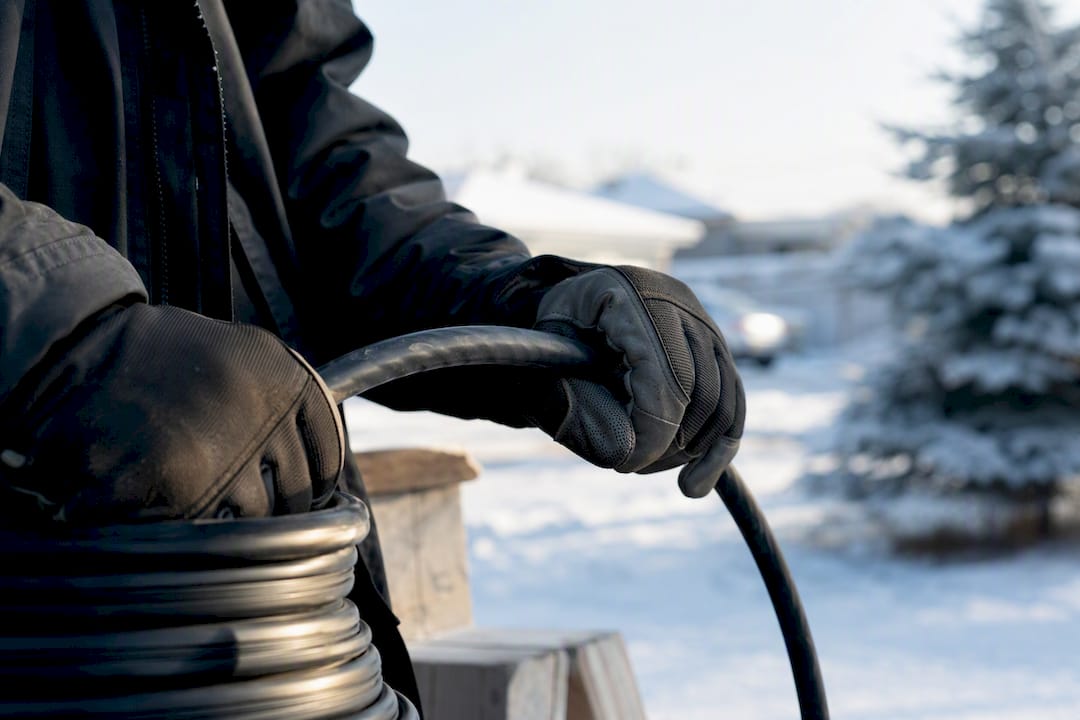
PVC doesn't have that problem. It stays flexible across a wider temperature range, resists abrasion well, and handles direct burial and outdoor exposure better than most LSZH formulations. That's why PVC remains the default for underground service runs and exterior conduit where mechanical toughness matters more than combustion behavior.
PVC does carry one hazard installers routinely miss: plasticizer migration. When PVC-sheathed cable sits in prolonged contact with expanded polystyrene insulation, the plasticizers that keep the jacket flexible can migrate into the foam, leaving the cable jacket brittle and prone to cracking years after installation.
Pro Tip: Never route PVC cable directly against polystyrene foam board or insulation batts. Use a physical separator, a conduit sleeve, or route the cable through timber blocking instead.
- Pre-warm LSZH coils before pulling in cold conditions and avoid sharp bends during installation.
- Keep PVC cable separated from polystyrene-based insulation with a physical barrier.
- Inspect jackets for handling damage before termination, especially on cold-weather jobs.
Cost, Lifespan, and Where Each Cable Actually Belongs
LSZH typically costs more than PVC, sometimes running 1.5 to 2 times higher for equivalent cable, and the reason is the compound itself and how it's processed. Halogen-free formulations need heavier mineral filler loads, and extruding them takes more energy and tighter process control than standard PVC.
That premium buys something specific: reduced smoke and corrosive gas in a fire event. It does not buy circuit fire resistance. A cable that keeps power or data flowing during an active fire is a completely separate construction, typically using mica tape or mineral insulation, and tested against a different standard entirely. Don't assume an LSZH jacket means the circuit survives a fire; check the actual fire-resistance rating if that's what the job needs.
Here's a simple way to sort applications:
- Specify LSZH for data centers, server rooms, cable shafts, plenum spaces, tunnels, and rail systems where people and expensive equipment share the space.
- Specify PVC for buried service runs, exterior conduit, agricultural buildings, and general residential wiring where mechanical durability and cost matter more than smoke output.
- Verify separately whether the job requires fire-resistant circuit integrity, and if so, spec that construction on top of your smoke/halogen decision.
How to Specify and Verify LSZH on a Job
Getting LSZH right on paper is easy. Getting it right on the delivered reel takes a short verification routine.
- Request documentation before ordering: ask suppliers for IEC 60754, IEC 61034, and IEC 60332 test reports, current material safety data sheets, and batch-specific compliance certificates.
- Check labeling on delivery: confirm the jacket print matches the ordered specification and cross-reference it against the datasheet, not just the packing slip.
- Inspect before termination: look for handling damage, cracking, or discoloration that could indicate cold-weather stress or a bad batch.
- Document the decision: record why LSZH or PVC was chosen for each run in the handover pack, especially on mixed-material jobs.
A few judgment calls matter more than the paperwork:
- Insist on LSZH wherever the space is enclosed, occupied, or houses critical equipment, even if the base spec doesn't explicitly demand it.
- Accept PVC for exterior, buried, or high-abrasion runs where its cost and flexibility genuinely outperform LSZH.
- When a client's spec is silent on cable type, default to the higher standard for anything indoors and note the reasoning in your file.
What Changes on Site: A Field Perspective
Standards are one thing. Deciding what a specific ceiling void, riser, or duct actually needs is another, and that's where field experience does the real work.
A short excerpt from Djcengineering's installation checklist covers routing away from heat sources, physical protection at penetrations, clear labeling at both ends, and material verification against the job spec before termination.
A server room and an external duct twenty meters apart can call for two completely different cables. One is occupied, equipment-dense, and needs LSZH. The other is exposed, buried, and needs PVC's toughness. Treating them the same is how good specs turn into bad installations.
- Server rooms and comms cabinets: LSZH, verified against IEC 60754/61034 reports, with appropriate network cabinets & comms infrastructure stocked in Dublin.
- External duct runs and buried feeds: PVC, rated for outdoor and direct-burial conditions.
Why the "Just Use LSZH Everywhere" Advice Falls Short
The safest-sounding advice on this topic is also the laziest: specify LSZH for everything and skip the analysis. It's wrong often enough to matter. Burying LSZH cable outdoors wastes money on smoke and toxicity performance nobody will ever test in that location, while sacrificing the abrasion resistance and moisture tolerance PVC actually offers underground.
What gets underestimated is how often the fire-resistance question gets conflated with the smoke question. Contractors see "LSZH" on a spec sheet and assume the circuit survives a fire. It doesn't, not without a separate fire-resistant construction. That gap between what a label implies and what it actually certifies causes more disputes after the fact than any pricing disagreement.
Prioritize the occupancy and equipment density of the space first, cost second, and treat fire-resistance rating as its own line item every single time. Read the actual IEC test reports before you trust a jacket print. That habit alone will save you more callbacks than any blanket rule ever could.
Get Your Cabling Specified Right the First Time
Reading about IEC test standards is one thing. Having someone verify batch certificates, check jacket integrity, and match the right material to your specific space is another.

Whether you're fitting out a server room that demands LSZH or running structured cabling through a mixed indoor/outdoor property, Djcengineering's data cabling and network installation service handles the material decision as part of the scoped job, not as an afterthought. No subcontractors, no guessing on spec, and documentation you can hand straight to a client or a compliance file. If you have a project that needs a defensible cable choice and a clean install, get in touch with Djcengineering to scope the job.
Frequently Asked Questions
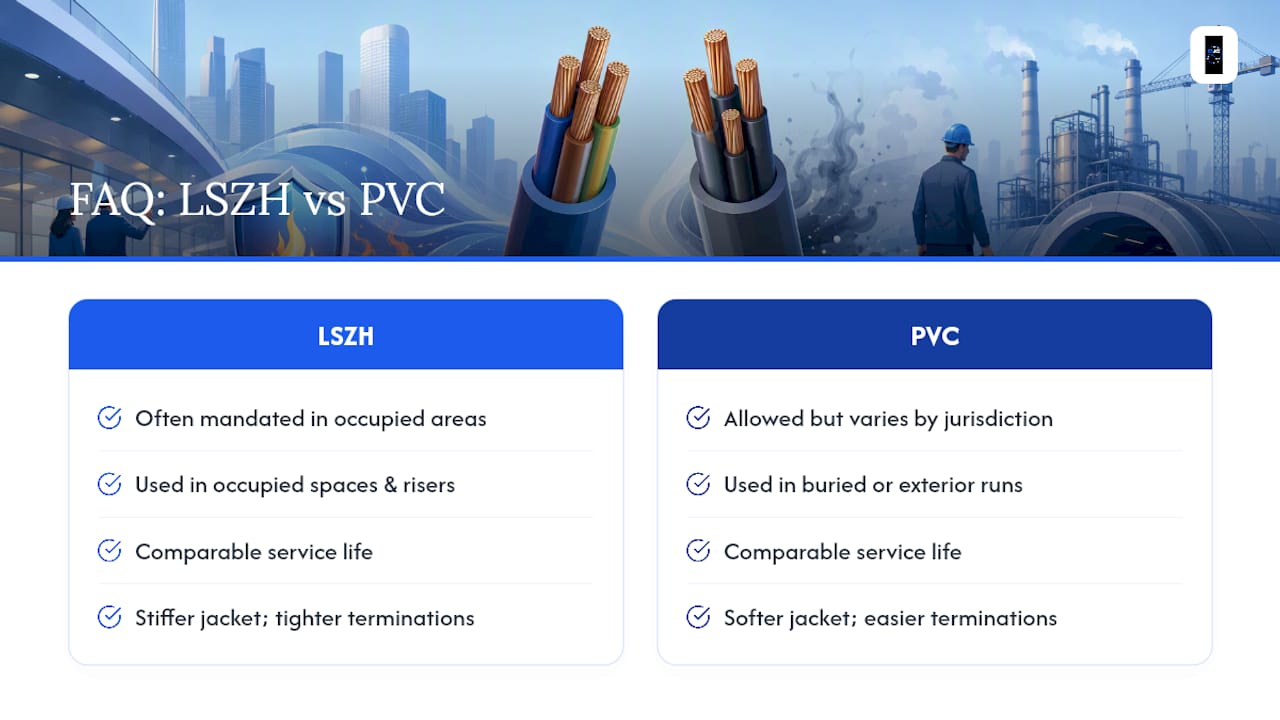
Is LSZH cable required by law for commercial buildings? Requirements vary by jurisdiction and building type. Many commercial and public-occupancy buildings mandate low-smoke, halogen-free cable in enclosed or high-occupancy areas, but you should confirm the exact requirement with local building codes or an electrical compliance professional rather than assuming.
Can PVC and LSZH cable be run in the same building? Yes. Many buildings mix both, using LSZH in occupied spaces, plant rooms, and cable risers while running PVC through buried or exterior sections. The key is documenting which material goes where and why.
Does LSZH cable last as long as PVC? Both can offer long service life when installed correctly. LSZH's main vulnerability is cold-weather cracking during installation rather than long-term degradation, while PVC's main risk is plasticizer migration near incompatible foam insulation.
Is LSZH cable harder to terminate than PVC? LSZH's stiffer jacket can make tight termination work slightly more demanding, but it doesn't require different tools or techniques, just more careful handling on tight bends and cold days.
What does "zero halogen" actually mean? It means the cable compound contains no halogen elements, such as chlorine, bromine, or fluorine, which are the chemicals responsible for producing corrosive acid gases when a cable burns.
Sources
- Polyvinyl chloride — Wikipedia
- PVC insulated and sheathed cables in a domestic installation — IET Wiring Matters (Nov 2019)
Recommended
- Data Cabling & Networks Brisbane SEQ | DJC
- Data Cabling Gold Coast: The 2026 High-Performance Installation Checklist | DJC Engineering
- Commercial Network Cabling Brisbane: The Engineered Backbone of Modern Business in 2026 | DJC Engineering
- Commercial CCTV Security: A Professional Guide to High-Performance Surveillance | DJC Engineering