
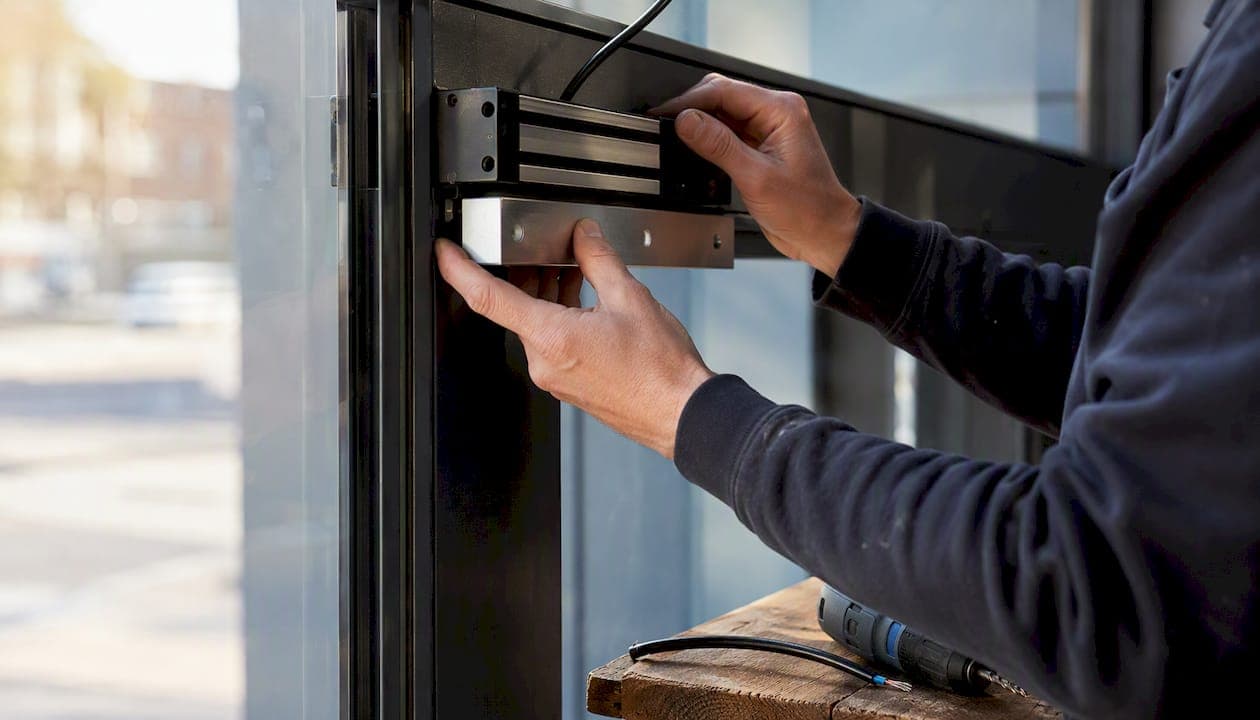
Use an electric strike for perimeter, fire-rated, and stairwell doors. Use a maglock for glass, frameless, or aluminum doors where a mechanical strike pocket isn't practical. That's the short answer. The longer one depends on fail-safe vs fail-secure behavior, NFPA and IBC egress requirements, and what your door frame can actually accept. Electric strikes are generally the safer default for code-regulated doors, as they preserve mechanical latching. Maglocks earn their place on specialty door types where strikes simply won't fit.
- Best for maglocks: Glass, frameless, or aluminum doors; dedicated fail-safe egress routes
- Best for electric strikes: Perimeter doors, fire-rated assemblies, stairwell re-entry, retrofit into existing metal or wood frames
- Default fail mode: Maglocks fail open (power cut = door unlocks); electric strikes can be configured fail-safe or fail-secure
- Retrofit complexity: Strikes are usually easier in prepared frames; maglocks require surface mounting and fire alarm tie-in
Key Takeaways
Electric strikes suit most code-regulated and fire-rated doors; maglocks are the right call for glass, frameless, or aluminum doors where mechanical latching isn't practical, but both require proper fire alarm integration and licensed installation to meet NFPA and IBC requirements.
| Point | Details |
|---|---|
| Fail mode drives the decision | Maglocks fail open; electric strikes can fail secure or open — match the fail mode to the door's security and egress role. |
| Fire-rated doors need listed strikes | A maglock cannot provide the positive latching NFPA 80 requires for fire door assemblies; use a listed electric strike. |
| Maglocks require fire panel tie-in | Every maglock on an egress path must release on fire alarm activation — budget for supervised power and integration wiring. |
| Use the checklist before accepting a quote | Confirm door type, fail mode, fire rating, power backup, and commissioning deliverables before signing off on any proposal. |
| Djcengineering provides full-scope installation | Site survey, hardware specification, installation, fire panel integration, and commissioning reports for maglocks and electric strikes. |
Table of Contents
- How do maglocks actually work?
- How do electric strikes work?
- How do maglocks and electric strikes compare across key dimensions?
- Why you'd choose a maglock
- Why you'd choose an electric strike
- What do US codes actually require for maglocks and electric strikes?
- Installation and retrofit realities: frames, fire ratings, and paired doors
- How to choose the right device: a checklist for building managers
- What experienced installers know that spec sheets don't tell you
- Djcengineering handles the specification, installation, and compliance paperwork
- Sources
How do maglocks actually work?
A maglock, or electromagnetic lock, holds a door shut by maintaining a magnetic bond between a wall-mounted electromagnet and a steel armature plate attached to the door. No moving parts. No latch. Just continuous magnetic force as long as power flows.
Holding force is rated in pounds of continuous holding force. Commercial-grade maglocks typically hold between 600 and 1,200 lbs, with heavy-duty models reaching higher. That number reflects the force required to pull the armature plate away from the electromagnet face-to-face. In practice, a 600 lb maglock is more than adequate for most interior access points; perimeter doors in high-security environments often spec 1,200 lb units.
The electrical behavior is straightforward: power on, door locked. Power off, door opens. Electromagnetic locks are almost always fail-safe because the design requires continuous current to maintain the hold. This makes them a natural fit for emergency egress routes where you want the door to open automatically during a fire alarm or power failure.
Core components:
- Electromagnet body (surface-mounted to frame or header)
- Armature plate (mounted to door face)
- Power supply with battery backup capability
- Request-to-exit (REX) sensor for free egress
- Door position sensor (recommended for monitoring)
Mounting variants include single-door surface mounts, double-door configurations with a center-mounted magnet, shear locks (where the force is applied laterally rather than face-to-face, useful for sliding doors), and low-profile units designed for narrow aluminum frames on glass doors.
Key installer note: A maglock with no fire alarm tie-in is a code violation waiting to happen. The electromagnet must release automatically when the fire panel activates. This isn't optional in any jurisdiction following NFPA 101 or IBC — it's a wiring requirement that affects your power supply spec, your conduit run, and your commissioning checklist.
How do electric strikes work?
An electric strike replaces the fixed mechanical strike plate in a door frame. Instead of a solid keeper, it uses a spring-loaded pivoting keeper that can be electrically released to allow the latch bolt to pass through, letting the door open without turning the handle from the outside.
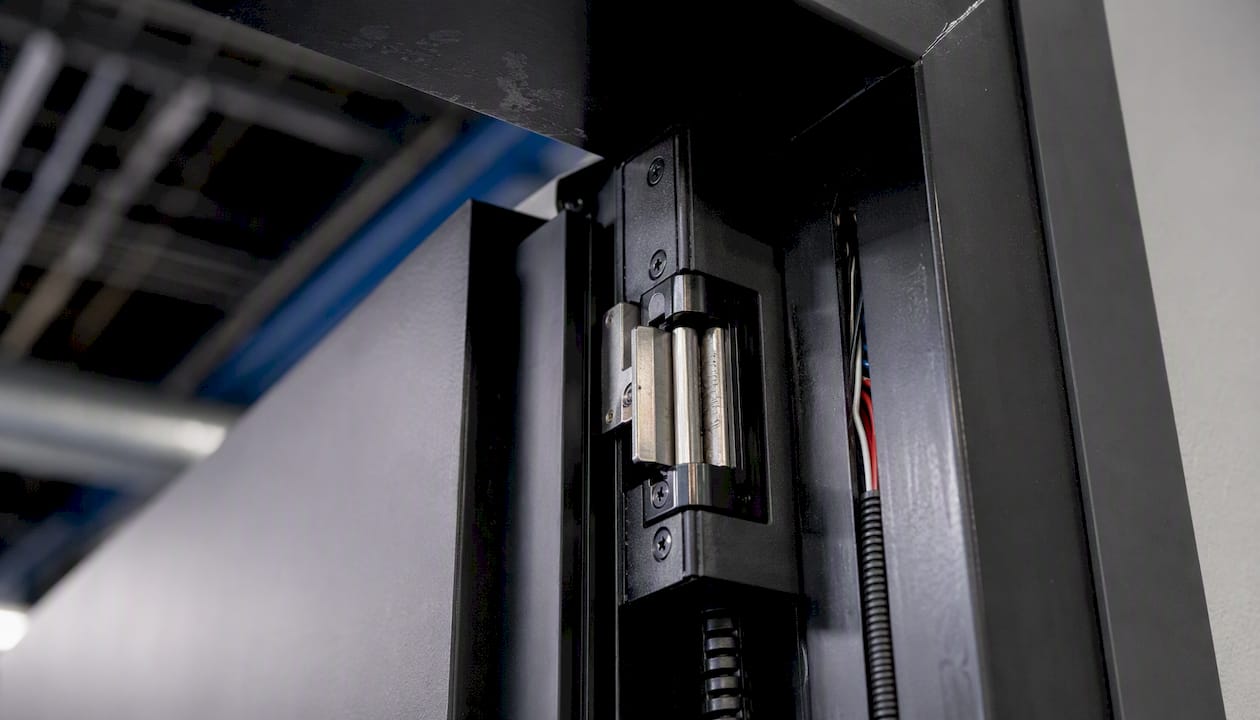
The door's mechanical lockset stays in place. The latch still engages the keeper when the door closes. That's the critical difference from a maglock: the door remains positively latched whether power is on or off (in fail-secure mode), and free egress from the inside is always available through the lever or panic hardware.
Keeper types and latch compatibility
Matching the strike to the lockset is where most specification errors happen.
- Full-lip strikes: Work with cylindrical (bored) locksets; the lip covers the latch bolt gap and is the most common type in commercial applications
- Lipless (deadlatch) strikes: Used where the door stop covers the gap; common with mortise locksets
- Wrap-around strikes: Designed for narrow stile aluminum doors and some hollow metal frames
- Deadbolt-compatible strikes: Accommodate both latch bolt and deadbolt in a single unit
Fail-safe vs fail-secure electric strikes
This is where the maglock vs electric strike decision gets real. Fail-secure devices are more common for security applications because they keep the door latched when power is removed. A fail-secure strike holds the keeper locked until it receives power to release. A fail-safe strike does the opposite: it holds the keeper open (door can be pushed open) until power is applied to lock it.
Most perimeter door installations use fail-secure strikes. Stairwell re-entry doors and some egress paths require fail-safe behavior, which is where the code gets specific.
Common electric strike applications by door type:
- Cylindrical lockset on hollow metal frame (office, retail) — full-lip strike, fail-secure
- Mortise lockset on wood or metal door (commercial entry) — lipless or mortise-compatible strike
- Narrow stile aluminum storefront door — wrap-around or surface-mounted strike
- Panic hardware interface — electrified trim or strike rated for panic devices
How do maglocks and electric strikes compare across key dimensions?
| Dimension | Maglock | Electric Strike |
|---|---|---|
| Default fail mode | Fail-safe (unlocks on power loss) | Fail-secure most common; fail-safe available |
| Best door types | Glass, frameless, aluminum, no-latch doors | Hollow metal, wood, fire-rated, standard latch doors |
| Holding force | 600–1,200 lbs (continuous magnetic force) | Dependent on mechanical lockset; strike itself doesn't hold |
| Egress behavior | Requires REX sensor; releases on power cut | Mechanical lever/panic hardware always allows exit |
| Code compatibility | Requires fire alarm tie-in; AHJ scrutiny varies | Generally simpler compliance for fire-rated doors |
| Retrofit friendliness | Easier on unprepared frames; surface mount | Requires strike pocket; easier in prepared frames |
| Power requirement | Continuous draw; battery backup strongly advised | Momentary or continuous depending on config |
| Maintenance | Clean magnet face; check armature alignment | Inspect keeper spring; lubricate per manufacturer |
| Typical cost drivers | Hardware + supervised power supply + fire panel wiring | Hardware + frame prep; lower engineering overhead |
Three things a building manager should take from this:
- Fail mode drives the decision more than price. A maglock that fails open on a perimeter door is a security gap. A fail-secure strike on a required egress path may be a code violation.
- Fire-rated doors almost always require a listed electric strike, not a maglock, because the door assembly listing depends on maintaining positive latching.
- Maglocks carry higher engineering overhead in jurisdictions with strict AHJ review. Budget for fire panel integration and supervised power circuits before assuming a maglock is the cheaper option.
Why you'd choose a maglock
The strongest argument for a maglock is simplicity on the right door type. Glass doors, frameless aluminum systems, and doors without a traditional latch have no practical place to mount a strike. A surface-mounted maglock solves that problem cleanly, with no frame modification and no latch compatibility puzzle to solve.
Practical advantages:
- No moving mechanical parts means no keeper spring to wear out, no latch bolt to misalign, and no strike pocket to crack or deform over time
- Aesthetically clean on glass and frameless doors where exposed hardware would look out of place
- Instant release on power cut integrates naturally with fire alarm systems — the door opens the moment the panel activates, with no additional relay logic required
- High holding force (600–1,200 lbs) provides strong resistance to forced entry on interior access points
The low mechanical wear argument is real for high-traffic interior doors. A maglock on a door that cycles hundreds of times a day has no latch mechanism to fatigue. That said, the electromagnet face and armature plate need to stay clean and properly aligned. Dirt, paint overspray, or a warped door can reduce holding force significantly, sometimes to the point of failure.
Pro Tip: A maglock looks cheaper on the hardware quote until you add the supervised power supply, battery backup, fire alarm relay, REX sensor, door position switch, and any required signage. Get a fully scoped quote before comparing maglock and strike costs line by line.
Why you'd choose an electric strike
Electric strikes are the workhorse of commercial access control for a reason: they work with the door hardware that's already there. The mechanical lockset stays, the latch stays, and the frame modification is limited to the strike pocket. For a building manager retrofitting access control into an existing facility, that's a significant advantage.
Key strengths:
- Door remains mechanically latched during power loss in fail-secure mode, which is the right behavior for most perimeter and exterior doors
- Free egress from the inside is always available through the lever or panic hardware, with no REX sensor required
- Compatible with fire-rated door assemblies when the strike itself carries the appropriate listing for that assembly
- Lower engineering overhead in most jurisdictions: no mandatory fire panel tie-in for the strike itself (though the access control system may still require it)
- Easier to retrofit in hollow metal and wood frames where the strike pocket can be cut or the frame is already prepared
The fail-secure vs fail-safe choice on a strike gives you flexibility a maglock can't match. A single product line often covers both configurations, sometimes switchable in the field. That means you can specify the same strike family across a building and configure each unit by door function.
Pro Tip: Always verify that the strike keeper is compatible with the latch bolt geometry before ordering. A full-lip strike on a mortise lockset, or a lipless strike on a cylindrical lockset, will either not latch properly or damage the latch bolt over time. Get the lockset spec sheet before selecting the strike.
What do US codes actually require for maglocks and electric strikes?
The short answer: NFPA 101 and IBC govern permissible locking arrangements for swinging egress doors, and those requirements directly determine which hardware is allowed where. Getting this wrong isn't a paperwork problem — it's a life-safety issue.
Where fail-safe maglocks are typically required or appropriate:
- Dedicated egress doors on required exit paths where the door must open on fire alarm activation
- Stairwell re-entry doors in some configurations (though stairwell doors often require positive latching, which a maglock cannot provide).
- Interior access control points where power loss should default to open
Where fail-secure electric strikes are typically required:
- Perimeter and exterior doors where security must be maintained during power loss
- Fire-rated stairwell doors that require positive latching per NFPA 80
- Doors with panic hardware where the strike must hold until the panic device is actuated
Technical bulletins from institutional sources confirm that electromagnetic locks and electric strikes differ not just in fail mode but in code applicability. A maglock cannot provide the positive latching that NFPA 80 requires for fire door assemblies. An electric strike listed for a specific fire door assembly can.
Wiring and supervision requirements for maglocks:
- Fire alarm tie-in is mandatory in most jurisdictions: the maglock must release when the fire panel activates
- Power supplies must be supervised (monitored for failure) in many AHJ interpretations
- Signage ("Door alarmed — do not prop") and local alarms are sometimes required when a maglock is on a required egress door
- ADA compliance requires that any door on an accessible route open with no more than 5 lbs of force — a maglock that doesn't release fully is a compliance failure
Statistic callout: Improperly installed maglocks have been flagged as life-safety hazards requiring immediate remediation in some jurisdictions. The engineering and permitting costs of correcting a non-compliant maglock installation routinely exceed the cost of specifying the right hardware from the start.
Code red flags that require AHJ or engineer consultation:
- Any maglock on a fire-rated door assembly
- A maglock on a required egress path with no documented fire alarm tie-in
- A fail-secure strike on a stairwell re-entry door where re-entry is required by code
- Any locking arrangement on a door serving an occupant load above the threshold that triggers special egress rules under IBC
Installation and retrofit realities: frames, fire ratings, and paired doors
The hardware decision and the installation decision are not the same thing. A maglock might be the right device for a door type but the wrong choice for a specific frame condition or building permit situation.
Door and frame compatibility:
- Glass and frameless aluminum doors: maglocks are often the only practical option; surface mounting avoids frame modification
- Hollow metal frames with existing strike pockets: electric strikes drop in with minimal modification
- Wood frames without a prepared pocket: strike installation requires routing or cutting, which adds labor and can affect fire ratings if done incorrectly
- Narrow stile aluminum storefront doors: wrap-around strikes or surface-mounted maglocks, depending on latch configuration
Fire-rated door constraints are non-negotiable. A fire door assembly carries a listing that covers the door, frame, hardware, and installation method as a system. Modifying the frame for a strike pocket, or adding a surface-mounted maglock, can void that listing if the modification isn't covered by the assembly's certification. Any hardware added to a fire-rated assembly must itself be listed for that assembly.
Structural and access considerations:
- Double doors with active and inactive leaves require separate hardware on each leaf, plus coordination between the two locking devices
- Mullion-mounted maglocks on double doors need a center mullion that can accept the magnet body and carry the wiring
- Paired doors without a mullion (often glass) may require a floor-mounted maglock or a specialized frameless glass door strike
- Access control readers, REX sensors, and door position switches all need conduit runs that must be planned before walls are closed
Maintenance differences that affect lifecycle cost:
- Maglocks: clean the magnet face and armature plate quarterly; check alignment after any door adjustment; test holding force annually
- Electric strikes: inspect and lubricate the keeper spring per manufacturer schedule; check latch bolt engagement; replace keeper if worn
- Both: test the fail mode behavior (power cut test) at commissioning and annually thereafter
Retrofit decisions often come down to frame condition and latch compatibility. If the frame isn't prepared for a strike pocket, a maglock may appear cheaper up front but can create permitting and safety costs downstream.
How to choose the right device: a checklist for building managers
Work through these questions in order. The first one eliminates more wrong choices than any other.
- Is this door on a required egress path or fire-rated assembly? If yes, consult your AHJ and a licensed installer before specifying any locking device. Fire-rated assemblies require listed hardware. Egress paths require fail-safe behavior or specific egress hardware.
- What type of door and frame does this opening have? Glass or frameless = maglock likely. Hollow metal with latch = electric strike likely.
- What fail mode does this door need? Perimeter security = fail-secure. Egress route = fail-safe. Stairwell re-entry = confirm with AHJ.
- Is reliable power available, and is battery backup planned? Maglocks draw continuous power and need backup. Strikes draw momentary power but still need a reliable supply.
- What is the retrofit scope? Existing strike pocket = strike is faster. No pocket, no latch = maglock is faster.
- What is the access control system integration? Both devices need reader, REX, and door position sensor wiring. Maglocks additionally need fire panel integration.
Questions to ask your installer before accepting a quote:
- Is this door fire-rated, and is the proposed hardware listed for this assembly?
- How is the maglock tied to the fire alarm panel, and who is responsible for that integration?
- Can this electric strike be listed for this specific frame and lockset combination?
- What supervised power supply is specified, and does it include battery backup?
- Will you provide a commissioning report and wiring diagram?
Red flags that should stop a maglock proposal:
- No fire alarm tie-in specified or budgeted
- No REX sensor included
- No door position switch
- No supervised power supply
- Installer cannot name the AHJ or confirm permit requirements
Budget and lifecycle notes: Electric strikes generally cost less to install in prepared frames and carry lower engineering overhead. Maglocks on specialty doors can be cost-competitive when the alternative is significant frame modification. The expensive scenario is a maglock installed without proper permitting that requires remediation — improperly installed maglocks have been flagged as life-safety hazards in multiple jurisdictions, and remediation costs can dwarf the original installation.
What experienced installers know that spec sheets don't tell you
Hire a licensed installer for any maglock project. For electric strikes on fire-rated or complex doors, the same rule applies. The hardware is straightforward; the code compliance, fire panel integration, and commissioning documentation are not.
Installer qualifications to require:
- Licensed electrician or low-voltage certification valid in your state
- Documented experience with AHJ submissions for access control projects
- Knowledge of NFPA 80 and NFPA 101 as they apply to door hardware
- Familiarity with fire door listing requirements and what modifications void them
- Ability to provide a written commissioning report and as-built wiring diagram
A professional scope for a maglock installation should include an on-site survey, a power backup plan with load calculations, a wiring diagram showing fire panel integration, and documentation of the REX sensor placement and door position switch. If a quote doesn't include those deliverables, it's not a complete scope.
Common installation errors that professional commissioning prevents:
- Maglock installed on a fire-rated door without a listed assembly modification
- Fire alarm tie-in wired incorrectly so the maglock doesn't release on panel activation
- REX sensor positioned where body heat or HVAC airflow triggers false releases
- Power supply undersized for the number of locks on the circuit
- No annual test procedure documented, leaving the building manager unaware of a degraded holding force
Djcengineering's approach to access control installation starts with an on-site survey that covers door type, frame condition, fire rating status, and power infrastructure before any hardware is specified. That sequence matters. Specifying hardware before surveying the site is how remediation costs happen.
Djcengineering handles the specification, installation, and compliance paperwork
Skip the guesswork on hardware selection and code compliance. Djcengineering's security installation services cover the full scope: on-site survey, hardware specification for maglocks and electric strikes, installation, fire alarm integration, and commissioning documentation. Every project includes a written commissioning report and as-built wiring diagram so your facility records are complete.

Contact Djcengineering for a site survey and quote.
Sources
Confirm requirements with your local Authority Having Jurisdiction (AHJ) — codes are adopted and interpreted locally, and what applies in one city may differ in another.
- Fail Safe vs Fail Secure — Allegion / Schlage (technical bulletin)
- Swinging egress door operation — NFPA
- Fail‑safe vs fail‑secure: What's the difference & how to choose — Axis newsroom
- Electric strike vs maglock detailed comparison — National Lock Supply
- Fail Safe vs Fail Secure Electronic Locksets — ORF (NIH technical bulletin)
Recommended
- Commercial Alarm Systems: A Technical Guide for Gold Coast Businesses in 2026 | DJC Engineering
- Access Control System Installation Brisbane: Engineering Secure Entry Points for 2026 | DJC Engineering
- Security Systems Gold Coast: The 2026 Buyer’s Guide to Integrated Protection | DJC Engineering
- Commercial Access Control Systems Gold Coast: A Technical Guide to Industrial Security | DJC Engineering