
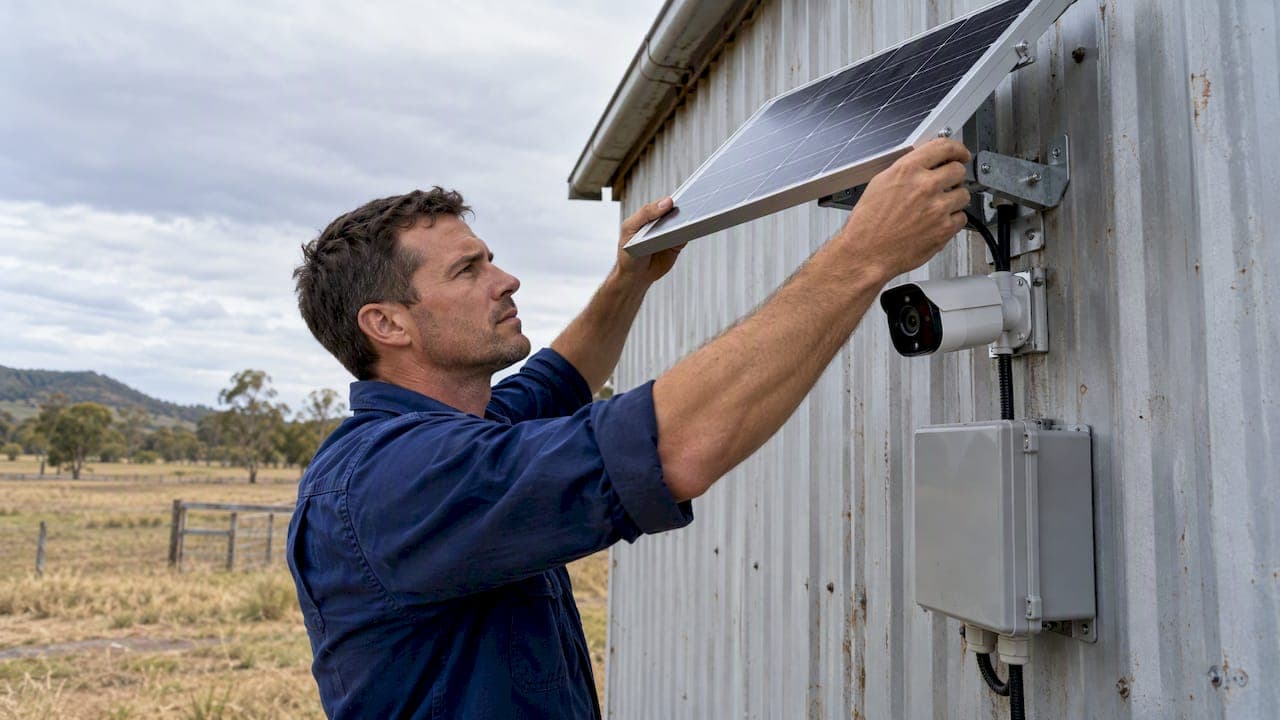
Yes, solar can reliably power CCTV when you size the panels and batteries to match the camera's actual power draw and your local sunlight. The qualifier matters: connectivity (Wi-Fi, cellular or satellite) and battery autonomy during cloudy stretches are what separate a system that works year-round from one that drops out when you need it most. Get the sizing right first, then worry about the kit.
TL;DR:
- A 10W camera and modem use 240Wh daily; two cloudy days and an 80% lithium depth of discharge require 600Wh of battery capacity.
- Panel capacity must account for local peak sun hours and include 20% to 30% for losses; MPPT improves charging in weak sunlight.
- Test cellular reception at the exact camera location and include modem or router power in the daily load, because coverage maps may miss local gaps.
- Have a licensed electrician verify earthing, fuses, surge protection, and DC isolation under AS/NZS 5033 and AS/NZS 5139; missing safeguards can raise fire risk.
Table of Contents
- What makes up a solar CCTV system: panels, controller, battery, power interface
- Sizing your system: step-by-step power calculations with a worked example
- Connectivity options for remote CCTV: Wi-Fi, cellular and satellite trade-offs
- How to choose a kit or build-by-component: buyer checklist
- Installation and compliance: standards and commissioning checklist
- Battery runtime, degradation and replacement planning
- Mounting and siting: maximize solar harvest and protect equipment
- Maintenance and troubleshooting: quick diagnostics before you call support
- DJC Engineering's approach and proof points
- Getting started with a professional installation
- FAQ
- Sources
What makes up a solar CCTV system: panels, controller, battery, power interface
A working solar CCTV setup is four components working together, and each one has a spec that actually matters more than the number printed on the box.
The solar panel's wattage rating is measured under lab conditions, so real-world output in overcast weather or with partial shading runs lower. Panel choice also affects mounting: rigid panels need a secure frame, while semi-flexible panels suit uneven rural rooftops but degrade faster in heat.
The charge controller sits between the panel and battery, and this is where an MPPT (maximum power point tracking) controller earns its keep. MPPT controllers continuously adjust voltage and current to pull more usable energy from the panel than a basic PWM controller, particularly in low light or cold mornings when solar output is weakest.

Battery chemistry decides lifespan and usable capacity. Lead-acid batteries are cheaper upfront but only tolerate a shallow depth of discharge (DoD) before damage sets in, while lithium batteries (typically LiFePO4) allow a deeper DoD and far more charge cycles, which matters when you're relying on stored power through several overcast days.
Cameras connect in one of two ways: direct 12V or 24V DC wiring, or Power over Ethernet (PoE), which carries both power and data over a single cable. PoE simplifies cabling for multi-camera sites, while DC wiring is common for single remote cameras paired directly to a small battery bank.
- Panel wattage should be checked against real output data, not just the rated label.
- MPPT controllers outperform PWM controllers in marginal or cold-weather sun.
- Battery chemistry determines usable Wh after accounting for safe DoD.
- PoE vs DC wiring choice depends on camera count and cable run length.
- DC isolators and surge protection are not optional extras, they're safety essentials.
Sizing your system: step-by-step power calculations with a worked example
Sizing a solar CCTV system is arithmetic, not guesswork, and skipping this step is the single biggest reason off-grid cameras fail within their first winter.
- Measure total daily load. Add up the wattage of the camera and any modem or router, then multiply by 24 hours to get watt-hours per day (Wh/day). A camera drawing 6W plus a 4G modem drawing 4W equals 10W, or 240Wh/day.
- Choose days of autonomy. Two to three days of autonomy is a sensible range for most sites, covering a stretch of heavy cloud without forcing an oversized, expensive battery bank.
- Calculate battery capacity. Multiply daily Wh by days of autonomy, then divide by the usable DoD. For 240Wh/day over 2 days with a lithium battery rated for 80% DoD, you need (240 x 2) / 0.8 = 600Wh of battery capacity. At 12V, that's roughly 50Ah.
- Size the solar panel. Divide daily Wh by your region's average peak sun hours, then add 20 to 30% for system losses. At 4 peak sun hours, 240Wh/day needs a panel rated around 75 to 90W after losses.
MPPT controllers can meaningfully narrow the gap between rated panel output and real-world charging in low sun, which AS/NZS 5033 guidance and industry practice both point to as a reason to prioritize MPPT over cheaper PWM controllers.
The worked example above illustrates a panel and battery combination as a comfortable, slightly oversized baseline for a single 4G-connected camera without specific wattage or amp-hour figures. Scaling up for multiple cameras simply means repeating the same four steps with the combined load.
Connectivity options for remote CCTV: Wi-Fi, cellular and satellite trade-offs
The camera is only half the system. Without a dependable data link, solar power keeps the unit running but doesn't get footage anywhere useful.
- Wi-Fi works well when the camera sits within range of an existing network; mesh nodes or directional antennas extend coverage to sheds, gates or paddocks without a full rewire.
- Cellular (4G/5G) suits properties with no fixed internet, but signal strength varies by location, so testing at the exact mounting point before committing is worth the hour it takes.
- Satellite links, including Starlink, make sense for genuinely remote sites where cellular coverage is weak or absent, though they carry higher upfront cost and added latency compared to terrestrial options.
- SIM redundancy or dual-SIM failover protects against a single carrier outage, particularly for rural sites where one provider's coverage can be patchy.
Modem and router power draw needs to be added into your sizing calculation from the start, not bolted on afterward, since cellular and satellite equipment both pull meaningfully more power than a simple Wi-Fi camera. Rural deployments commonly face what industry discussion describes as "salt and pepper connectivity," where coverage is inconsistent across a single property, making on-site signal testing more reliable than relying on a carrier's coverage map. Spectrum allocation also plays a role in remote wireless options: the ACMA's work on the 3.4 to 4.0 GHz band affects which point-to-point and point-to-multipoint wireless licences are available in regional areas, which can influence long-range wireless deployment choices for remote properties.
How to choose a kit or build-by-component: buyer checklist
Marketing copy on solar CCTV kits tends to lead with battery AH figures and panel wattage, neither of which tells you what the system can actually sustain. A sharper checklist looks at usable capacity and real compatibility.
- Usable battery Wh, not raw AH, is the number that predicts autonomy, since AH without a stated voltage and DoD is meaningless for comparison.
- MPPT controllers should be standard on anything marketed for CCTV use, given how much more efficiently they charge in low-light conditions.
- Camera input compatibility (PoE versus DC) avoids the need for inefficient voltage converters that waste captured solar energy.
- Mounting hardware robustness matters as much as the panel itself. A lightweight bracket on an exposed rural pole won't survive a storm season.
- Local warranty, spare parts and installer support determine how fast a failed component gets replaced, which matters more in a security context than almost anywhere else.
Pro Tip: Ask any kit supplier for measured output data under real conditions, not just lab-rated wattage, before comparing prices.
Buyer guides covering solar-powered home security cameras note that small integrated panels in the 3 to 10W range suit compact, low-power cameras and can meaningfully cut maintenance visits by keeping the battery topped up without manual charging. For larger installations with multiple cameras or cellular modems, that same logic scales up with appropriately sized panels and batteries to meet the combined load, without specifying exact sizes.
Installation and compliance: standards and commissioning checklist
Solar CCTV systems involve both electrical safety and physical security, which is why installation compliance isn't a box-ticking formality, it's what keeps the system safe and insurable.
Two standards govern the electrical side. AS/NZS 5033 sets installation and safety requirements for photovoltaic arrays, covering DC wiring, protection devices, switching and earthing. AS/NZS 5139 covers safety requirements specifically for battery energy storage systems, including safe enclosure and installation practices. Together they define what a compliant small-scale solar CCTV installation looks like.
- Licensed electrician commissioning confirms correct earthing, DC isolators and fusing are in place, not assumed.
- Shading analysis and tilt assessment during a site survey prevent underperformance that only shows up months later.
- Theft and vandalism risk should factor into both panel placement and camera housing choice.
- Installation certificates should be kept on file, along with contact details for whoever commissioned the system, in case compliance ever needs verifying.
Many self-installed kits skip these protections entirely, omitting surge protection or correct DC isolation in ways that create real fire risk and void warranty coverage, a pattern standards guidance specifically flags. Professional commissioning closes that gap and gives you a documented record if anything needs to be checked later.
Battery runtime, degradation and replacement planning
Every battery's runtime depends on usable Wh after accounting for safe depth of discharge, and that figure shrinks over time as the battery ages.
- Convert AH to usable Wh by multiplying AH by system voltage, then applying the chemistry's safe DoD (roughly 50% for lead-acid, up to 80% for lithium).
- Expect different cycle life by chemistry. Lead-acid batteries typically tolerate a few hundred full discharge cycles before capacity drops meaningfully, while lithium batteries handle several times that before reaching the same point, which is why many installers now default to lithium for remote sites.
- Account for temperature. Batteries installed in direct sun or unventilated enclosures degrade faster; a shaded, ventilated enclosure extends service life noticeably.
- Watch for early failure signs, including voltage sag under load, longer charge times, or the system dropping out overnight when it previously held through to morning.
A practical guide to converting battery AH into usable watt-hours walks through exactly this kind of calculation, useful when comparing a 200Wh-rated battery against what it actually delivers after DoD limits are applied.
Mounting and siting: maximize solar harvest and protect equipment
Panel placement decides more of your system's performance than any spec sheet. Orientation and tilt should match your latitude and the sun's seasonal path, angled to catch the lowest winter sun without losing summer output.
- Avoid shading from trees, structures or even growing vegetation that wasn't a problem at install time but will be in a year.
- Soiling mitigation matters in dusty rural settings, where panels accumulate grime faster and need periodic cleaning to maintain output.
- Vandal-resistant mounting, including security cages for exposed panels, protects against tampering in accessible locations.
- Minimize DC cable runs between panel, controller and battery, and use correctly rated cable gauge to avoid voltage drop over distance.
Birds nesting under or around panels is a surprisingly common cause of soiling and wiring damage in rural installs, and bird-proofing guidance for solar panels covers practical deterrent methods worth factoring into the mounting plan from the start.
Maintenance and troubleshooting: quick diagnostics before you call support
Most solar CCTV problems trace back to one of four things, and checking them yourself before calling for help saves time and often the cost of a callout.
- Inspect panels and enclosures for dust buildup, loose connections or cracked seals that let moisture in.
- Check battery resting voltage with a multimeter; a reading well below the battery's rated voltage after a full charge cycle signals degradation.
- Run connectivity diagnostics, checking signal strength, router logs and SIM status to rule out a data issue rather than a power one.
- Measure actual camera and modem draw against the original spec to catch a fault drawing more power than expected.
Pro Tip: Before contacting a licensed installer, note your battery's resting voltage, recent weather conditions and any error codes. It cuts diagnostic time dramatically.
DJC Engineering's approach and proof points
When we scope a solar CCTV installation, we start with a site survey that covers sun exposure, shading, connectivity and camera placement before any component gets selected. That groundwork is why our team reports a 98% first-visit fix rate: the system is sized correctly the first time. Our installs are handled end-to-end, from mesh Wi-Fi and Starlink integration to licensed electrical commissioning, without subcontractors involved at any stage.
— Dylan
Getting started with a professional installation
If you're weighing a solar CCTV setup for a home, business or rural property, we handle the full scope: site survey, licensed security system installation, and connectivity integration through mesh Wi-Fi, PoE networking or Starlink and NBN.

Before your survey, have a few photos of proposed camera locations ready, rough distances between panel and camera sites, and notes on whatever connectivity (Wi-Fi signal, cellular coverage) already exists on the property. Reach out through our site survey enquiry page to get a scoped quote.
FAQ
Can solar power a CCTV camera?
Yes, solar can power a CCTV camera reliably when the panel and battery are sized to match the camera's actual watt draw and your local sun hours. The main variables are days of autonomy needed and whether a cellular or satellite modem is also drawing power from the same battery.
What is the best solar power supply for CCTV systems?
The best setup pairs an MPPT charge controller with a lithium battery sized to provide multiple days of autonomy based on your calculated daily watt-hour load. MPPT controllers charge more efficiently than basic PWM controllers, which matters most during low-light winter months.
What power supply do I need for a CCTV camera?
Most CCTV cameras run on 12V or 24V DC, or draw power through Power over Ethernet (PoE) if wired into a network switch. The right choice depends on whether you're running a single remote camera or multiple cameras on one site.
What is the best solar panel kit for CCTV?
There's no single best kit since the right panel wattage depends on your camera's power draw, modem load if any, and local peak sun hours. A single 4G-connected camera typically needs a panel and battery sized to match its load and local solar conditions, scaled up appropriately for additional cameras.