
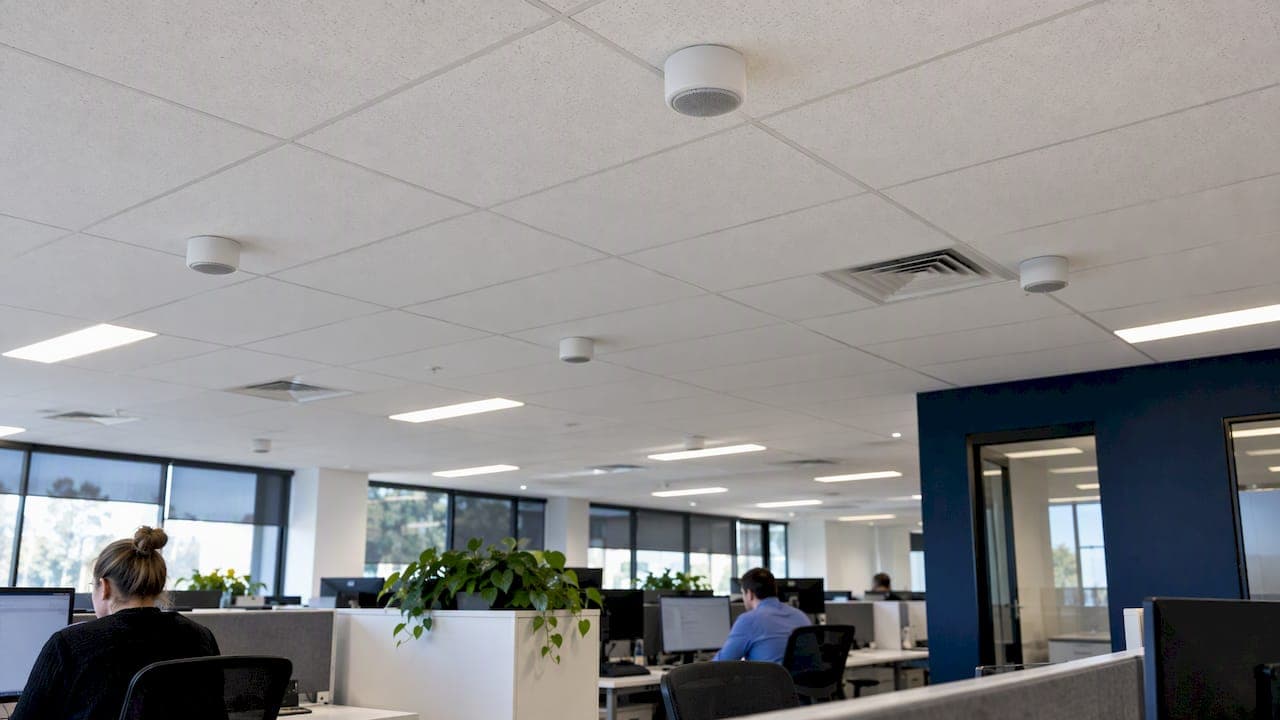
Sound masking raises an unobtrusive background sound tuned to speech frequencies, which reduces how far conversations carry and improves speech privacy and focus. It works best as part of a layered acoustic plan, calibrated to AS/NZS 2107 targets and commissioned by someone who measures the result rather than guesses at it. It is not a fix for thin walls or a noisy HVAC system on its own.
TL;DR:
- Systems target roughly 500 to 4,000 Hz, where most speech information sits, and use a smoother spectrum than flat white noise.
- Ask installers for a sample postinstallation measurement report showing calibrated sound levels and spectral shape by zone before comparing quotes.
- Fix door and partition gaps, loud HVAC noise, and reflective surfaces before adding masking, because it cannot repair structural or mechanical problems.
- Recheck each zone after furniture, partitions, or flooring changes; those shifts alter sound behavior, and the original commissioning report provides the reference for retuning.
- Masking reduces speech intelligibility at a distance, but it cannot stop deliberate eavesdropping or replace absorption in rooms with hard, reflective surfaces.
Table of Contents
- What sound masking is and why offices use it
- How sound masking works: frequencies, spectrum, and equipment
- Deployment and commissioning: what a good installation looks like
- Sound masking vs white noise and other masking sounds
- When to use masking and how it fits into the ABCs
- Practical checklist for office managers
- Why professional installation and commissioning matter
- Maintenance and ongoing management of sound masking systems
- Impact of office layout and materials on sound masking effectiveness
- Employee acceptance and perception of sound masking systems
- Integration of sound masking with other office technologies
- Perspective: realistic outcomes and getting occupant buy-in
- How a professional installer can help
- FAQ
- Sources
What sound masking is and why offices use it
Sound masking is engineered background sound, piped through a ceiling speaker network and shaped to cover the frequency range where human speech lives. Unlike a fan or an open window, it is designed specifically to reduce how intelligible nearby conversations are, not just to add general noise.
Offices install masking for a handful of practical reasons: to stop a phone call in the next pod from becoming public knowledge, to cut down on the drift of chatter across an open floor, and to make meeting rooms feel more private without full floor-to-ceiling construction. The goal is rarely silence. It is making speech blend into the background instead of standing out.
Common places where offices deploy it include:
- Open-plan work areas where desks sit close together with no partitions.
- Reception and waiting areas adjacent to private offices or exam rooms.
- Healthcare settings where patient conversations need confidentiality.
- Zones next to meeting rooms, where sensitive discussions could otherwise leak.
How sound masking works: frequencies, spectrum, and equipment
Masking systems target roughly the 500 to 4,000 Hz range, the band where most speech information sits, according to Biamp's comparison of masking and noise types. By concentrating sound energy there, the system reduces how clearly words can be picked out of a conversation rather than simply making the room louder overall.
The spectral shape matters as much as the level. A pink-noise-like curve, with more energy at lower frequencies and less at the top end, reads as smoother and less fatiguing than flat white noise over a full workday.
A typical system includes a masking generator or software controller, a grid of ceiling-mounted emitters wired in zones, and equalization tools to shape the spectrum per zone. Larger floors are usually divided into several zones so levels near a noisy copy room differ from levels in a quiet corner, rather than applying one setting everywhere.
Measurement during and after setup relies on a calibrated sound level meter reading LAeq across one-third octave bands, which shows whether the masking sound matches its target curve at each frequency. Emitters placed too far apart or too loud in one spot become localizable, which defeats the purpose: the goal is a field occupants cannot pinpoint, as ASD's overview of masking system design explains.
Deployment and commissioning: what a good installation looks like
A proper installation follows a sequence, not a single visit with a box of speakers.
- Site survey: an installer measures existing ambient noise, ceiling type, and plenum space before specifying hardware.
- Zoning plan: the floor gets divided into zones based on layout, so a loud zone near a kitchenette doesn't drown out a quiet zone near private offices.
- Speaker grid design: emitters go into the ceiling plenum at spacing that avoids hot spots or gaps.
- Commissioning measurements: a technician checks LAeq and spectral shape at multiple points per zone, adjusting until the field is even.
- Reporting: a documented record of measured levels per zone gives facility managers a baseline for future troubleshooting.
Pro Tip: Ask any installer for a sample post-installation measurement report before signing a contract. It shows whether they actually verify their work or just install and leave.
The most common pitfalls are visible or audible speakers that occupants can locate, uneven coverage that leaves pockets too quiet or too loud, and a spectrum pitched too high, which sounds like hiss instead of a neutral hum. An acoustic consultant typically handles design and target-setting on larger or more complex projects, while a certified installer handles the physical work and commissioning. For a single floor, expect a timeline measured in days for installation plus a day or two for commissioning, not weeks.
Sound masking vs white noise and other masking sounds
The terms get used loosely, but the acoustic differences matter for anyone evaluating a vendor's proposal.
White noise carries equal energy across every frequency, which often reads as a harsh hiss and can itself become a distraction over a full day. Pink noise shifts more energy into lower frequencies, which most people find considerably more comfortable to sit near for hours.
Sound masking, properly engineered, is neither. It is tuned specifically to the speech band and shaped to stay unobtrusive, which is why it is generally the better choice for speech privacy goals in an office rather than a generic noise generator, per Biamp's technical comparison.
None of these approaches guarantee privacy against someone deliberately trying to eavesdrop, and masking does little good in a room with hard, reflective surfaces and no absorption. It reduces intelligibility at a distance; it does not block sound at the source.
When to use masking and how it fits into the ABCs
Acousticians often describe three categories of intervention: absorb, block, and cover. Absorb means soft finishes like carpet, acoustic panels, and ceiling tiles that reduce reflected sound. Block means partitions, sealed walls, and gap-free doors that physically stop sound transmission between rooms. Cover is sound masking, which doesn't stop sound from traveling but makes it harder to understand once it arrives.
Masking is usually the right first step when a space is simply too quiet, a problem Green Star's IEQ-4 commentary notes can undermine privacy even when the space is otherwise well built, since silence lets every word carry (AcousPlan's Green Star guide). It also suits spaces that need flexible zoning, where construction changes aren't practical.
Masking is the wrong starting point when the real problem is poor partitioning or loud HVAC plant. In those cases:
- Fix sealing gaps around doors and partition walls first.
- Address mechanical noise at its source before layering sound over it.
- Treat hard, reflective surfaces with absorption before adding masking.
- Bring masking in once the structural and mechanical basics are handled.
Practical checklist for office managers
Budget depends mainly on floor area, ceiling type, the number of zones required, and how much commissioning the project includes. A single open zone costs less than a floor split into six zones each needing individual tuning.
A typical project timeline:
- Site survey: one to two weeks.
- Design and zoning plan: one to two weeks.
- Installation: one to three days per floor.
- Commissioning: one to two days.
Pro Tip: Request measurement standards and a sample zone report from any vendor before comparing quotes. Vague specs are the clearest sign of a rushed job.
Before signing, ask what measurement standard the installer uses, whether they provide a post-install report, what speaker type and spacing they plan, and what warranty or maintenance plan is included. Red flags include no commitment to measurement, vague technical specs, no mention of commissioning, and no warranty terms in writing.
Why professional installation and commissioning matter
A commissioned system gets verified with calibrated meters, checking one-third octave band slopes and measured LAeq by zone rather than relying on a default factory setting. We design, scope, and install audio-visual and networking systems including in-ceiling speaker runs, concealed cabling, and system integration with existing AV and building services.
Maintenance and ongoing management of sound masking systems
A masking system is not a set-and-forget installation. Levels drift as furniture gets rearranged, new partitions go up, or occupancy patterns change, and a zone that was properly tuned at commissioning can drift noticeably within a year or two.
Routine management involves periodic spot checks with a sound level meter to confirm each zone still sits at its target level, particularly after any office layout change. Adding desks, moving a wall, or swapping carpet for hard flooring all change how sound behaves in that zone, and a system tuned for the old layout may no longer match the room.
Software-based controllers make this easier by allowing zone-level adjustments without physically rewiring speakers, but someone still needs to own the task of checking levels and logging any changes. Facility teams that treat masking as part of regular building maintenance, alongside HVAC servicing and lighting checks, tend to catch drift before occupants start noticing or complaining. A service agreement with the original installer typically covers these periodic checks along with troubleshooting if a zone starts sounding uneven or a speaker fails.
Documentation from the original commissioning report becomes the reference point for every future adjustment, which is another reason to insist on one at installation rather than treating it as optional paperwork.
Impact of office layout and materials on sound masking effectiveness
Masking doesn't operate in a vacuum. The physical space around it determines how well the engineered sound field actually performs.
Hard, reflective surfaces, glass partitions, bare concrete ceilings, and uncarpeted floors bounce both speech and masking sound around a room unpredictably, which can create uneven coverage even with a well-designed speaker grid. Rooms with more soft material, carpet, acoustic ceiling tile, upholstered furniture, absorb excess reflections and let the masking field settle into a more even, predictable level.

Layout matters just as much as materials. Open-plan floors with long sightlines and few obstructions need more careful zoning than floors broken up by low partitions or storage units, since sound travels farther unimpeded. A zone that worked perfectly in a mocked-up layout can perform differently once desks, screens, and furniture are actually in place, which is one reason commissioning happens after installation rather than relying purely on design modeling.
Ceiling height and plenum depth affect how emitters distribute sound too. A low, deep plenum changes speaker spacing requirements compared to a high, open ceiling, and a system designed for one configuration rarely transfers cleanly to another without re-tuning.
This is part of why early coordination between acoustic design and architectural or interior fit-out decisions reduces costs later, since retrofitting a masking system around furniture and finishes already locked in is more expensive than planning for both at once, a point Green Star's IEQ-4 guidance makes in the context of meeting recommended acoustic targets.
Employee acceptance and perception of sound masking systems
Getting the technical specification right doesn't guarantee occupants will like the result. Research on speech privacy and masking shows laboratory measurements of reduced intelligibility don't always line up with how occupants subjectively rate their own comfort in the field, according to conference research on speech privacy and masking effectiveness. Some people notice the masking sound immediately and find it intrusive, even when it's objectively reducing how far their conversations carry.
Acceptance tends to improve when the sound is introduced gradually rather than switched on at full level overnight, giving people time to acclimatize. It also improves when facility teams explain what the system does and why, rather than letting it appear as an unexplained change to the office environment.
Complaints after installation are often less about the masking level itself and more about spectrum shape, a system pitched too high toward hiss generates far more pushback than one with a smoother, pink-noise-like curve. This is another reason commissioning includes checking the spectral slope, not just the overall loudness.
Consulting occupants before and during rollout, even informally, tends to produce fewer complaints than treating the installation purely as a facilities decision made without their input. A system that technically meets its design targets but annoys the people sitting under it has still failed at its actual job.
Integration of sound masking with other office technologies
Masking rarely operates as a standalone system in a modern office. HVAC noise interacts directly with masking design, since a loud air handling unit can itself mask speech in some frequencies while adding unwanted noise in others, and a masking system tuned without accounting for HVAC output can end up either redundant or fighting against the mechanical noise floor.
Lighting systems and masking increasingly share the same ceiling infrastructure and control platforms, particularly in newer buildings where both run through a common building management system. Coordinating these at the design stage avoids conflicts over ceiling space and plenum access later.
AV systems in meeting rooms and boardrooms also intersect with masking zones, since a masking field that's well tuned for an open-plan area can interfere with conference call audio if zoning doesn't account for the room boundary. Getting microphone and speaker placement right in these shared spaces matters for both privacy and call quality, a detail worth raising with whoever handles AV integration during the same project, as outlined in this overview of microphone types for speaker systems.
Structured cabling ties all of this together physically. Masking emitters, zone controllers, HVAC controls, and AV equipment often share the same ceiling plenum and rack space, so a cabling plan that accounts for all of them at once avoids the rework that comes from treating each system as a separate, later addition.

Perspective: realistic outcomes and getting occupant buy-in
Masking is a tool, not a cure. The offices that get the most out of it consult occupants early and prioritize comfort over chasing a headline decibel target. Small adjustments after go-live, based on how people actually react, usually matter more than the original design spec. Durable results come from pairing masking with layout fixes and mechanical noise control, not from masking alone.
— Dylan
How a professional installer can help
Getting masking right means coordinating ceiling speaker placement, zoning, cabling, and commissioning as one project rather than separate tasks handed to different people. We handle site surveys, in-ceiling speaker installation, structured cabling, and measurement-based commissioning reports as part of a scoped project, with maintenance options available afterward for offices that want ongoing checks.

A quote includes a defined scope, expected zone layout, and what the post-install measurement report will cover, so there are no surprises once the work starts.
- Site survey and zoning plan before any equipment is ordered.
- In-ceiling speaker installation integrated with existing AV and cabling.
- Commissioning report showing measured levels by zone.
- Maintenance options for ongoing checks as layouts change.
If a quiet floor or a leaky meeting room is costing your team privacy, request a site survey and quote for office networking and AV integration to see what a properly scoped installation looks like for your space.
FAQ
What is the best sound masking system for offices?
There is no single best system since the right choice depends on floor layout, ceiling type, and how many zones a space needs. A properly commissioned ceiling-speaker system, tuned to the speech band and verified with measurements, consistently outperforms an uncommissioned or off-the-shelf generator regardless of brand.
Does sound masking actually work?
Research shows masking reduces how intelligible nearby speech is when designed and tuned correctly, though field studies report mixed results on how occupants subjectively perceive annoyance versus lab measurements of intelligibility, per research on speech privacy and masking effectiveness. It works best as one part of a broader acoustic plan rather than a standalone fix.
What is the best noise masking machine for the office?
A personal desktop machine can help one individual but doesn't create the even, non-localizable sound field a ceiling-based system provides across an open floor. For office-wide privacy goals, a zoned ceiling speaker system with proper commissioning is the more reliable approach.
How do I reduce noise in my office?
Start with the ABC framework: absorb reflective surfaces with soft finishes, block gaps in partitions and doors, then cover remaining speech transmission with a properly tuned masking system. Addressing structural and mechanical noise sources first makes any masking system that follows considerably more effective.