
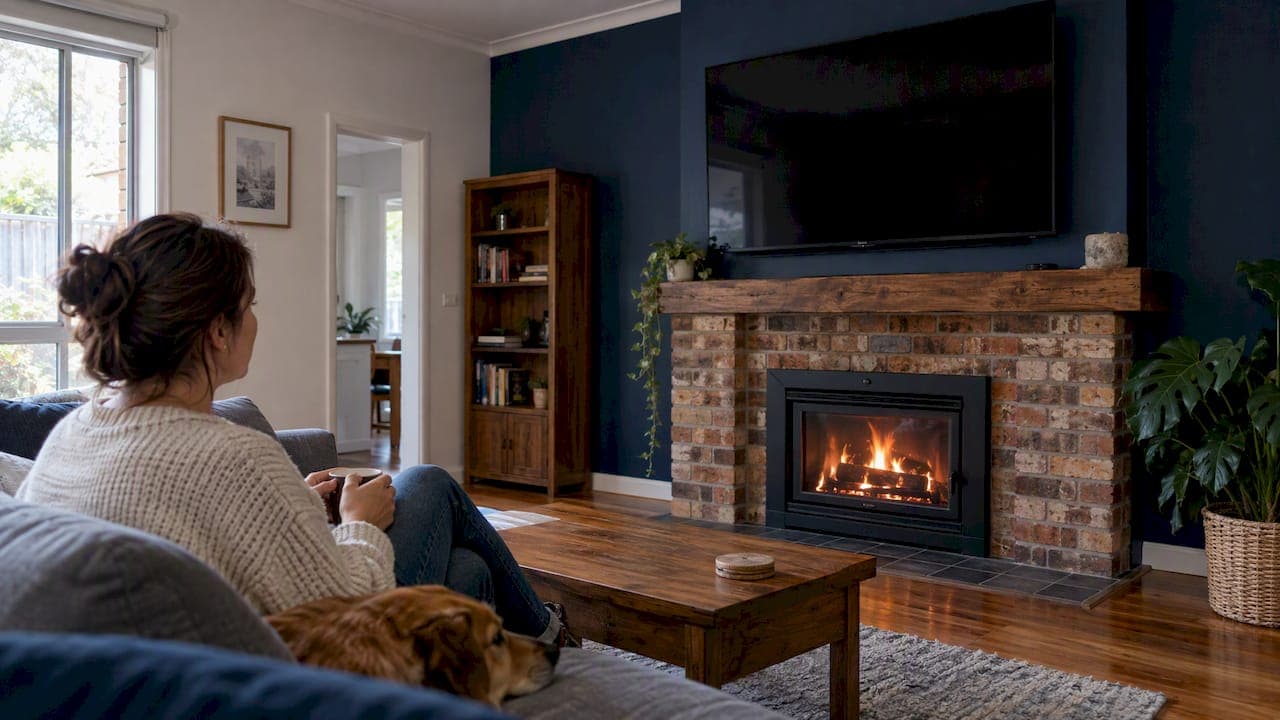
Yes, often, but only when the fireplace type, manufacturer clearances, and proper heat management are confirmed, otherwise you should choose a different wall or bring in a professional. Start by pulling your fireplace's installation manual and checking its stated clearance dimensions against your TV's operating temperature range. If either is unclear or your fireplace burns gas or wood, a professional can assess the site and handle the mounting safely.
TL;DR:
- Electric fireplaces generally run coolest; gas models depend on venting, fans, and heat kits, while wood or solid fuel units need professional assessment.
- Escea recommends placing the TV base at least 200 mm above the glass, but treats that distance as guidance, not a universal clearance.
- After checking both manuals and measuring the bracket, TV, mantel, and required air gap, run the fireplace for an hour and check for hot spots.
- Measure seated eye height before choosing a mount; if clearance forces the screen higher, a downward tilt of 5 to 15 degrees helps.
- Have a licensed electrician install recessed power; cables near the firebox need thermal insulating sleeves, and splices must not remain unprotected inside hot enclosures.
Table of Contents
- Which Fireplace Types Work Best for a TV Above Them
- What Manufacturer Manuals Say About Heat and Clearances
- Mounting Hardware and Where to Put the Power
- Finding the Right Viewing Height
- Wiring, Cable Concealment, and Power Placement
- Materials and Mantel Design That Keep Things Safe
- When to Call a Professional Installer
- Aesthetics Versus Longevity: Where We Land
- Get Your TV Mounted Safely Above the Fireplace
- FAQ
- Sources
Which Fireplace Types Work Best for a TV Above Them
Not every fireplace behaves the same way once it is running, and that difference decides whether mounting a TV above it is simple or risky.
Electric fireplaces run the coolest of the group. Surface temperatures stay low, so clearance requirements are usually easier to meet and the TV faces less ongoing heat stress. Gas fireplaces vary more: some vent heat upward in a steady plume that can sit right behind the TV, while others use factory fans or top-discharge designs that change the math entirely. Manufacturer notes typically require a mantel or buildout when passive heat kits or fans are present, so check your specific model's manual rather than assuming.
Solid fuel fireplaces carry the highest risk. Radiant heat, soot, and unpredictable flare-ups make them a poor candidate for a TV directly above without serious buildout work and professional input. Bioethanol units fall somewhere in between, with heat output that varies by model and ventilation setup, so treat each one individually.
- Electric: generally the safest option with the fewest clearance headaches.
- Gas: workable but depends heavily on fan type, venting, and manufacturer-specified mantel requirements.
- Solid fuel: high-risk due to radiant heat and soot buildup; involve a professional before proceeding.
- Bioethanol: check the specific unit's heat profile and ventilation before committing to a layout.
What Manufacturer Manuals Say About Heat and Clearances
Fireplace manuals describe clearance numbers as a starting point, not a guarantee. The 864CF-40K installation manual frames its TV clearances as good faith recommendations and places the responsibility on the installer to confirm actual TV temperatures once the unit is running, since airflow in a real room rarely matches a lab test.
Escea's builder and architect guidance recommends a TV's base sit at least 200 mm above the glass viewing area on the DN1150 Peninsula sheet, and it notes that figure is a suggestion rather than a fixed rule. That one line matters: it means every installation needs its own check, not just a copy of someone else's dimensions.
Manuals commonly reference a handful of measurements worth knowing before you shop for a bracket:
- Mantel depth and height above the firebox opening.
- The air gap required behind the TV for heat to dissipate.
- The C, B, and D dimensions some manufacturers use to define safe zones around the opening.
- Whether a passive heat kit or factory fan is installed, since either one usually raises the minimum clearance.
Once you have those numbers, run a practical check: measure from the top of the fireplace to where the TV's bottom edge will sit, measure your mantel's depth if you have one, add the thickness of your mounting bracket plus the TV itself, and after installation, run the fireplace for an hour and feel the wall and TV back panel for hot spots. If anything feels warmer than the room around it, add protection or move the TV higher.
Mounting Hardware and Where to Put the Power
The mounting method you choose changes how heat moves around the TV, not just how it looks on the wall.
- A surface mount sits the TV a few inches off the wall, which allows the air gap manuals ask for and makes it easier to feel for heat during a post-install check.
- A recessed niche looks cleaner but reduces airflow around the back of the TV, so it demands a verified air gap and sometimes a passive vent to let hot air escape.
- A tilt mount angles the screen down toward seated eye level, which helps when the fireplace clearance forces the TV higher than comfortable viewing height.
- A full-motion mount solves awkward room layouts but adds weight and leverage, so it needs a stud or masonry anchor rated for the combined weight of the arm and TV.
Pro Tip: Keep tilt angles between 5 and 15 degrees when mounting above eye level: steeper angles distort the picture and strain the neck during long viewing sessions.
Fixing hardware depends entirely on the wall behind the fireplace. Masonry and brick need rated anchors or a sleeve system rated for the TV's weight, while plasterboard over a timber frame needs the bracket secured into studs, not just the board. If your plan includes recessed power behind the TV, that in-wall wiring is electrical work and belongs with a licensed electrician, not a DIY cable run.

Finding the Right Viewing Height
Mounting a TV too high above a fireplace is the most common complaint homeowners raise after installation, and it is avoidable with one simple measurement.
Sit in your usual viewing spot and measure from the floor to your eye level while seated. That number should land close to the vertical center of the screen, not its top or bottom edge. When fireplace clearances push the TV higher than that ideal center, a tilt mount angled downward recovers much of the comfort you would otherwise lose.
- Measure seated eye height first, before you decide on a mount or bracket.
- If the TV must sit higher than ideal, add 5 to 15 degrees of downward tilt to compensate.
- When the gap is still too large, a feature wall, framed art piece, or symmetrical shelving above the mantel reduces the visual strain of looking up at a screen mounted well above eye level.
Wiring, Cable Concealment, and Power Placement
A tidy cable run makes or breaks the finished look, but the planning matters more than the aesthetics.
Surface raceways are the simplest option and require no wall modification, though they are the most visible. In-wall conduit hides everything but needs careful planning around the firebox and flue. Recessed power points behind the TV give the cleanest result and let you skip a visible power cord entirely, but that work falls under electrical regulations. AS/CA S008+A1 2025 sets out requirements for installing and maintaining fixed or concealed cabling, and those standards apply directly when you are running cable behind a wall near a heat source.
Wrap any cable that passes near the firebox or flue in thermal-insulating sleeving, and never leave an unprotected splice inside a hot enclosure. A useful planning list before you open the wall:
- Power: confirm whether you need a new recessed outlet or can route to an existing circuit.
- HDMI and AV cabling: plan the run length with slack for future equipment changes.
- Network cabling: add it now if you plan to stream, since retrofitting later means opening the wall again.
- Ventilation: leave a path for hot air to escape rather than sealing the cavity completely.
Pro Tip: Label each cable at both ends before closing the wall. It saves an hour of guesswork the next time you upgrade the TV or add a device.
Materials and Mantel Design That Keep Things Safe
The facing material around your fireplace does more than set the style, it also affects how much heat reaches the TV.
Non-combustible facing such as stone, tile, or certain fiber cement boards is what most manufacturer manuals recommend around the opening, and it gives you a buffer that timber paneling does not. If the wall above the firebox runs warm to the touch, a layer of fibreglass or mineral wool insulation behind the finish protects both the wall surface and the TV mounted above it.
A mantel or buildout is often the simplest fix for marginal clearances, since depth and overhang can redirect rising heat away from the TV rather than straight up into it.
- Choose non-combustible facing materials around the firebox opening wherever the manual allows a choice.
- Size the mantel depth to match or exceed the manufacturer's minimum, not just what looks proportionate.
- Use a buildout or shallow alcove to channel hot air sideways instead of straight up the wall.
- Keep trim and molding details simple near the heat path. Ornate woodwork close to the opening adds combustible material exactly where you want the least.
When to Call a Professional Installer
Some installs are straightforward weekend projects. Others involve masonry anchors, in-wall power, recessed niches, or a gas or solid-fuel fireplace, and that is when professional input stops being optional.
A qualified installer checks the clearance numbers against your actual TV model, measures real operating temperature after the fireplace has been running, verifies that any recessed power meets wiring standards, and confirms cable routing keeps every run away from hot surfaces. professional installers carry out accredited audio-visual installations across homes and businesses, including recessed power and concealed cabling work, without subcontracting any part of the job.
Aesthetics Versus Longevity: Where We Land
Conservative clearances protect your TV's lifespan and warranty far more than a tight, stylish fit does. Our approach on site is simple: measure first, check both manuals, add a mantel or buildout if the numbers are close, and verify TV temperature after the fireplace has run for a while. A screen that looks perfectly placed on day one but runs warm every evening is not a win.
— Dylan
Get Your TV Mounted Safely Above the Fireplace
We handle the part homeowners find hardest to judge themselves: confirming clearances, running recessed power safely, and hiding every cable without leaving a hot splice behind the drywall. Our accredited team scopes the fireplace, the wall type, and your TV before quoting a fixed price, so there are no surprises once the job starts.

- TV wall mounting with recessed power for a cable-free finish.
- Concealed low-voltage cabling for HDMI, network, and AV runs.
- Licensed electrical coordination for any in-wall power work.
- A site survey before every quote, so the plan matches your actual fireplace and wall.
If your fireplace, wall material, or wiring plan feels complicated, reach out through our audio-visual installation page to request a survey and a fixed quote.
FAQ
Can you install a TV above a gas fireplace?
Often yes, but gas units vary widely in how they vent heat, and factory fans or passive heat kits typically raise the minimum clearance a manufacturer requires. Check your specific model's installation manual before mounting, and consider a mantel or buildout if the manual calls for one.
How can I protect my TV from heat above a fireplace?
Keep the clearance distances your fireplace manual specifies, and add a mantel, buildout, or shallow alcove to redirect rising heat away from the screen. If the wall itself runs warm, a layer of fibreglass or mineral wool behind the facing material adds another buffer.
How do you hang a TV on a brick wall?
Brick and masonry need anchors or a sleeve system rated for the combined weight of the bracket and TV, not standard drywall fixings. A full-motion or tilt mount still works on masonry as long as the anchoring point is solid and rated for that load.
Does heat from the fireplace damage a TV?
It can, if the TV's actual operating temperature exceeds what its manufacturer allows, which is why fireplace manuals describe their clearance numbers as guidance that homeowners must verify on site. Running the fireplace for an hour after installation and checking the TV's back panel for warmth is a practical way to catch a problem before it causes damage.
What height should a TV be mounted above a fireplace?
Measure your seated eye height and aim to keep the screen's vertical center close to that line rather than well above it. When fireplace clearances force the TV higher than ideal, a downward tilt of 5 to 15 degrees recovers most of the lost comfort.