

Hire a site-surveyed professional installer. That's the short answer. Whether you're dealing with dead zones in a home office, patchy coverage across a small business, or no reliable signal at a rural property, the fix starts with a proper RF site survey — predictive modeling from your floor plans, followed by an on-site walk to validate real-world interference and signal-to-noise ratios. Before you sign anything, demand these deliverables in writing:
- RF heat maps (before and after)
- Access point placement plan with channel assignments
- Cat6/Cat6a or fiber cabling specification with PoE switch grade
- Commissioning test logs (throughput, latency, roaming handover results)
- Signed acceptance report and documented SLA with warranty terms
FCC regulations govern wireless spectrum use, and TIA/EIA standards set the baseline for structured cabling. Any installer worth hiring knows both. For rural properties without fiber or cable, Starlink integration is now a practical backhaul option — but it needs to be scoped into the design from day one, not bolted on afterward.
Table of Contents
- Why Djcengineering delivers end-to-end Wi-Fi design you can rely on
- Key Takeaways
- What to ask before you hire any Wi-Fi installer
- Get a site survey and quote from Djcengineering
Why Djcengineering delivers end-to-end Wi-Fi design you can rely on
Djcengineering handles the full lifecycle: site survey, heat mapping, structured cabling (Cat6/Cat6a and fiber for longer backbone runs), PoE switch selection, managed AP deployment using platforms like Ubiquiti UniFi, Cisco Meraki, and Aruba Networks, plus Starlink and NBN integration for rural and semi-rural sites. Every job is delivered by in-house, accredited installers — no subcontractors.

The 98% first-visit fix rate matters because it reflects scoping discipline. Djcengineering doesn't quote AP counts without capacity planning, and they don't recommend equipment without a documented design process behind it. You get commissioning reports with acceptance test logs, before/after coverage maps, and SLA terms in writing before work starts.
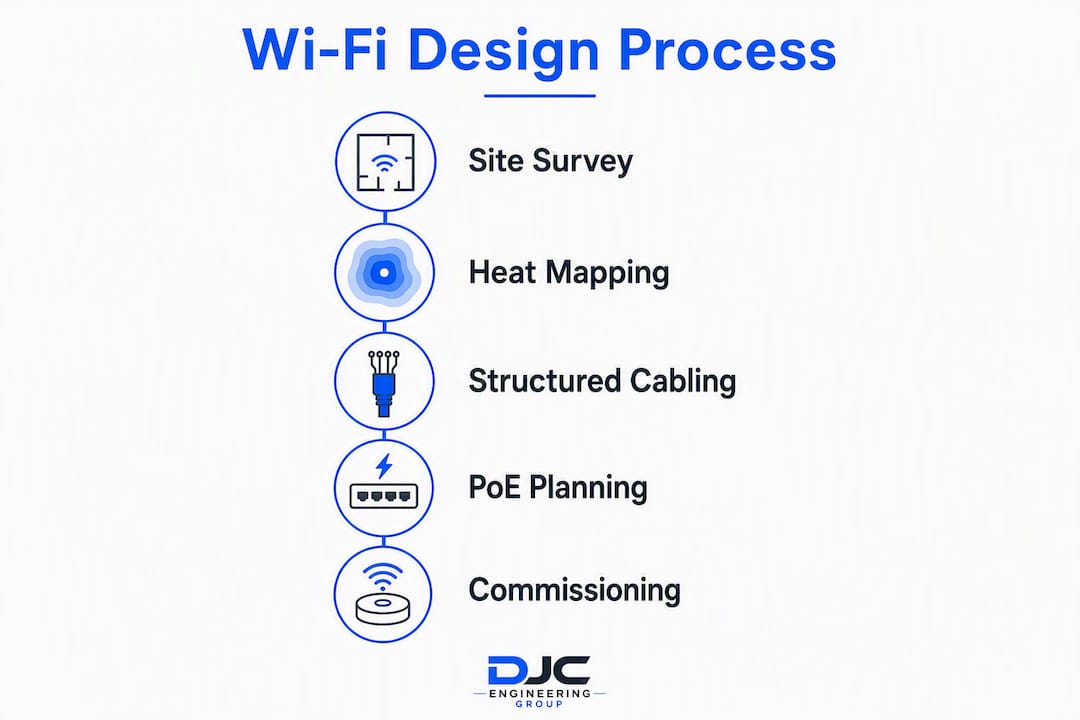
Structured cabling choices and PoE planning directly affect switch selection, power budgets, and how far your network can grow. Djcengineering specs this to your actual site, not a generic template.
Pro Tip: Ask your installer to show you a commissioning report from a previous job. If they can't produce one, that tells you everything about how they'll handle yours.
Key Takeaways
A site-surveyed, installer-led Wi-Fi design is the most reliable route to eliminate black spots and maintain performance as your property or business grows.
| Point | Details |
|---|---|
| Demand both survey types | Predictive modeling plus on-site RF validation catches interference that floor plans alone miss. |
| Capacity beats coverage | Too many APs without planning causes co-channel interference; design for device density, not just signal reach. |
| Rural backhaul needs scoping | Starlink, fixed wireless, and fiber each carry different latency and cost tradeoffs — integrate backhaul into the design, not after. |
| Commissioning logs protect you | A signed acceptance report with throughput and roaming test results is your primary protection if performance fails post-handover. |
| Djcengineering | Full-lifecycle installs with a 98% first-visit fix rate, accredited in-house teams, and documented SLAs for SEQ homes, businesses, and rural properties. |
What to ask before you hire any Wi-Fi installer
Choose an installer who owns the full lifecycle: design, installation, commissioning, and ongoing support. Vendors who hand off between separate cablers, network engineers, and ISPs create finger-pointing gaps that slow down every problem resolution.
Ten questions worth asking on your first call:
- Do you perform both predictive and on-site RF surveys?
- Will you supply heat maps and commissioning test logs?
- Are your installers accredited, and do you use subcontractors?
- What warranty and SLA terms are included in writing?
- Which AP brands and management platforms do you use?
- Do you test roaming handovers between access points?
- How do you handle PoE power budgets and switch redundancy?
- How is rural backhaul (Starlink or fixed wireless) integrated into the design?
- What monitoring and alerting is provided after handover?
- What is your first-visit fix rate?
Red flags: a quote that lists equipment with no survey, refusal to share test logs, no documented SLA, or AP counts pulled from thin air without capacity planning. Avoiding common facilities management mistakes during planning — like skipping proper scoping or splitting accountability across contractors — saves significant rework costs later.
Get a site survey and quote from Djcengineering
Send Djcengineering your floor plans or site photos, a list of devices and applications, expected concurrent users, any outdoor coverage areas, and your current internet backhaul details. In return, you get predictive survey notes, an on-site survey booking, final heat maps, AP placement and cabling specs, a commissioning report with signed acceptance tests, and SLA options.
Phone, contact form, or request a site survey directly — typical response is fast, and Djcengineering covers all of South East Queensland with in-house installers and documented warranties on every job.
Recommended
- Professional WiFi Design & Installation: Engineering Seamless Connectivity in SE QLD | DJC Engineering
- WiFi Design & Install Brisbane SEQ | DJC Engineering
- Commercial WiFi Design Brisbane: The Master Technician’s Guide to Business Connectivity | DJC Engineering
- Commercial WiFi Systems: Engineering High-Performance Networks for QLD Businesses | DJC Engineering