
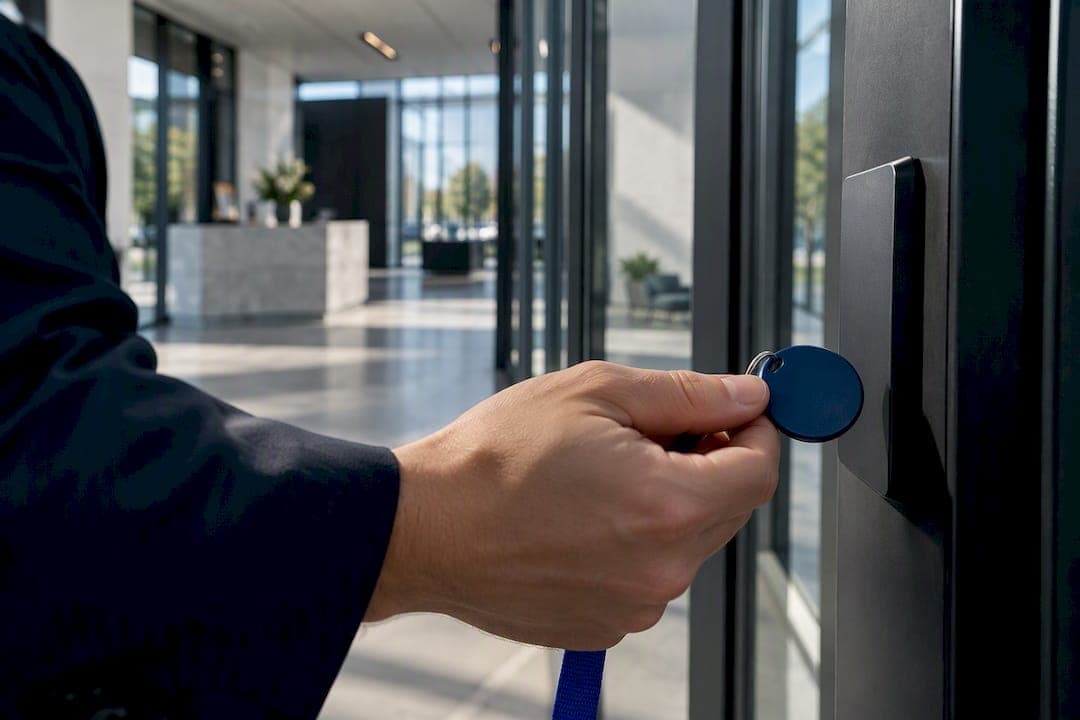
Plan on roughly $1,500 to $4,500 per door installed for a typical commercial access control system in Australia, with straightforward single-door setups sitting at the low end and multi-door networked systems climbing into the tens of thousands. Hardware choice, door type, cabling runs, and licensing all move that number. The only way to lock in a firm figure is an engineered site survey, the approach DJC Engineering uses to scope jobs before quoting.
TL;DR:
- Hardware costs vary widely, with standalone keypads starting at $1,500 and large networked installations reaching $75,000 for 20 doors.
- Labor for cabling and installation often exceeds hardware costs, especially on retrofit projects with long cable runs or complex door types.
- Ongoing expenses include $300 to $1,200 annually for maintenance and $3.50 to $15 monthly per door for cloud system subscriptions.
- Price discrepancies between quotes usually stem from hardware choices and unitemized quotes that obscure labor and configuration costs.
- A site survey and detailed, fixed-scope quote are essential to accurately budget and avoid unexpected expenses in access control projects.
Table of Contents
- Access Control Cost Australia: Typical Installed Prices Per Door
- What Drives the Price of Access Control Installation
- Ongoing Costs: Licensing, Maintenance and Credential Churn
- How to Scope and Compare Access Control Quotes
- Compliance and Timelines for Australian Access Control Projects
- An Engineer's View: Why Predictable Cost Starts With the Survey
- Get a Fixed-Scope Access Control Quote
- Sources
- FAQ
Access Control Cost Australia: Typical Installed Prices Per Door
The per-door number is the single most useful way to budget, because it lets you multiply a known unit cost by the doors you actually need secured. Australian market guides put a standalone keypad door at $1,500 to $3,000 installed, while a managed one-door card or fob system, complete with a controller talking back to software, runs $2,000 to $4,500.
Scale changes the math. A typical four-door managed system lands at $7,500 to $17,000 once you account for shared infrastructure like a head-end controller and network switch. A 20-door networked rollout across a commercial building or warehouse complex climbs to $35,000 to $75,000, largely because larger jobs need server capacity, redundant power, and more cabling labour per door than a single-door retrofit.

An "installed" quote should include the reader or keypad, the electric lock or strike, a power supply unit with battery backup, the cable run, and commissioning: the testing and handover that confirms every door actually works before the installer leaves site. Separate Australian pricing data confirms a similar band, $1,500 to $4,000 per door installed, which lines up closely with the ranges above.
Two quick examples show how this plays out in practice:
- Small office, 1 to 2 doors: A front entry with a card reader and a server room with a keypad typically lands between $4,000 and $8,000 installed, including a basic cloud management license.
- Small warehouse, 4 to 6 doors: Loading dock, office entry, and internal secure storage doors together usually total $12,000 to $22,000, depending on how far the cabling has to travel and whether the warehouse needs a roller door interface.
| System size | Typical installed range |
|---|---|
| Standalone keypad, 1 door | $1,500 to $3,000 |
| Managed card/fob, 1 door | $2,000 to $4,500 |
| Managed system, 4 doors | $7,500 to $17,000 |
| Networked system, 20 doors | $35,000 to $75,000 |
What Drives the Price of Access Control Installation
Two quotes for the "same" job can differ by thousands of dollars, and hardware is usually the biggest swing factor. Hardware typically makes up 60 to 70% of the upfront cost, with readers ranging from $80 for a basic keypad to $1,200 for a high-end mobile credential or biometric unit, controllers from $180 to $3,500, and electronic locks from $50 to $900 per door.
- Door and frame type: A standard hollow-metal internal door is cheap to fit. Glass doors, aluminium shopfronts, and fire-rated or egress doors often need special brackets, magnetic locks rated for fire release, or door closer modifications that add labour and hardware cost.
- Wiring and power: Long cable runs, concrete slab penetrations, or a site that needs a new PoE switch to power readers all add cost. Cabling and installation labour frequently makes up a larger share of the total than most clients expect, especially on retrofits where cable paths aren't already accessible.
- Integrations: Linking access control to CCTV, an intercom, a lift, or a third-party API for visitor management each adds configuration time and sometimes a licensing fee. Combined access control and CCTV integration tends to cost less than buying and commissioning the two systems separately later.
Pro Tip: Ask every installer to quote hardware and labour as separate line items. If a quote only shows one lump total, you can't tell whether you're paying for premium readers or just a long, difficult cable run.
Ongoing Costs: Licensing, Maintenance and Credential Churn
The upfront install is only part of the bill. Cloud-based platforms typically charge $3.50 to $15 per door per month in subscription fees, while on-premises systems avoid that recurring charge but need a local server and periodic software updates instead.
- Annual service contracts: Budget $300 to $1,200 per year depending on system size, covering firmware updates, battery checks, and reader cleaning or recalibration.
- Credential churn: Staff turnover means replacing lost or unreturned cards and fobs, plus the admin time to add and remove users. This cost is easy to overlook when comparing quotes, but it adds up fast in businesses with high staff turnover.
- Cloud vs on-prem over five years: Cloud systems can run 20 to 30% cheaper over five years for multi-site businesses despite the monthly fee, because they skip server hardware refreshes and reduce the IT time spent maintaining on-site infrastructure.
A four-door office weighing $150 a month in cloud fees against a one-off on-prem server and licence purchase should run both numbers out five years before deciding. The cheaper monthly fee doesn't always win once server replacement and IT labour are factored in.
How to Scope and Compare Access Control Quotes
Getting comparable quotes means asking every installer for the same level of detail, in the same format. Here's the checklist that actually catches the gaps between a cheap quote and a complete one.
- Request an itemised bill of materials per door, listing the reader model, lock or strike model, power supply, battery backup, cable allowance, and any brackets or frame hardware.
- Ask for labour hours separately from materials, so you can see what you're paying for cabling, mounting, and programming versus hardware itself.
- Clarify the software licensing model: is it a one-time purchase, an annual fee, or a per-door monthly subscription, and what happens to your access if you stop paying?
- Get the integration costs in writing if you're linking to CCTV, intercoms, or a lift system, since these are often quoted as add-ons after the fact.
- Confirm who signs off on the electrical work. Ask for evidence of a licensed contractor and, where required, an endorsed Qualified Technical Person.
- Watch for red flags: a single lump-sum total with no breakdown, no mention of testing or commissioning, and no stated warranty period are all signs the quote is incomplete.
Compliance and Timelines for Australian Access Control Projects
Access control on fire-rated or egress doors isn't just an electrical job. The National Construction Code sets requirements for fire indicators, intercoms, and fire door performance that can force a magnetic lock to have a fail-safe release tied to the fire panel, adding both hardware and witnessed testing time.
- Electrical licensing: Anyone terminating mains power or working on fire-interlocked hardware needs a licensed electrical contractor, and in Queensland that means an endorsed Qualified Technical Person on the job.
- Typical timeline: Site survey (1 to 2 weeks), quoting (1 to 2 weeks), procurement (2 to 4 weeks for hardware), then install and commissioning (1 to 4 weeks depending on door count).
- Schedule risks: After-hours work, staged installs across occupied tenancies, or council permits for structural door changes all push the timeline out and usually add cost.
An Engineer's View: Why Predictable Cost Starts With the Survey
Most access control cost blowouts trace back to one thing: someone quoted from a floor plan instead of walking the site. An engineered survey catches the glass door that needs a different lock, the concrete wall that needs core drilling, and the fire door that needs sign-off before a single cable gets run.
DJC Engineering scopes every job with a site survey and an itemised bill of materials, then delivers the install with its own accredited team rather than subcontractors, an approach reflected in a 98% first-visit fix rate on completed jobs. That matters for cost control specifically: one accountable team means fewer callbacks, less finger-pointing between trades, and a documented handover with test results, not just a working system and a wave goodbye.
— Dylan
Get a Fixed-Scope Access Control Quote
DJC Engineering is the alternative to guessing at a lump-sum number off a website calculator. Instead of a rough estimate, you get a site survey, an itemised bill of materials by door, and a fixed-scope quote before any cabling gets run.
Beyond access control and intercom systems, DJC Engineering handles the surrounding infrastructure that access control depends on: data cabling and PoE network readiness, Wi-Fi and mesh coverage, and integration with existing CCTV systems. A DJC quote spells out compliance testing, commissioning steps, and documented handover, so you know exactly what you're paying for before work starts. If you're weighing a single-door retrofit or a full multi-door rollout, request a site survey through the access control and security page and get a scoped, itemised quote instead of a ballpark figure.
Sources
- How Much Does Access Control Cost? - Security Wholesalers
- Coram
- Commercial Security Cost Australia 2026
- NCC 2025 — residential fire safety systems (extract)
- Electrical contractor licences — WorkSafe QLD
FAQ
How much does an access control system cost in Australia?
A single door with a standalone keypad typically runs $1,500 to $3,000 installed, while a managed card or fob door costs $2,000 to $4,500. Multi-door systems scale from around $7,500 for four doors up to $75,000 for a 20-door networked installation.
What is the average cost of installing an access control system?
Installed cost includes the reader, lock, power supply with battery backup, cabling, and commissioning testing, not just the hardware. For most Australian commercial sites, that lands between $1,500 and $4,000 per door, depending on door type and cable run length.
What are the ongoing prices of access control systems?
Expect $300 to $1,200 a year for maintenance and service contracts, plus cloud subscription fees of $3.50 to $15 per door per month if you choose a cloud-managed platform. On-premises systems skip the subscription but need periodic server and software upkeep instead.
What is the average cost of a home security system in Australia?
Home security pricing varies more than commercial access control because it depends heavily on whether you're adding cameras, alarms, or both alongside door access. DJC Engineering's CCTV installation guide covers typical camera system costs, which often run alongside or instead of full access control for residential properties.
How do I get an accurate access control quote for my property?
Request a site survey rather than a phone estimate, since door type, cable access, and integration needs all change the final number. DJC Engineering scopes jobs this way, providing an itemised bill of materials and fixed-scope quote through its access control service page before any work is booked.