
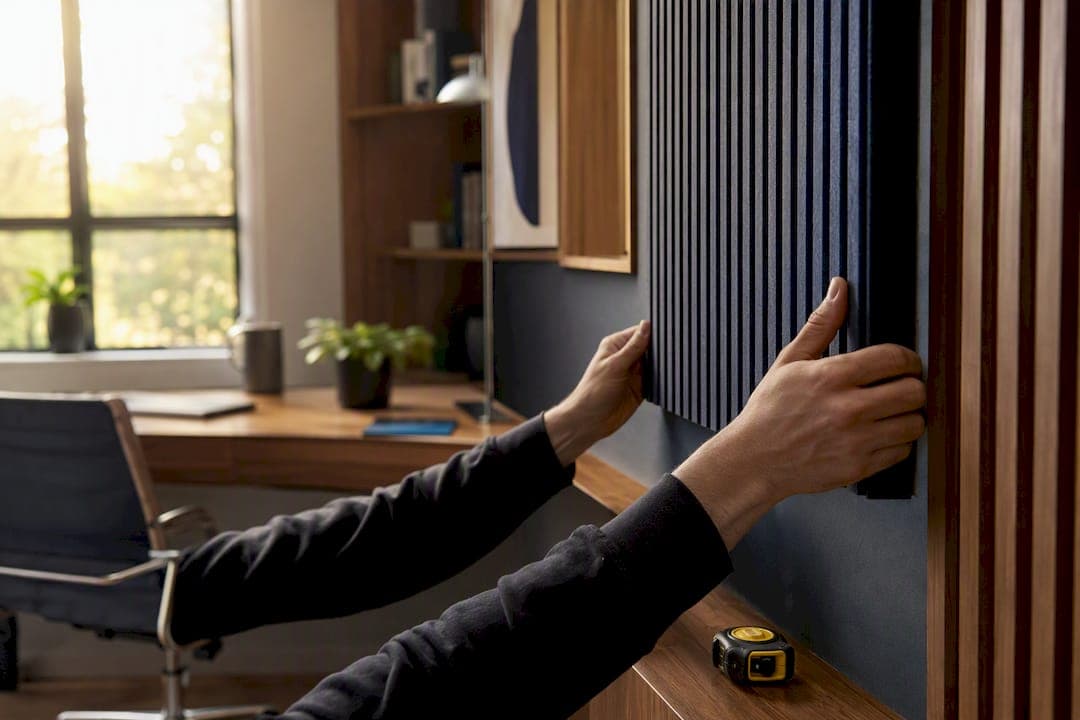
Meeting room acoustics come down to three numbers: reverberation time (RT60) at or below 0.6 seconds, background noise under 35 dBA, and speech intelligibility (STI) of at least 0.60. For rooms carrying heavy video-conferencing traffic, tighten that to RT60 of 0.4 to 0.5 seconds and background noise under 30 dBA. If your room misses these marks, start with the ceiling, not the walls.
Three moves fix most rooms fast:
- Add absorption to the ceiling first (tiles or baffles), since it typically supplies 60 to 75% of a room's total absorption.
- Seal the door and reposition microphones away from HVAC vents and hard glass surfaces.
- Add soft furnishings (curtains, rugs) as a stopgap while you scope permanent treatment.
Pro Tip: If your room needs confidentiality between spaces (legal, HR, board discussions), an acoustic consultant should measure sound transmission class (STC) between walls, not just RT60 inside the room. Those are two separate problems with two separate fixes.
Key Takeaways
Meeting room acoustics improve fastest when ceiling absorption, background noise control, and AV placement are addressed together rather than one at a time.
| Point | Details |
|---|---|
| Hit the three targets | RT60 ≤ 0.6 s, background noise ≤ 35 dBA, STI ≥ 0.60, tighter for VC-heavy rooms. |
| Treat the ceiling first | Ceiling absorption typically supplies 60 to 75% of a room's total absorption. |
| Diagnose before you spend | Use the clap test, a talk test, and RT60/STIPA apps to triage before hiring a consultant. |
| Separate noise from leakage | HVAC noise and wall/door sound transmission are different problems with different fixes. |
| Coordinate AV and acoustics early | Beamforming microphones and AEC depend on room DRR, not just hardware quality. |
Table of Contents
- What Do RT60, STI, and Background Noise Actually Mean?
- How Do You Check Room Acoustics Without a Lab?
- Quick Fixes You Can Try Before Calling a Contractor
- What Acoustic Treatment Actually Fixes a Meeting Room?
- How Do HVAC and Doors Affect Meeting Room Soundproofing?
- Why AV Setup Depends on Room Acoustics, Not Just Microphones
- What Belongs in a Meeting Room Acoustic Design Brief?
- Is Acoustic Treatment Worth the Cost?
- Why Hire a Professional for Meeting Room Acoustics Work?
- An Editorial Take on Fixing Meeting Rooms That Actually Works
- Sources
What Do RT60, STI, and Background Noise Actually Mean?
RT60 measures how long sound takes to decay by 60 decibels after a source stops. Long RT60 means speech smears together, consonants blur, and remote participants hear a wash of echo instead of words. STI (speech transmission index) measures how much of that speech survives the trip from a talker's mouth to a listener's ear, scored from 0 to 1. Background noise, measured in dBA or NC (noise criteria), is the steady hum from HVAC, traffic, or equipment competing with speech.
Here's what the numbers mean in practice:
- RT60 ≤ 0.6 s (500 to 2000 Hz): standard meeting rooms; 0.4 to 0.5 s for video-conferencing-heavy rooms.
- Background noise ≤ 35 dBA, tightened to ≤ 30 dBA for constant VC use, per AS/NZS 2107 guidance.
- STI ≥ 0.60 is rated "good" under IEC 60268-16. Below 0.45, a listener starts losing whole words, not just clarity.
Push any one of these past its threshold and the other two suffer with it. A noisy HVAC system forces talkers to raise their voice, which excites more reflections, which drags RT60 in the wrong direction.
How Do You Check Room Acoustics Without a Lab?
You don't need a certified acoustician to get a first read on a room. Start here:
- Clap test. Stand in the middle of the room and clap once, sharply. A metallic, ringing tail or a rapid "zzzt" flutter between parallel walls signals excess reverberation and flutter echo.
- Talk test. Have someone stand at the far end of the table and speak at normal volume with their back to you. If you strain to catch words, STI is likely below 0.60.
- Phone app measurement. RT60 and STIPA measurement apps give a reasonable estimate for triage, though they're no substitute for calibrated lab-grade gear, particularly at low frequencies.
- Call a consultant when the room needs confidentiality (STC targets between walls), serves as a flagship VC space, or fails the talk test consistently across multiple furniture layouts.
Pro Tip: Run the clap test with the door open and closed. A big difference tells you flanking noise through the corridor, not the room itself, is your real problem.
Quick Fixes You Can Try Before Calling a Contractor
Temporary treatment buys you time and tells you how much permanent work is worth doing. None of it requires construction.
- Hang heavy, lined curtains over glass walls. Glass reflects almost all speech energy, and fabric is the fastest way to knock that down.
- Add a large rug or carpet tile under the table. Hard floors bounce sound straight back up into microphones.
- Swap hard chairs for upholstered ones, and drape a table felt or heavy cloth runner down the center of the table to cut tabletop reflections hitting the mic array.
- Reposition the microphone away from the door, vents, and window wall, and close the door fully during calls.
These fixes buy real improvement, often enough to move a marginal room from unusable to workable. What they won't do is fix a concrete ceiling or a genuinely undersized HVAC duct. Those need permanent treatment, covered next.
What Acoustic Treatment Actually Fixes a Meeting Room?
Ceiling treatment does the heaviest lifting in almost every room. Aim for ceiling tiles or baffles with an NRC of 0.85 or higher, covering 60 to 80% of the ceiling area, especially where you've got glazing or exposed concrete pulling absorption in the wrong direction. Exposed concrete has an absorption coefficient near 0.02, essentially nothing, and remediating a bad ceiling after the fact costs two to three times more than specifying it right at the design stage.
Walls get treated surgically, not wholesale. Cavity-backed panels (with roughly a 100 mm air gap) control flutter echo and low-frequency buildup that surface-mounted foam simply can't touch below about 1 kHz. Case study data on speech-focused rooms points to ceiling-plus-rear-wall placement as one of the most efficient absorber configurations, while decorative diffusers rarely move the needle for speech intelligibility on their own.
| Surface | Treatment | Target Coverage |
|---|---|---|
| Ceiling | High-NRC tiles or suspended baffles | 60 to 80% of area, NRC ≥ 0.85 |
| Walls | Cavity-backed absorptive panels | Rear wall and flutter-echo zones |
| Glazing | Curtains, micro-perforated glass, freestanding absorbers | Full window wall coverage |
For a 20-person room, six to ten square meters of wall panel is a reasonable starting allocation, adjusted after you've treated the ceiling and remeasured.
How Do HVAC and Doors Affect Meeting Room Soundproofing?
Background noise and speech leakage are separate fights from reverberation, and both matter for meeting room soundproofing.
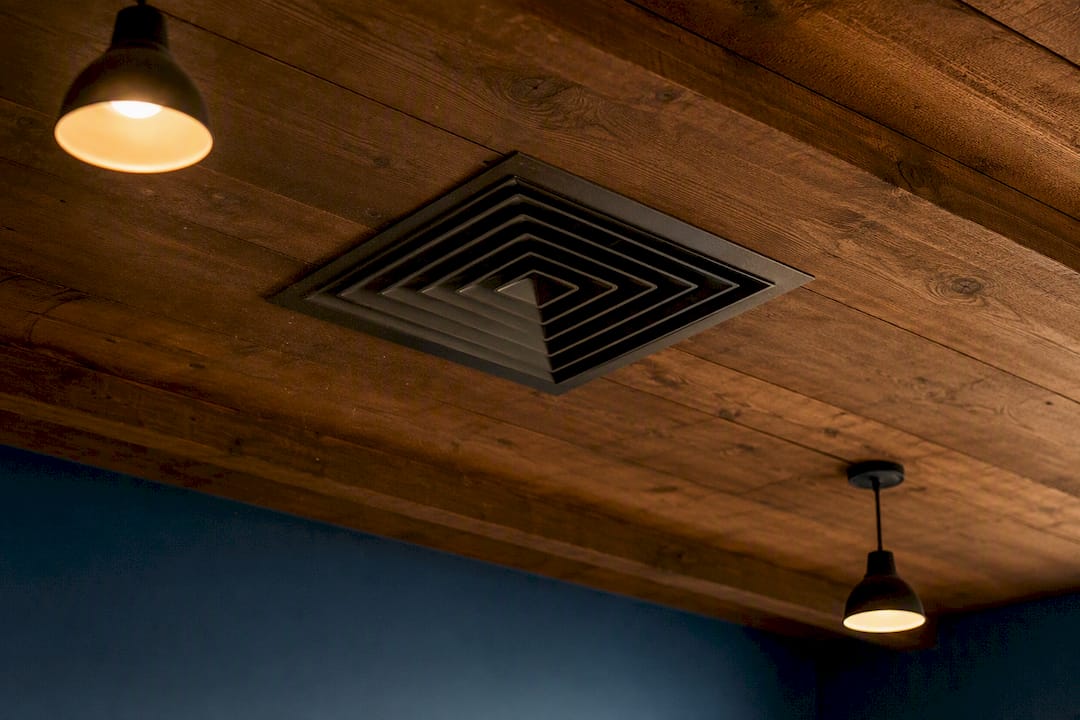
On the HVAC side, specify NC-30 or better for the room's supply and return. Common mitigations include duct silencers, lower face velocity at diffusers, and flexible connectors that stop vibration from transferring into the ductwork itself. A whistling diffuser or a rattling fan coil unit will blow past your dBA target no matter how good your ceiling tiles are.
On the door and partition side:
- Specify drop seals and full perimeter gasketing on doors, not just a sweep at the bottom.
- Run partitions slab-to-slab rather than stopping at the ceiling tile line, or sound travels straight over the top into the next room.
- Check for flanking paths through shared ductwork, electrical penetrations, or a continuous corridor ceiling.
If a room needs real confidentiality, mechanical changes to the partition and door are non-negotiable. Acoustic panels inside the room won't stop sound from crossing into the next office.
Why AV Setup Depends on Room Acoustics, Not Just Microphones
A better microphone cannot fix a room with a long RT60. Beamforming mics and acoustic echo cancellation (AEC) both depend on a clean direct-to-reverberant ratio (DRR), and when reverberation is high, AEC struggles to converge and beamformers pick up more room than voice. Fix the room, then the mic choice matters far less.
A short coordination sequence for facilities and AV teams:
- Measure or model RT60 and background noise before finalizing microphone placement.
- Choose ceiling or table mic arrays based on measured DRR, not manufacturer marketing claims.
- Keep a small reflective zone directly above the table if the beamformer's design calls for it. Some systems use that reflection deliberately, so don't treat every square inch of ceiling on principle.
- Loop in the boardroom AV design team early, since mic and speaker placement decisions get locked in well before acoustic treatment goes up.
Pro Tip: If your video calls sound fine to people in the room but garbled to remote participants, the problem is almost always DRR at the microphone, not the far-end connection.
What Belongs in a Meeting Room Acoustic Design Brief?
A tender or MEP brief that skips the numbers invites guesswork from every contractor bidding the job. Include these items explicitly:
- RT60 target at 500 to 2000 Hz, with the VC-specific tighter band if applicable.
- STI target measured at the far end of the table.
- Background noise limit in NC or dBA for the HVAC system.
- Ceiling NRC and coverage percentage, plus partition STC target where confidentiality matters.
- Construction notes: partition continuity to slab, ceiling cavity depth, and door seal specification.
- Sign-off protocol: post-construction measurement against ISO 3382-2 for RT60 and STIPA for intelligibility, witnessed by the acoustician or AV integrator before handover.
Is Acoustic Treatment Worth the Cost?
Acoustic treatment for a standard meeting room typically runs a small fraction of the overall AV budget, yet it drives most of the perceived audio quality improvement in video-conferencing-heavy rooms.
- Fewer failed or garbled calls means fewer re-scheduled meetings and less wasted staff time.
- Better acoustics reduce pressure to keep buying new microphones or speakers to chase a problem that was never about the hardware.
- Phased remediation, ceiling first, then walls, then glazing, works well when budget is tight and lets you remeasure between phases.
Why Hire a Professional for Meeting Room Acoustics Work?
Getting RT60, STI, and background noise all inside target at the same time is a coordination problem across ceiling contractors, HVAC techs, and AV integrators. Djcengineering specializes in exactly that intersection: audio-visual system design, structured cabling, and networking for offices and commercial spaces across South East Queensland.
What that looks like in practice:
- Site surveys that measure existing room conditions before specifying treatment or AV hardware.
- A 98% first-visit fix rate on installations, meaning less back-and-forth rework once equipment goes in.
- Integrated scoping of AV, networking and structured cabling so microphone and speaker placement isn't an afterthought to the cable run.
A room that measures well on paper still fails if the AV integrator and the acoustic treatment were specified by two teams that never talked to each other.
If your meeting room is fighting you on every video call, a scoped site survey is the fastest way to find out whether the fix is acoustic, mechanical, or both. Get a site survey scoped before you spend another dollar on hardware that won't solve a room problem.
An Editorial Take on Fixing Meeting Rooms That Actually Works
Most advice on this topic treats acoustics as an equipment problem: buy a better mic, add an AI noise filter, upgrade the codec. That's backwards. The research keeps pointing to the same conclusion: fix the room's physical reverberation and background noise first, and the AV hardware performs the way its spec sheet promised all along.
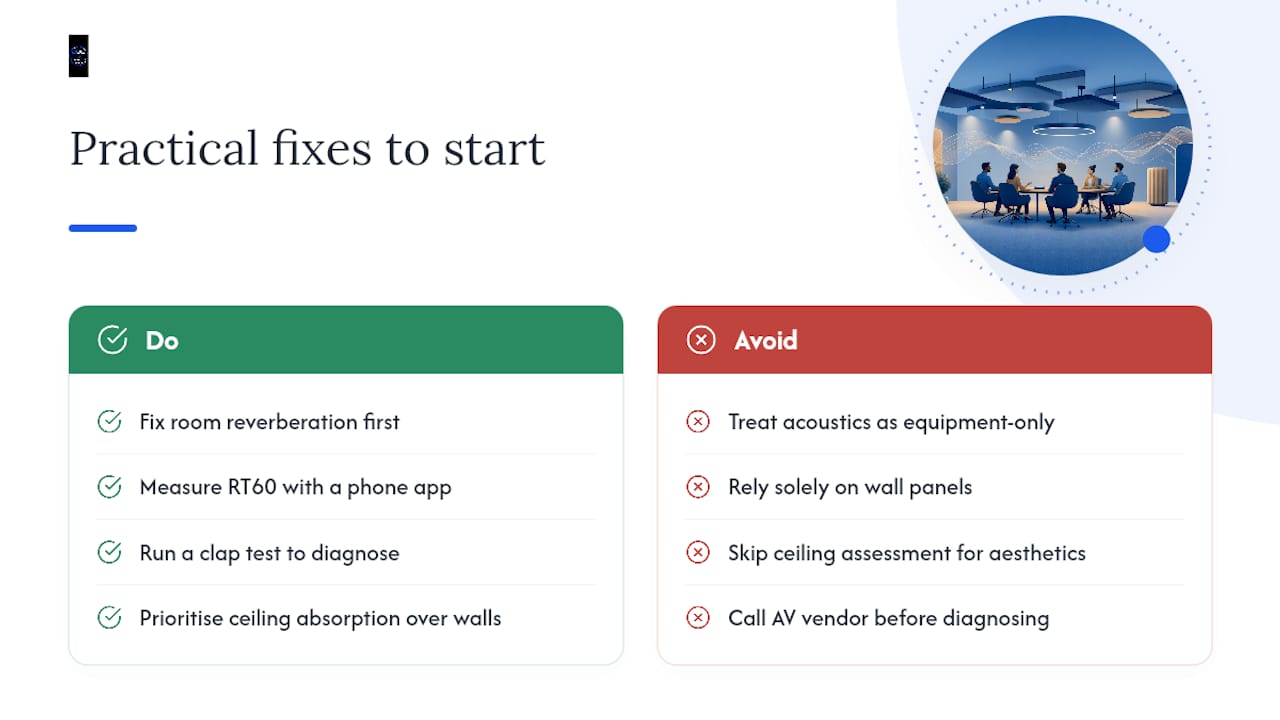
The conventional wisdom oversells wall panels. Walls matter for flutter echo and bass control, but the ceiling is doing most of the absorption work in a typical room, and plenty of offices skip it because a suspended ceiling grid full of baffles looks less "finished" than a wall covered in felt tiles. That's a design preference overriding a physics problem.
If you manage a meeting room and only do one thing this quarter, measure RT60 with a phone app and run the clap test before you touch anything else. You'll know within five minutes whether you're dealing with a ceiling problem, an HVAC problem, or a door seal problem, and that changes who you call next.
— Dylan