
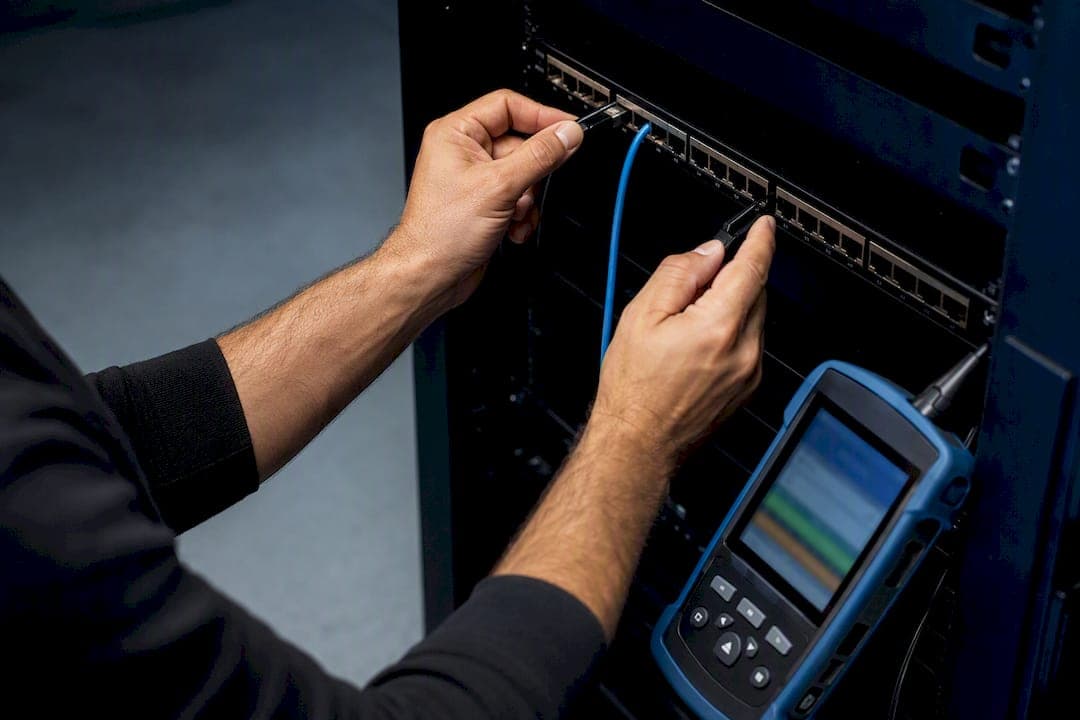
Cabling testing certification proves an installed link meets the required TIA or ISO/IEC standard, and it comes down to one action: run the job on a lab-verified, calibrated certifier and hand the client an organized project report. Skip that step and there is no objective proof the cabling will perform, no leverage if a manufacturer warranty claim comes up, and no defense if a client disputes the work later. A certifier that has not been independently verified cannot promise standards compliance, and a folder of scattered test screenshots is not a deliverable. Test right, save the report, close the job clean.
TL;DR:
- Using a properly calibrated, independent certifier is essential for objective proof of cabling compliance and successful warranty claims.
- Copper certification involves tests like attenuation, NEXT, FEXT, return loss, and length, with stricter limits for permanent links than channels.
- Fiber certification requires loss, length, and polarity tests, with Tier 2 OTDR tracing necessary for long backbone or complex runs.
- Proper cable preparation, including cleaning connectors and following category-specific procedures, is crucial to passing tests and preventing rework.
- Certified reports must be organized, matched to project labels, and include calibration certificates to satisfy legal, warranty, and quality standards.
Table of Contents
- What Copper Certification Actually Measures
- Certifying Fiber: Loss Budgets, Tiers, and OTDR Basics
- Standards, Certifier Levels, and What to Buy
- The Certification Process, Step by Step
- Fast Fixes for the Failures You'll See Most
- Certification as a Deliverable, Not Just a Test
- Reading the Numbers: When "Pass" Isn't the Whole Story
- Copper vs. Fiber: More Than Just Different Tests
- Why Cable Prep Decides the Test Result Before You Plug In
- How the Process Changes by Cable Category and Fiber Type
- Why Trained Technicians, Not Just Good Tools, Determine the Result
- Field Perspective: Why Discipline Beats Talent Here
- Get Certified Cabling Done Right the First Time
- Sources
- FAQ
What Copper Certification Actually Measures
A copper link either meets its category's limits or it fails, and the certifier decides that by running six core electrical tests against a published standard. Attenuation measures signal loss across the link. NEXT (near-end crosstalk) and PSNEXT (power sum NEXT) catch interference between pairs at the near end; FEXT and its power-sum cousin ELFEXT catch it at the far end. Return loss flags impedance mismatches from bad terminations or damaged jumpers, and length confirms the run falls inside the standard's maximum.
Those limits shift depending on what you are testing: a permanent link (wall plate to patch panel, no patch cords) has tighter tolerances than a full channel (which includes patch cords on both ends), because every connector adds loss. The channel maximum for copper Ethernet is 100 meters, or 328 feet, a number every installer should know cold.
That 100-meter figure has an asterisk worth flagging in a callout:
Cat6 running 10GBASE-T typically maxes out around 55 meters, not 100, because of alien crosstalk between bundled cables. Cat6A closes that gap and holds the full 100-meter channel at 10 Gbps.
Practical notes for the field:
- Shielded cable (F/UTP or S/FTP) reduces alien crosstalk and helps in dense bundles or near EMI sources, but it demands grounded connectors at both ends, or you introduce noise instead of blocking it.
- Most copper failures trace back to three causes: bad terminations (untwisted pairs at the jack), pair-management errors (crossed or split pairs), and marginal patch cords that pass a quick continuity check but fail return loss under load.
- When a channel test fails, isolate the permanent link first. A clean permanent link with a failing channel almost always points to the patch cords.
Certifying Fiber: Loss Budgets, Tiers, and OTDR Basics
Fiber certification splits into two tiers, and knowing which one your contract requires saves hours. Tier 1 testing verifies loss, length, and polarity with an optical loss test set and light source, and it satisfies most commercial structured cabling contracts on its own. Tier 2 adds an OTDR (optical time-domain reflectometer) trace that maps the fiber's loss event by event, which is what you need for long backbone runs, underground plant, or any job where the spec explicitly demands it.
Loss budgets vary by standard and media type, and getting them wrong is how a link passes the tester but fails the application:
- 10GBASE-SR on OM3 multimode typically supports around 300 meters.
- 10GBASE-LR on singlemode fiber reaches roughly 10 kilometers.
- 100GBASE-SR4 on OM4 tops out closer to 100 meters, a much tighter budget than the 10G equivalents.
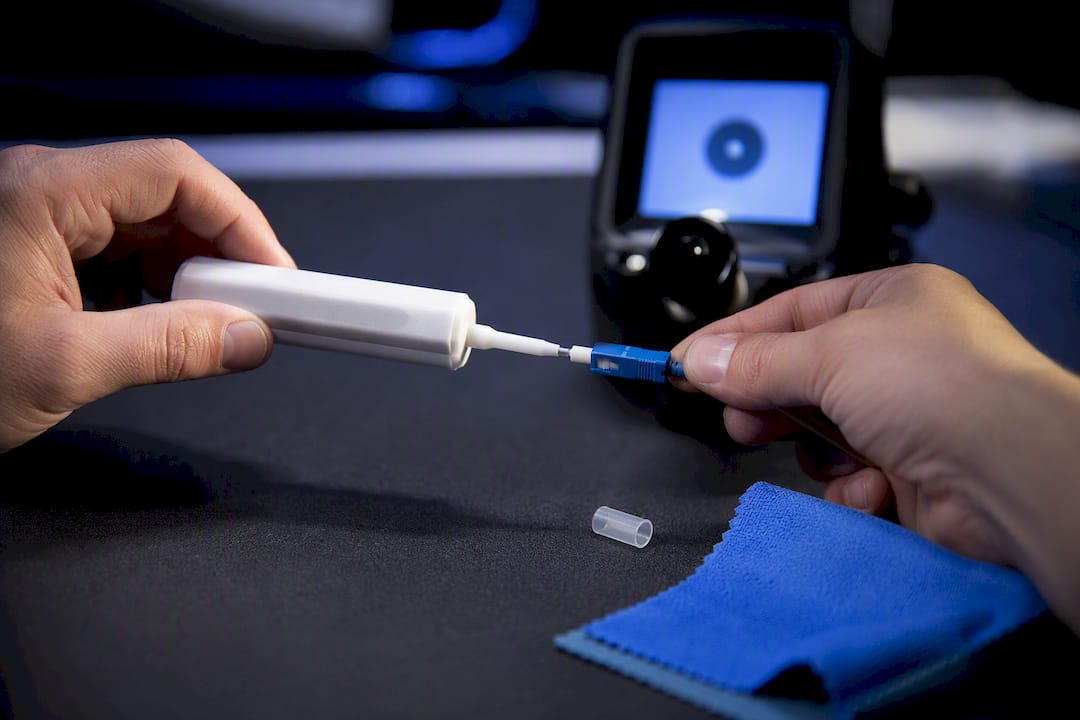
An OTDR trace shows loss as a slope, with sharp spikes marking connectors, splices, or bends. A gradual, even slope with no unexpected spikes means clean fiber; a sudden spike mid-run usually means a bad splice or a kink, and that is your cue to call a splicing team rather than keep re-terminating ends. Before any test, inspect and clean every connector end-face with a proper fiber-cleaning tool. A speck of dust on a connector face causes more false failures than any other single factor in fiber testing, and it costs nothing to check first.
Standards, Certifier Levels, and What to Buy
Three standards families govern how you test and what "pass" means. The TIA-568 series (ANSI/TIA) sets copper and fiber cabling requirements for North America. ISO/IEC 11801 is the international equivalent, used across most of the rest of the world including Australia's adapted frameworks. IEC references cover connector and component specifications that both regional standards lean on. Know which one your contract cites, because pass/fail limits are not identical across them.
Certifier hardware gets ranked by performance level, roughly ANSI/TIA Level II, III, and IIIe, with ISO/IEC using a comparable tier system. The level determines the highest cable category the device can accurately certify, and this is not marketing language. A tester only earns the "certifier" label after an independent lab verifies its measurement accuracy against the standard. A field tester without that verification can still show you numbers, but it cannot prove standards compliance, and TREND Networks draws the same distinction between simple verification, qualification, and true certification tools when installers pick equipment for a job.
When you are buying or renting a certifier, check for:
- Frequency range that covers the highest category you install (Cat6A needs 500 MHz coverage at minimum).
- Fiber Tier 1 and Tier 2 support, either built in or via an OTDR module.
- Exportable, editable reports in a format like LinkWare or J-Reporter.
- Remote unit compatibility so one technician can test both ends alone.
Pro Tip: Keep your calibration certificate with the job file, not just in a drawer back at the shop. Manufacturers increasingly ask for proof of calibrated equipment before they will honor an extended warranty claim, and a missing certificate can sink an otherwise clean job.
Calibrate certifiers on the manufacturer's recommended schedule, typically annually, and never let that lapse on an active project.
The Certification Process, Step by Step
A certification job that runs smoothly follows the same sequence every time, starting before anyone plugs in a tester.
- Plan the scope. Confirm cable category, labeling scheme, and which test limits apply (standard TIA/ISO limits, or a stricter manufacturer or project-specific limit).
- Visual inspection. Check terminations, bend radius, and labeling before powering anything on.
- Continuity check. Catch open pairs, shorts, and split pairs early with a quick wire-map test.
- Permanent link or channel test. Run the copper certifier against the correct configuration for the contract.
- Fiber Tier 1, and Tier 2 if specified. Test loss, length, and polarity, adding an OTDR trace where the spec requires it.
- Compile and archive the report. Export a per-link PDF, name files by drop location, and store calibration certificates alongside the results.
A few habits keep this from turning into rework:
- Set test limits before you start, not after a failure forces the question.
- Use manufacturer-specific limits when a warranty program requires them; they are often tighter than the base standard.
- File reports by project, not by date, so a client dispute months later takes minutes to resolve instead of hours.
Fast Fixes for the Failures You'll See Most
Most retest calls trace back to a handful of repeat offenders, and knowing the shortcut saves a truck roll.
- On copper, swap the patch cord first. A marginal cord fails return loss more often than the permanent link does, and it is the cheapest thing to rule out.
- Untwisted pairs at the jack cause the majority of NEXT failures. Re-terminate and retest before assuming a cable fault.
- On fiber, clean and re-inspect the end-face before touching anything else, then test from both directions to isolate which end is bad.
- Bundle density and proximity to EMI sources (fluorescent ballasts, motors, power conduit) degrade copper performance even on a technically correct install.
Pro Tip: Testing from both ends and swapping the patch cord isolates most intermittent failures without ever pulling out an OTDR. Save the OTDR for backbone runs and buried plant where you genuinely need the event map.
Escalate to a full OTDR trace or a splicing specialist only when a Tier 1 fiber test fails and cleaning/reseating does not fix it. That combination usually means a bad splice or damaged fiber mid-run, not a connector problem.
Certification as a Deliverable, Not Just a Test
A certification report is a legal and insurance document as much as a technical one. Manufacturers frequently require an organized report paired with a current calibration certificate before they will honor an extended warranty, and a disorganized set of screenshots will not satisfy that requirement. Structured LinkWare or J-Reporter exports, filed by project and cross-referenced to drop labels, are what separates a defensible deliverable from a folder nobody can use.
Installer credentials matter here too. BICSI's progressive certification tracks, covering Installer 1, Installer 2 Copper, Installer 2 Optical Fiber, and Technician levels, give clients and general contractors a way to verify that the person holding the certifier actually knows how to terminate and troubleshoot the cabling they are testing.
A short checklist worth adopting on every job:
- Verify certifier calibration before the first test of the day.
- Match test limits to the contract before starting, not after.
- Export per-link reports the same day, while faults are still fresh in memory.
- Archive calibration certificates with the project file, every time.
Djcengineering's accredited installers apply this same discipline on residential, commercial, and rural jobs across South East Queensland, which is a direct factor in the 98% first-visit fix rate the business tracks on structured cabling work.
Reading the Numbers: When "Pass" Isn't the Whole Story
A single pass/fail flag on a certifier screen hides a lot of useful information, and reading the margins matters as much as reading the result. A link that passes attenuation by 0.3 dB is not the same as one that passes by 8 dB, even though both show green. The first is a link that will likely fail as connectors age, cables get flexed during renovations, or ambient temperature climbs in a roof space. The second has real headroom.
Look at trends across a project, not just individual results. If every permanent link on a floor passes NEXT with a comfortable margin except three drops that all barely scrape by, that is not three unlucky cables. It is a pattern, usually pointing to a bad batch of jacks, a technician who was terminating pairs inconsistently that day, or a run of cable that got bundled too close to lighting ballasts. Certification software that exports to LinkWare or J-Reporter lets you sort by margin and length across an entire job, which turns a stack of individual pass/fail sheets into a diagnostic tool.
Return loss deserves particular attention because it is the most sensitive indicator of poor termination quality, and it is also the parameter installers most often ignore when a link technically passes. A worst-case margin analysis, checking how close every tested parameter came to its limit across the whole project, catches marginal work before a client ever notices a slow connection. Treat a barely-passing result as a flag for rework, not a win, especially on any link feeding a server room or a point where a future speed upgrade is likely.
Copper vs. Fiber: More Than Just Different Tests
The testing differs between copper and fiber, but so does everything that happens before the tester ever gets connected, and installers who treat both media identically end up with avoidable failures.
Bend radius is the clearest example. Copper cable tolerates a bend radius of roughly four times its outside diameter without meaningful performance loss. Fiber is far less forgiving: exceed the manufacturer's minimum bend radius, often around 10 times the cable's diameter for tight-buffered fiber, and you introduce microbending loss that will not always show up as a hard failure but will degrade the link's margin permanently. That loss frequently will not appear until a Tier 2 OTDR trace, long after the drywall is closed up.
Connector types add another layer of difference. Copper certification cares about jack quality and termination method (110-style punch-down versus tool-free connectors), but the connector itself does not usually introduce loss variables the way fiber connectors do. Fiber certification has to account for connector type directly: LC, SC, and ST connectors each have different insertion loss characteristics, and mixing connector types across a link (an LC patch cord into an SC bulkhead via an adapter) adds loss that a Tier 1 test will catch but a rushed continuity check will not.
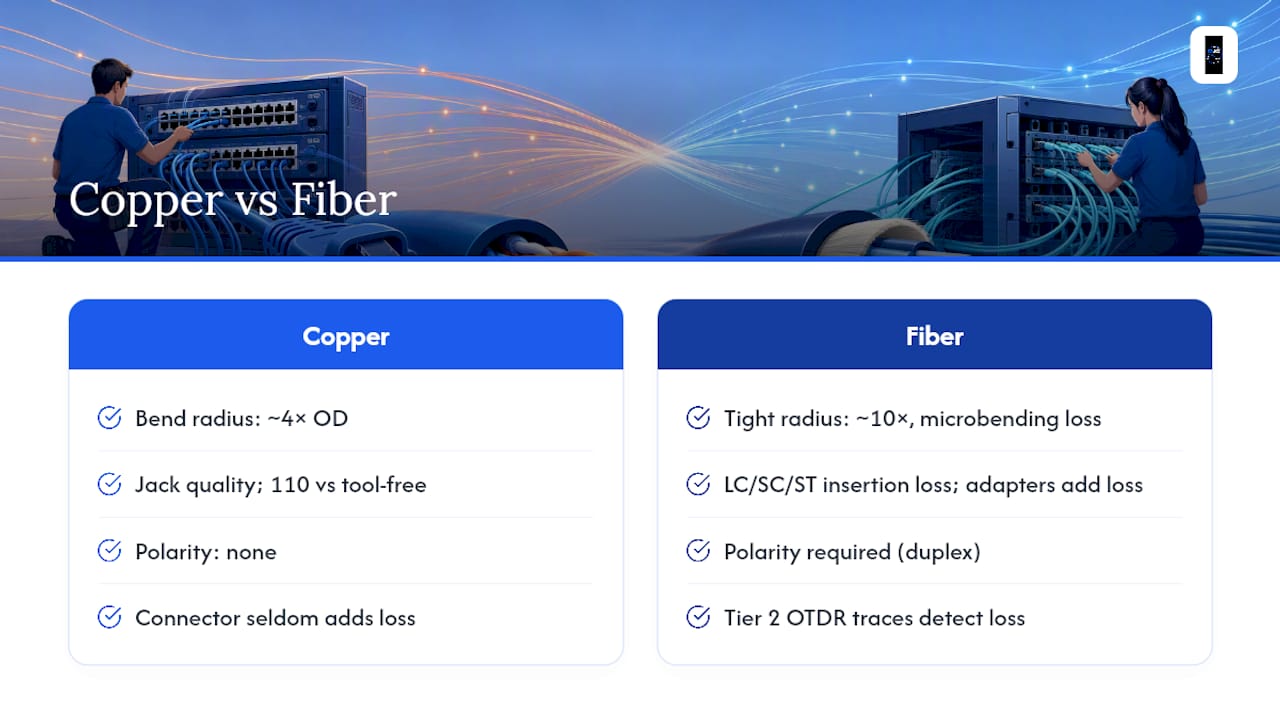
Polarity is a fiber-only concern with no copper equivalent. Multimode duplex fiber has to maintain correct transmit/receive polarity across every patch panel and adapter in the link, and a polarity error will not show up as a loss failure. It shows up as a dead link that tests "fine" on loss alone, which is why Tier 1 fiber testing always includes a dedicated polarity check.
Why Cable Prep Decides the Test Result Before You Plug In
The certifier does not create most failures. Poor cable preparation does, and the test just reveals it. Untwisting copper pairs more than the standard allows during termination, typically no more than 13 millimeters (half an inch) for Cat6A, introduces crosstalk that no amount of retesting will fix without redoing the termination.
Jacket stripping length matters more than most technicians assume. Strip too much jacket off a shielded cable and you expose unshielded pair beyond the connector's drain wire contact point, which defeats the shielding entirely and shows up as a NEXT or alien crosstalk failure that looks like a bad cable run when it is actually a two-minute prep error.
Fiber preparation is even less forgiving. A cleave angle even slightly off, or a connector polished with the wrong technique, adds insertion loss that stacks up across a multi-connector channel. An end-face that looks clean to the eye but carries microscopic contamination will pass a casual glance and fail a certifier's loss test, which is exactly why inspection scopes and one-click cleaners have become standard kit rather than optional extras.
The pattern across both media is the same: five extra minutes of careful prep on the front end saves an hour of troubleshooting on the back end, and it is the single most controllable variable in whether a link passes on the first test.
How the Process Changes by Cable Category and Fiber Type
Certification is not one procedure applied uniformly. It shifts depending on the category or fiber type on the job, and treating a Cat5e drop the same as a Cat6A drop wastes time in one direction or risks a bad result in the other.
Cat5e certification is the simplest case: verify wire map, length, and the core electrical parameters against the Cat5e limits, and most field certifiers handle it without breaking a sweat. Margins tend to be generous at Cat5e's lower frequency range, so borderline failures are rarer.
Cat6 tightens the limits considerably and introduces alien crosstalk as a real concern in bundled runs, particularly at the 10GBASE-T ceiling discussed earlier. Testing takes longer because the certifier is checking against a much narrower margin.
Cat6A demands the certifier support a higher frequency range (500 MHz), and shielded Cat6A installations add a grounding continuity check that unshielded categories skip entirely. Skipping that check on shielded cable is one of the more common oversights on commercial jobs.
OM3 and OM4 multimode fiber testing differs mainly in loss budget expectations. OM4's tighter modal bandwidth supports higher speeds over the same or longer distances than OM3, so a link that would pass comfortably on OM3 limits might need re-checking against OM4's specification if the application calls for 40G or 100G. Singlemode adds its own consideration: longer typical runs mean loss accumulates differently, and Tier 2 OTDR testing becomes far more common on singlemode backbone runs than on short multimode horizontal cabling.
Why Trained Technicians, Not Just Good Tools, Determine the Result
A Level III certifier in untrained hands produces bad data just as easily as a Level II certifier in skilled ones, maybe more easily, because a skilled technician recognizes when a result looks wrong before it goes into the client's report.
Training teaches the parts a spec sheet cannot: how to set realistic test limits before a project starts, how to recognize a marginal pass that will not survive a building's first summer, and how to choose between a permanent link and channel configuration correctly for the contract in front of them. BICSI's certification tracks exist specifically to standardize that judgment across installers, moving competence out of tribal knowledge and into a credential a general contractor or facilities manager can actually verify.
There is a liability dimension too. A certification report with a technician's name and credential attached carries more weight in a warranty dispute or insurance claim than an anonymous export file. Clients increasingly ask for proof of installer training before signing off on commercial jobs, and citing a completed BICSI credential on a proposal is a documented way to answer that question before it gets asked.
The tool matters. The person running it matters more.
Field Perspective: Why Discipline Beats Talent Here
Certification failures rarely come from bad luck. They come from skipped steps: a calibration date nobody checked, a test limit nobody set before starting, a report nobody archived. Fix the discipline and the callbacks mostly disappear on their own.
— Dylan
Get Certified Cabling Done Right the First Time
Structured cabling jobs are typically run using calibrated certifiers, standards-matched test limits, and a full LinkWare-style report delivered at completion to support warranties and accountability.

When you hire Djcengineering for structured cabling and network installation, you get accredited, licensed technicians on site, a documented test result for every link, and a completion report you can hand straight to an insurer, an auditor, or a future tenant. If you are planning a new build, an office fit-out, or a rural property upgrade and want the cabling done to a standard that holds up to scrutiny, request a quote or site survey and get a scoped proposal before work starts.
Sources
- Category 6 cable — Wikipedia
- Cabling certification — Fluke Networks
- Cable installer certification | BICSI
- Optical link standards and distances — University knowledge base
- Maximum run length for reliable Ethernet cabling — Stanford Optics (blog)
FAQ
How Do I Certify Cat6 Cable?
Run a Level II or higher certifier against the TIA Cat6 limits for wire map, length, attenuation, and crosstalk, and remember that 10GBASE-T on Cat6 typically caps out around 55 meters rather than the full 100-meter channel.
What Cabling Standards Apply Outside North America?
Most regions outside North America reference ISO/IEC 11801 alongside local adaptations, while TIA-568 governs the North American market. Confirm which standard your contract cites before setting test limits, since pass/fail thresholds are not identical between them.
What IEC Standards Cover Cable Testing?
IEC standards define component and connector specifications that both TIA and ISO/IEC cabling standards reference, particularly around cabling components and measurement methods rather than acting as a standalone testing framework.
Why Are Cable Certifiers So Expensive?
Certifiers cost more than basic testers because they carry independent lab verification of measurement accuracy, higher frequency ranges for advanced categories, and fiber Tier 1/Tier 2 support, features a simple continuity tester cannot match.
Does Djcengineering Provide Certification Reports?
Yes. Djcengineering delivers organized, per-link certification reports on structured cabling installs across South East Queensland, backed by its accredited installation process and documented 98% first-visit fix rate.