
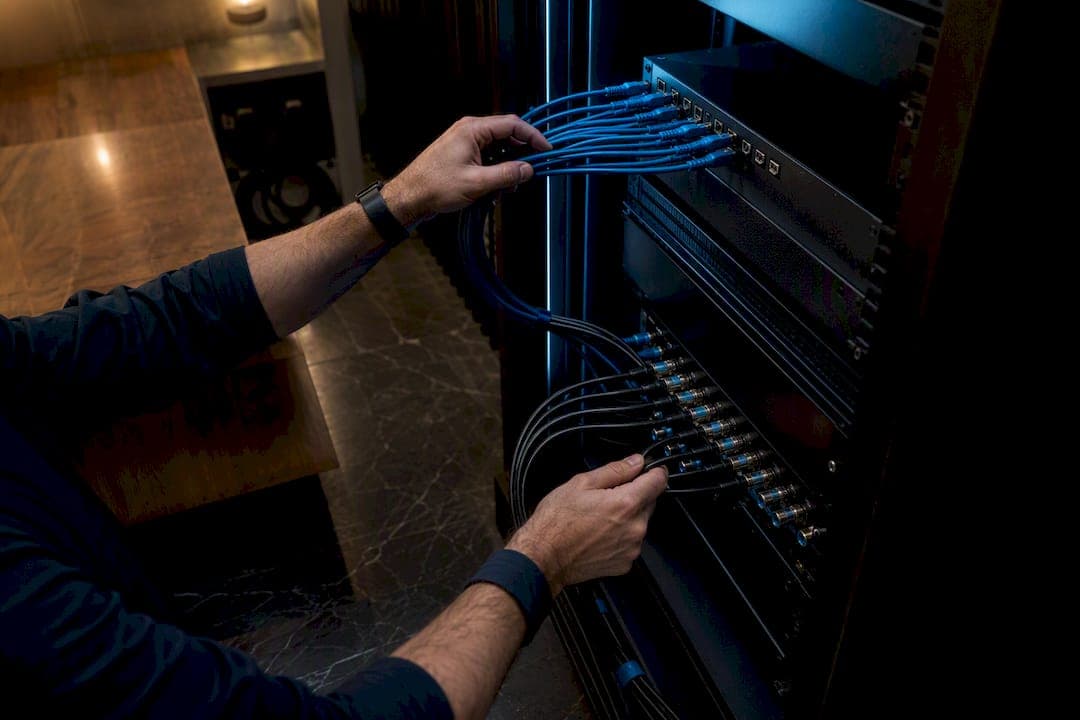
For a single room or small fixed matrix, HDBaseT still wins on latency and setup simplicity. Once you're routing video across multiple rooms, floors, or a campus, HDMI over IP takes over on scalability.
TL;DR:
- HDBaseT is ideal for small, fixed setups with fewer than 16 endpoints, offering low latency, simplicity, and minimal network complexity.
- HDMI over IP scales better for larger, multi-building systems but requires proper network configuration, IGMP snooping, and higher switch capacity for reliable performance.
- Uncompressed SDVoE over 10GbE matches HDBaseT latency but demands more expensive infrastructure, making it suitable for control rooms and critical applications.
- Hybrid systems that localize AV over HDBaseT and distribute over AVoIP provide flexible growth options and reduce the need for future hardware replacements.
- Correct cabling, switch configuration, and early planning are crucial to avoid common failures such as multicast issues and bandwidth limitations, especially in large or expanding deployments.
Table of Contents
- HDMI Over IP vs HDBaseT: The Core Architectural Difference
- How Do Latency, Bandwidth, and Distance Actually Compare?
- When Should You Choose HDBaseT, HDMI Over IP, or a Hybrid?
- How Do You Design a Hybrid HDBaseT and AVoIP System?
- Cabling and Network Setup That Actually Holds Up
- The Decision Checklist for Your Next AV Project
- What Twelve Years of Callbacks Taught Us About This Decision
- Get Your AV Network Designed and Installed Right the First Time
- Sources
- FAQ
HDMI Over IP vs HDBaseT: The Core Architectural Difference
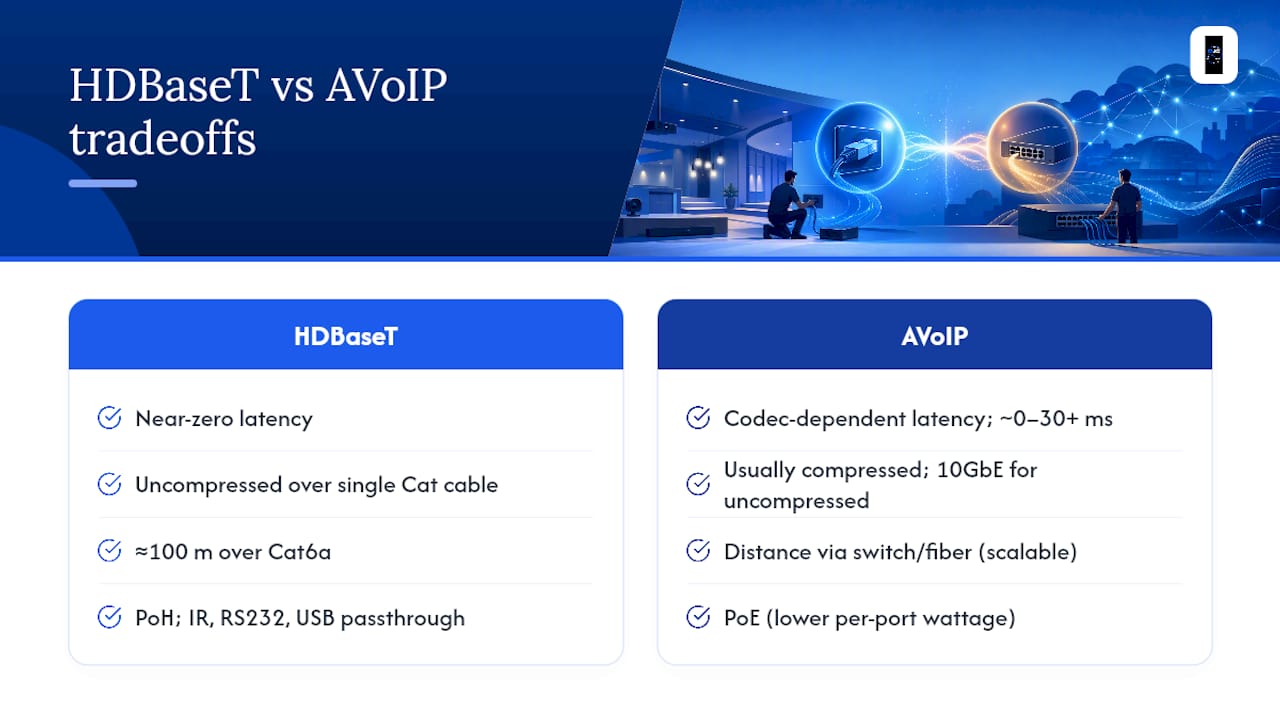
HDBaseT is a dedicated, point-to-point transport. One Cat6a cable runs from a transmitter to a receiver, carrying video, audio, Ethernet, control, and power over what the standard calls 5Play, and nothing else touches that link. HDMI over IP, often called AV over IP or AVoIP, works differently: encoders and decoders sit on a managed network switch, and video moves as packetized traffic alongside (or on a VLAN separate from) your regular data.
That structural difference drives almost every trade-off in this comparison.
- HDBaseT: fixed topology, plug-and-play, minimal configuration, distance capped near 100 meters per run.
- HDMI over IP: routed topology, scales by adding switch ports, distance limited mainly by your network backbone and fiber runs, not the display standard itself.
- Terminology trap: not every product labeled "HDMI over Ethernet" is true AV over IP. Some are dedicated extenders using Cat cable without ever touching a routed network switch, so always confirm topology before wiring it into a live IT network.
The practical implication for integrators: HDBaseT reduces project risk on small, self-contained rooms because there's less to misconfigure. AVoIP reduces long-term risk on large or growing systems because you're not locked into a fixed matrix size.
How Do Latency, Bandwidth, and Distance Actually Compare?
Latency is where the two technologies diverge most sharply. HDBaseT 3.0 delivers uncompressed or visually lossless video with near-zero latency, which is why it remains the default for live camera feeds, KVM switching, and control rooms where a frame of delay is noticeable. HDMI over IP latency depends entirely on codec choice. SDVoE-class uncompressed transport over 10GbE can match HDBaseT's responsiveness, but it demands a higher-capacity backbone and more expensive endpoints. JPEG2000 compression typically adds 16 to 30 milliseconds, tolerable for most conferencing and signage. H.264 or H.265 encoding pushes latency higher still, which rules those codecs out for anything interactive.
Bandwidth tells a similar story. A single 4K/60 4:4:4 HDR signal at native bit depth vastly exceeds what a 1GbE link can carry, which is why most HDMI-over-IP deployments compress the signal before it ever hits the switch. Push for uncompressed or near-lossless AVoIP and you need 10GbE switching, not the 1GbE gear most IT departments already have racked.
Distance limits split cleanly too. HDBaseT tops out around 100 meters over Cat6a before you need repeaters or fiber extenders. AVoIP isn't bound by that number at all; distance becomes a function of your switch fabric and fiber uplinks, which is exactly why campus and multi-building deployments favor it.
Power and control passthrough differ as well. HDBaseT's Power over HDBaseT (PoH) commonly delivers enough power to run a display or receiver off the same cable carrying video, alongside native IR, RS232, and USB support. AVoIP endpoints rely on standard PoE from the switch, which is convenient for rack-mounted infrastructure but caps out at lower wattage per port than PoH in some configurations, so check your PoE budget before assuming every decoder can run unpowered locally.
When Should You Choose HDBaseT, HDMI Over IP, or a Hybrid?
Endpoint count is the fastest way to make this call. Several engineering comparisons put the cost crossover where AV over IP starts beating HDBaseT on a per-endpoint basis somewhere between 16 and 32 endpoints, depending on switch pricing and encoder/decoder cost. Below that range, a fixed matrix chassis is usually cheaper and simpler to commission.
- Huddle rooms and single boardrooms (1 to 4 displays, one source): HDBaseT. Low endpoint count, minimal IT involvement, and near-zero latency for wireless presentation or video calls.
- Digital signage across a retail chain or building lobby network: HDMI over IP. You're adding endpoints over time, and a routed network scales without swapping out a matrix.
- University campus or multi-building corporate site: HDMI over IP, almost without exception. Distance and endpoint count both exceed what HDBaseT handles cleanly.
- Control rooms and command centers: HDBaseT or uncompressed SDVoE-class AVoIP. Latency tolerance is near zero, so cut-rate compressed AVoIP is the wrong call here.
- Growing mid-size facility (5 to 15 rooms today, more expected): hybrid. Start with HDBaseT locally, plan the network backbone for AVoIP expansion.
Hidden costs catch a lot of integrators off guard. A matrix chassis has a fixed price regardless of how many ports you actually use, while AVoIP's per-port cost scales with your switch's backplane capacity and licensing. IT labor for VLAN configuration and multicast tuning is real, billable time that a straight HDBaseT job never requires.
How Do You Design a Hybrid HDBaseT and AVoIP System?
The pattern that holds up best in the field: treat each room as a local HDBaseT island, then trunk rooms together over an AVoIP backbone when content needs to move between spaces or reach a central switch room. A boardroom keeps its dedicated HDBaseT run to the display for zero-latency local switching, while an encoder on that same source feeds the building's AV-over-IP network for distribution to overflow rooms or recording.
- Partition by function, not by budget: local presentation stays HDBaseT, cross-room and campus-wide distribution moves to AVoIP.
- Phase the AVoIP backbone in before you need it. Retrofitting fiber and switch capacity after a building is finished costs far more than designing headroom on day one.
- Choose encoder/decoder models with an HDMI loop-out or local HDBaseT output, so a single source can feed the room directly while simultaneously feeding the network, avoiding a second cable run when you expand later.
Pro Tip: Before running a single cable, ask the client how many rooms they expect to add within three years. That answer determines whether you oversize the switch backbone now or eat the cost of a rip-and-replace later.
Cabling and Network Setup That Actually Holds Up
Cable choice makes or breaks both architectures long before anyone blames the electronics. Specify solid copper Cat6a, not copper-clad aluminum: CCA cable routinely fails under PoE or PoH load and under sustained high-bandwidth 4K transport. Shielded Cat6a earns its cost in any run near fluorescent ballasts, motors, or other EMI sources, and every run should be tested under expected PoH or PoE load before handover, not just checked for continuity.
AVoIP networks add a layer HDBaseT never touches: switch configuration. Multicast traffic needs IGMP snooping with fast-leave enabled, because default enterprise switch timeouts can saturate uplinks the moment a decoder switches sources, causing dropped frames across the whole system. VLAN segmentation to keep AV traffic off the general data network isn't optional at scale, and a dedicated AV fabric is worth the extra switch cost once you're past a dozen or so endpoints.
- Document every run: cable ID, length, PoH/PoE load, and switch port assignment.
- Keep AV and data VLANs separate, even on shared switch hardware.
- Size PoE/PoH budgets against worst-case simultaneous load, not average draw.
Statistic Callout: Multicast misconfiguration, specifically missing IGMP fast-leave settings, is one of the most frequently cited root causes of intermittent AVoIP failures reported in engineering trade-off analyses, ahead of cabling defects or encoder faults.
The Decision Checklist for Your Next AV Project
Before specifying either architecture, run through this:
- Fewer than roughly 16 endpoints, all in one building, low IT involvement wanted? Lean HDBaseT.
- More than 20 to 30 endpoints, multiple buildings, or growth expected over years? Lean HDMI over IP.
- Latency-critical application (KVM, live camera switching, control room)? HDBaseT or uncompressed SDVoE, never compressed AVoIP.
- Budget for ongoing IT labor and switch licensing? Only commit to AVoIP if that line item is funded.
The single-sentence version: match the architecture to your endpoint count and latency tolerance first, then build in hybrid flexibility wherever the project might grow.
What Twelve Years of Callbacks Taught Us About This Decision
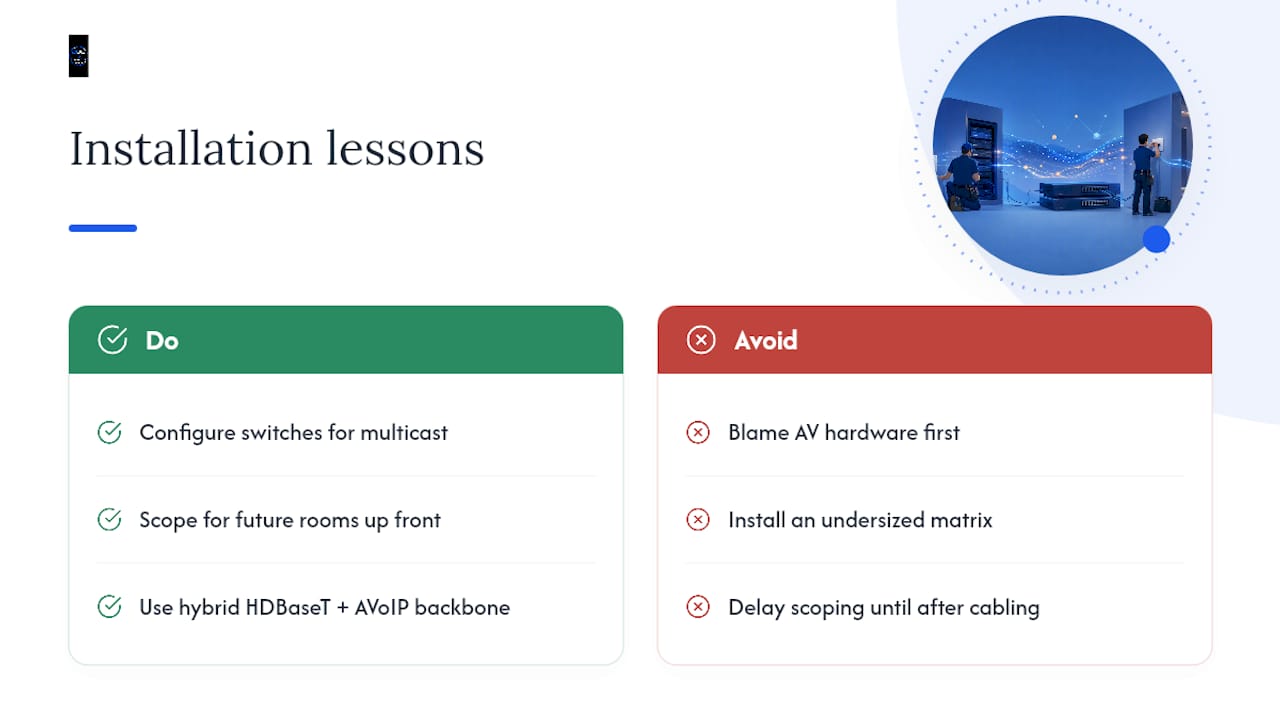
The failures we get called back for almost never come from the AV hardware itself. They come from a network switch that wasn't configured for multicast, or a matrix that got outgrown within eighteen months of install. Hybrid designs, HDBaseT locally and AVoIP for backbone distribution, consistently cut return visits because they don't force a rebuild when a client adds three more rooms next year.
Scoping that correctly on day one, before the first cable goes in, is most of what separates a clean handover from a service call six months later.
— Dylan
Get Your AV Network Designed and Installed Right the First Time
Choosing between HDBaseT and HDMI over IP is only half the job. The other half is a network that's actually built to support it, cabling that survives real PoE load, switches configured for multicast instead of fighting it, and a commissioning process that catches problems before handover instead of after.
A design engagement with us starts with a site survey, covers structured cabling and switch specification for Wi-Fi & mesh systems and network infrastructure and ends with a fully commissioned handover, whether that's a single boardroom or a multi-room facility built around boardroom and commercial AV. If you're planning a networked AV rollout in South East Queensland, get in touch and we'll scope the right architecture for your building before you commit to hardware.
Sources
FAQ
What Are the Disadvantages of HDBaseT?
HDBaseT's main limitation is distance: runs cap near 100 meters over Cat6a before you need repeaters or fiber extenders. It also scales poorly for large systems, since adding endpoints beyond a fixed matrix size often means replacing the entire chassis rather than just adding a switch port.
Is HDMI Over Ethernet Good for AV Distribution?
It depends entirely on what the product actually is. True HDMI over IP on a properly configured network with IGMP fast-leave and adequate bandwidth performs well for signage, conferencing, and multi-room distribution, but some "HDMI over Ethernet" products are point-to-point extenders rather than routed AV-over-IP systems, so check the topology before assuming scalability.
What Is HDBaseT HDMI Extension?
HDBaseT HDMI extension sends video, audio, Ethernet, control, and power over a single Cat6a cable from a transmitter to a receiver, a feature set the standard calls 5Play. HDBaseT 3.0 supports uncompressed or visually lossless video up to roughly 100 meters with near-zero latency.
Which HDMI Version Matters Most for These Systems?
The HDMI version at the source and display determines maximum resolution, refresh rate, and HDR support, but it's largely independent of whether you extend that signal over HDBaseT or HDMI over IP. What matters more for the extension technology itself is whether your chosen encoder or decoder, or HDBaseT chipset, actually supports the full bandwidth of that HDMI signal without forcing compression you didn't plan for.
Does Djcengineering Install Both HDBaseT and AVoIP Systems?
Yes. Djcengineering designs and installs both architectures, along with the structured cabling and network switch configuration each requires, as part of its audio-visual and networking services. Pricing depends on scope, so current project quotes are available directly through the site.