
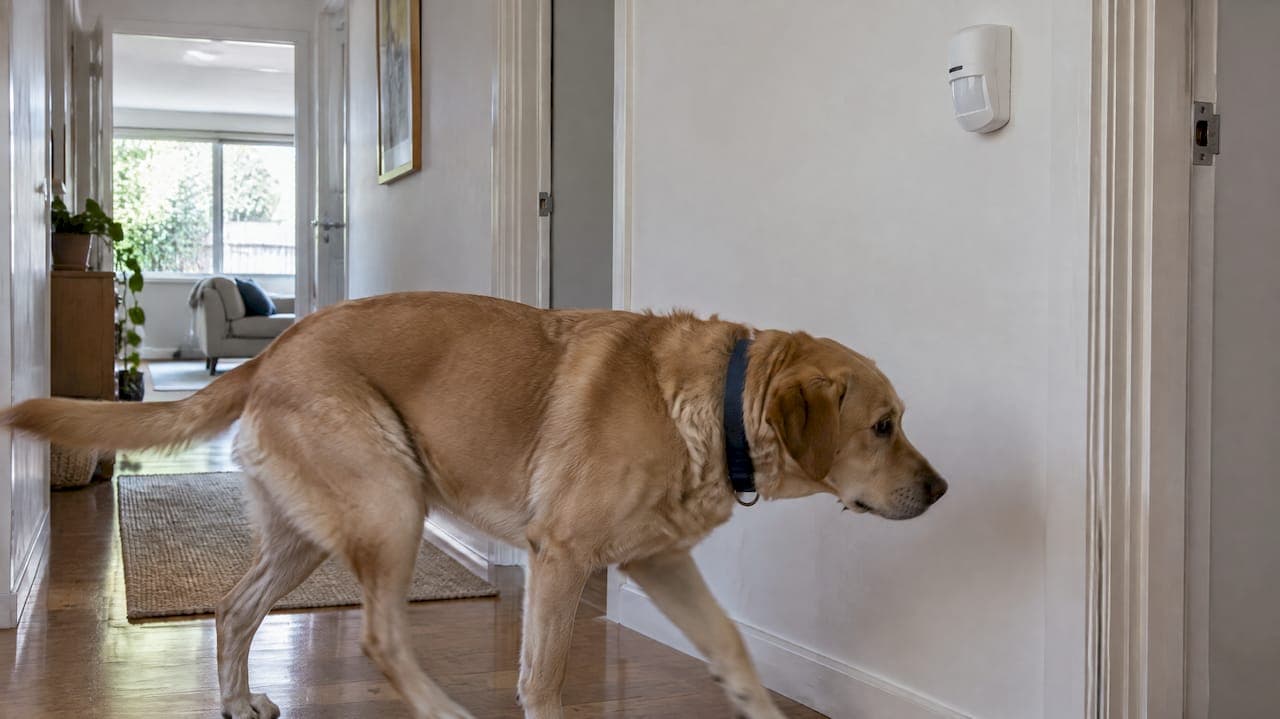
Yes, pet immune motion sensors exist and work by combining PIR optics with signal processing to ignore most pets under a stated weight threshold, commonly 18 to 40 kilograms. Your best results come from choosing a certified pet immune sensor and getting the placement right, either on your own or through a professional site survey and walk test.
TL;DR:
- Manufacturers commonly rate pet immunity from 18 to 40 kilograms, but edge zones, stairs, and elevated surfaces can trigger alarms below that limit.
- Mount the sensor center about 7.5 feet above the floor, keep pets roughly 6 feet away, and avoid vents, heaters, fish tanks, curtains, and fans.
- Make small sensitivity changes and retest after each adjustment, then test your pet’s normal routes at different angles and during its busiest time.
- Choose a sensor with a published weight threshold, adjustable sensitivity, and alarm panel compatibility; large or multiple pets may need professional commissioning.
Table of Contents
- How pet friendly motion sensors work
- Typical pet immunity thresholds and what they mean for your pet
- Placement and installation best practices to reduce false alarms
- Sensor settings and system level tuning to stop remaining false alarms
- How to choose a pet friendly motion sensor: a features checklist
- Why professional installation improves pet immunity
- Installer perspective: quick answers to common homeowner questions
- How we help: site surveys, sensor selection, and commissioning
- FAQ
- Sources
How pet friendly motion sensors work
Pet immune sensors rely on passive infrared, or PIR, detection: a sensor reads changes in infrared heat within its view and a Fresnel lens splits that view into multiple narrow optical zones. Each zone acts like a trip wire, and a body moving across several zones in sequence signals human motion rather than a small, low heat source passing through only a small number of zones.

Pet immunity is not a single trick; it is a system level optimization between the lens and the electronics that process its signal. A better lens design creates a wider margin between what counts as a small animal and what counts as a person. That margin lets manufacturers dial sensitivity down without losing range on actual intruders, which is the real mechanism behind "pet friendly" claims. It also explains why two sensors with the same marketing language can behave very differently in your home.
Typical pet immunity thresholds and what they mean for your pet
Manufacturers rate pet immunity by weight, and most residential sensors cluster in a similar band. Some models push higher: PowerG style detectors advertise immunity up to roughly 85 pounds on certain product lines, while DSC's MX974 is built to ignore pets as heavy as 40 kilograms, or about 88 pounds.
A threshold is a lab rating, not a guarantee in every corner of your living room. Pets near the edge of the sensor's field of view, on a windowsill, or climbing stairs can still trigger an alarm even under the stated weight limit, since detection sensitivity is not perfectly uniform across the whole cone of coverage.
Before buying, run through a quick check:
- Watch where your pet actually spends time, including furniture, stairs, and window ledges.
- Weigh your pet, or get a solid estimate, rather than guessing.
- Compare that number against the sensor's documented threshold, not just its "pet friendly" label.
Placement and installation best practices to reduce false alarms
Where you mount a sensor matters as much as which one you buy. Manufacturer and installer guidance points to a consistent set of rules that cut false alarms without sacrificing coverage of actual entry points.
- Mount the sensor with its center at about 7.5 feet from the floor, favoring a corner with a clear view of doors and hallways.
- Keep the detector away from your pet's regular paths, and use furniture placement or simple barriers to stop pets from getting within roughly 6 feet of the unit.
- Avoid aiming the sensor at heat sources like vents, heaters, or fish tanks, and keep curtains and fans out of its direct line of sight, since moving warm air and fabric can both register as motion.
After mounting, walk through the covered area the way an intruder would, then let your pet move through its normal routine, to confirm the sensor reacts the way you expect before you rely on it.
Pro Tip: Test at the time of day your pet is most active, since lighting and heat levels shift detection behavior between morning and evening.
Sensor settings and system level tuning to stop remaining false alarms
Most pet immune sensors offer adjustable sensitivity, and many pairs that with motion event counters that only trigger an alarm after a set number of qualifying movements, filtering out a single quick pass by a cat or dog. Firmware on newer units adds algorithms that look for the repeated, small, low level signals typical of pets rather than the steadier signature of a walking adult.
The trouble spots usually sit at the far edges of the field of view, which is why distance by angle testing matters: walking a pet or a test target at different distances and angles reveals exactly where a sensor's optical zones overlap poorly.
- Adjust sensitivity in small steps and retest after each change rather than guessing at a final setting.
- Log where false alarms happen, since a pattern at one angle usually points to a lens or mounting fix, not just a settings tweak.
- Treat firmware updates as part of tuning, since manufacturers sometimes refine detection algorithms after release.
Pro Tip: If false alarms persist after repeated DIY adjustments, that is usually a sign the fix needs a professional recalibration rather than another settings change.
How to choose a pet friendly motion sensor: a features checklist
A sensor marketed as "pet friendly" is only as good as the specs behind that label. Before you buy or brief an installer, check for:
- A documented weight threshold for pet immunity, stated in kilograms or pounds, not a vague claim.
- Adjustable sensitivity so the unit can be tuned to your specific pets and layout.
- Tamper protection to flag attempts to disable or redirect the sensor.
- Compatibility with your existing or planned alarm panel and CCTV system.
- Flexible mounting options and clear battery life or Power over Ethernet specifications.
Households with large or multiple pets should prioritize adjustable settings and professional commissioning over a cheaper, fixed-sensitivity unit. Treat "pet friendly" language without a stated threshold or testing notes as a warning sign, and favor products that publish their specifications openly.
Why professional installation improves pet immunity
A site survey catches what a spec sheet cannot: the exact mounting height for your ceilings, blind spots created by furniture or stairwells, and the specific angles where your pets are likely to trigger a false alarm. A trained installer can trade some optical margin for lower sensitivity at a given spot, something that is hard to judge without walking the space first.
Professional commissioning also means the motion sensor gets integrated properly with your CCTV and alarm panel, then retested after tuning rather than left on default settings. That retest step is where most remaining false alarms actually get solved.
Installer perspective: quick answers to common homeowner questions
Pets that spend time on furniture or windowsills push closer to a sensor's edge zones, so placement matters more than the weight rating alone. Multi-pet homes usually need tighter tuning and sometimes a second sensor to avoid blind spots. A certified pet immune unit with documented specs is worth the extra cost over an unrated "pet friendly" sensor every time. Try placement and sensitivity adjustments yourself first; if false alarms continue, that is the point to schedule a professional site survey.
— Dylan
How we help: site surveys, sensor selection, and commissioning
We design and install security systems tailored to your needs. Our approach starts by understanding your household's needs, then matching the system to them.

What that looks like in practice:
- Sensor selection based on your pets' size and habits, not just a generic "pet friendly" label.
- Mounting and tuning informed by a proper site survey rather than guesswork.
- Integration with your CCTV and alarm system so sensors, cameras, and panels work as one setup.
- A quote so you know what you are paying for before work starts.
If false alarms or blind spots are already a problem in your home, a visit to our security systems page has information about our security services.
FAQ
Are there any burglar alarms that are pet friendly?
Yes, many alarm systems use pet immune motion detectors rated to ignore animals under a stated weight threshold, commonly in the 18 to 40 kilogram range. Pairing a certified sensor with correct mounting height and placement gives the most reliable results.
What are the downsides of using motion sensor lights?
Motion sensor lights can trigger on passing cars, moving branches, or pets near the edge of their detection zone, leading to frequent false activations. Checking placement and keeping the sensor's field of view clear of heat sources and foliage reduces most of these issues.
Which outdoor light has the best motion sensor?
The best outdoor motion sensor for your home depends on your yard's layout, typical foot traffic, and whether pets or wildlife pass through the coverage area regularly. Look for a documented detection range and adjustable sensitivity rather than relying on general marketing claims.
What should I check before choosing a pet camera for my home?
Prioritize a camera with secure authentication, encrypted video storage, and regular firmware updates from the manufacturer. Checking how a model integrates with your existing alarm or CCTV setup also matters as much as the camera's standalone features.