
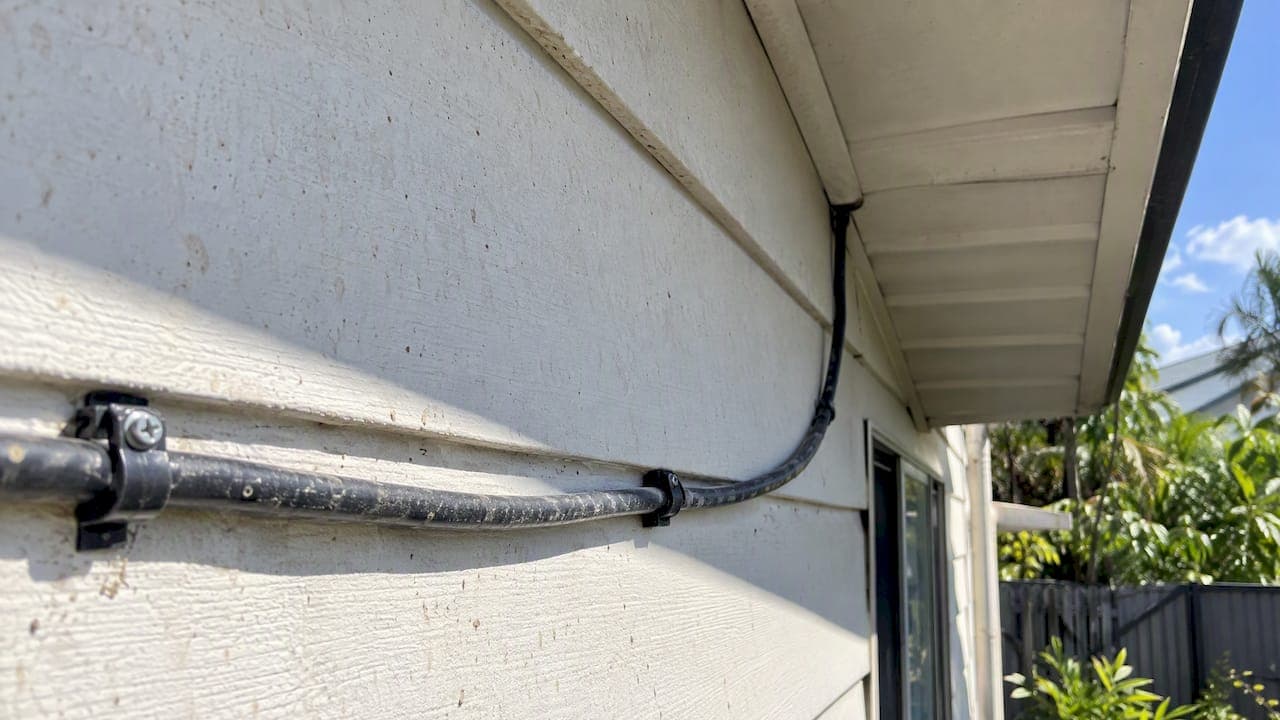
For exposed outdoor runs, buy a cable sold specifically as outdoor or UV resistant, with a carbon-black polyethylene jacket and copper conductors and a direct-burial construction if any of it goes underground. "UV rated" means the jacket is built and tested to survive sunlight without cracking. Before you buy, check the jacket material and the outdoor or direct-burial wording on the spec sheet.
TL;DR:
- For short camera or access point runs, Cat5e can work; choose Cat6 for PoE cameras, and reserve Cat6A for building links or faster speeds.
- Do not bury cable unless it has a direct burial rating and a dual jacket or gel fill; ordinary outdoor patch cable is insufficient.
- Outdoor jackets may lack required indoor fire ratings, so transition to indoor rated cable shortly after entry and seal the opening against water.
- Reject listings that claim only waterproofing; ask for the jacket material and stated UV exposure testing, such as 300 or 720 hours.
- A link light does not confirm cable performance; verify wiremap and category compliance, then measure PoE voltage at the device and retest after heavy rain.
Table of Contents
- Which cable category should you choose for outdoor runs?
- What jacket materials survive sunlight and weather?
- How do aerial, conduit, buried and building-entry runs differ?
- Which protective accessories help, and what should you avoid?
- What should you check before buying?
- How do you test an outdoor run and check PoE?
- How long does UV-rated Ethernet cable actually last?
- How often should you inspect outdoor cabling?
- Why does professional scoping prevent outdoor cabling failures?
- FAQ
- Sources
Which cable category should you choose for outdoor runs?
Outdoor jackets are offered across the common categories, so the choice comes down to what the run has to do, not whether a UV version exists. Retail listings show outdoor Cat6 cables advertised with anti-UV and waterproof claims, and Cat5e and Cat6A are sold in outdoor constructions too.
- Cat5e: fine for a single camera or access point on a short run, but it leaves little headroom.
- Cat6: the sensible default for most outdoor jobs, and our usual pick for PoE cameras.
- Cat6A: worth it for backbone links between buildings or where you want to future-proof for faster speeds. Our Cat6 vs Cat6A comparison goes deeper.
- Shielding: unshielded (UTP) cable suits clean, isolated runs. Foil-shielded (FTP) or fully shielded (SFTP) cable makes sense near power cables, motors or lighting, and some retail outdoor cables are sold as shielded FTP options. Shielded cable only helps if it is terminated and grounded correctly.
For PoE cameras, Cat6 with a proper outdoor jacket is usually enough. Save Cat6A for the links that carry everything.
What jacket materials survive sunlight and weather?
The jacket does the real work. Outdoor cable designs typically use a tough polyethylene (PE) outer jacket with carbon black to shield the core from sun, while gel-filled cores or dual jackets stop water migrating along the cable in wet or buried installations.
- PE with carbon black: the standard answer for UV resistance. The carbon black absorbs ultraviolet light before it degrades the plastic.
- PVC: common on indoor cable and fine under a roof, but a standard indoor PVC jacket will stiffen and crack in direct sun. Only use PVC that is explicitly marked outdoor or UV rated. Our LSZH vs PVC guide covers the trade-offs.
- LSZH: valued indoors for low smoke, but outdoor-rated LSZH is far less common, so check the datasheet instead of assuming.
- Gel-fill and dual jackets: look for these on anything buried or sitting in wet ground.
Pro Tip: If the listing says "waterproof" but never names the jacket material or a UV claim, treat it as unverified and ask the seller for the datasheet.
How do aerial, conduit, buried and building-entry runs differ?
The route decides what protection the cable needs. Whatever the route, outdoor jackets are specified with matching accessories: manufacturers such as LAPP note that UV-resistant cables are paired with UV-rated glands and accessories.
- Aerial: use aerial-rated or lashed cable with a UV jacket, support it properly and add strain relief so wind and sag never load the terminations.
- Conduit or trunking: the easiest upgrade. It shields the cable from sun and knocks, and it lets you pull a replacement later without digging.
- Direct burial: require a dual jacket or gel-filled construction and an explicit direct-burial rating. Standard outdoor patch cable is not enough.
- Building entry: outdoor jackets commonly lack the flame-retardant ratings indoor spaces require, so transition to indoor-rated cable shortly after the cable enters the building, and seal the entry point against water.
Which protective accessories help, and what should you avoid?
Good accessories extend the life of a correctly specified cable. They are not a rescue for the wrong one.
- Split-loom sleeving or UV-rated conduit: adds a second layer wherever the cable is exposed to sun, abrasion or animals.
- UV-resistant cable glands: these keep moisture out where the cable enters an enclosure, and the gland itself should be UV rated.
- Weatherproof junction boxes: use IP-rated boxes for any joint or termination outside, with the cable gland sealed properly.
- Paint: painting a jacket is a short-term patch at best. Paint cracks and traps moisture against the jacket, so don't rely on it.
When a jacket already looks chalky, brittle or split, replace the run. Patching degraded cable usually buys a few weeks before the next fault.
What should you check before buying?
Use this list on product pages or with a supplier:
- Explicit wording: "outdoor", "UV resistant" or "direct burial", plus the exact jacket material, not just "weatherproof".
- Conductors: 100% solid copper, not copper-clad aluminum (CCA), which wastes PoE power and ages badly.
- Shielding: UTP, FTP or SFTP, matched to the environment.
- Temperature range: make sure it covers your local extremes.
- UV test claims: a stated exposure test is a good sign.
- Support: a warranty, a named seller and a clear return policy.
On that last point about test claims, outdoor ratings from manufacturers are backed by long-term UV exposure tests measured in hours, with 300 and 720 hours cited as examples.
Test hours: a stated UV exposure test, such as 300 or 720 hours, is the clearest proof a jacket was built for sunlight. A listing that names no test at all asks you to take the claim on trust.
How do you test an outdoor run and check PoE?
A cable that lights up a link is not necessarily a good cable. Work through this order:
- Continuity and wiremap: confirm the conductors are connected in the right pairs, with no shorts or splits.
- Performance test: use a network tester to verify the cable meets its category. Where reliability matters, a copper certifier gives you a formal pass or fail, and our guide to verifying cabling certification explains what to ask an installer for.
- PoE voltage at the device: measure power where the camera or access point connects, not just at the switch. Long runs and thin conductors lose voltage along the way.
- Retest after the weather turns: a termination that passes on a dry day can fail after the first heavy rain.
If faults keep returning after you have retested, bring in an installer before replacing cable again.
How long does UV-rated Ethernet cable actually last?
There is no single lifespan figure, and we won't invent one. Life depends on how the cable is exposed. A carbon-black PE jacket in conduit, shaded and kept dry, is in the gentlest conditions you can give outdoor cable. The same jacket lashed along a sun-baked fascia sees constant ultraviolet light, heat cycling and wind movement, which is the harsh end of the range.
Several things shorten life regardless of rating. Heat is one: dark jackets run hotter in direct sun, and repeated expansion and contraction stresses terminations more than the cable itself. Standing water is another, which is why gel-fill or a dual jacket matters in buried or wet runs. Physical damage rounds it out: mowers, whipper snippers, rodents and tight bends all open a path for moisture long before the UV rating gets tested.

The stated test hours on a datasheet show the jacket was proven against sunlight for a defined period, but they are a comparison tool, not a warranty on years of service. A cable with a verified outdoor construction, correct glands and sensible routing will typically outlast one with a vague "waterproof" label by a wide margin. If a seller quotes a specific service life, ask what test or standard it is based on.
How often should you inspect outdoor cabling?
Treat inspection as a short routine, not a project. A regular walk-along check is a reasonable baseline, ideally before and after the harshest season where you live. Move to more frequent checks in coastal, high-heat or high-wind sites.
On each pass, look for these:
- Jacket condition: chalking, fading, stiffness, hairline cracks or flattened sections.
- Supports and ties: loose clips, sagging spans, UV-brittle plastic ties that need swapping.
- Terminations and glands: gaps, lifted seals, moisture or corrosion inside junction boxes.
- Conduit and sleeving: cracked or displaced sections and unsealed ends.
- Surroundings: new plant growth, rodent signs or building work near the route.
Pair the visual check with a quick link test. If a camera drops packets or a PoE device reboots, retest the run before blaming the hardware. Note the date and findings so you can spot a slow decline instead of a sudden fault.
For outdoor wireless gear sharing the same runs, our notes on outdoor WiFi coverage and surveys are a useful companion.
Why does professional scoping prevent outdoor cabling failures?
Most outdoor failures trace back to scoping, not the cable: the wrong route, an unsealed entry point or a termination that was never weatherproofed. Our team designs, scopes and installs without subcontractors, and we aim to fix issues on the first visit on every outdoor job. A correctly scoped run costs less than repeat visits to chase a wet termination. DIY is reasonable for a short, sheltered run with a few terminations; long, buried or high-mounted runs are where a pro earns their fee.
— Dylan
FAQ
Can I use a regular Ethernet cable outdoors?
Not for exposed runs. Standard indoor jackets are not built to resist sunlight and moisture, so they tend to crack and fail early. Choose a cable marked outdoor or UV resistant, and use conduit if you cannot.
Is it okay for an Ethernet cable to get wet?
Outdoor-rated cable is designed for it, especially gel-filled or dual-jacket types made for wet and underground use. Indoor cable is not, and the terminations are the weak point, so seal them in IP-rated enclosures.
What is a quality Ethernet cable?
Look for solid 100% copper conductors, a clearly stated category, a named jacket material and the right shielding for the site. For cameras, a PoE-focused buying guide can help you match cable to device.
Is Cat6 overkill for home use?
Usually not. Cat6 costs little more than Cat5e and leaves room for faster speeds and PoE devices later. It is a sensible default for outdoor camera runs.