
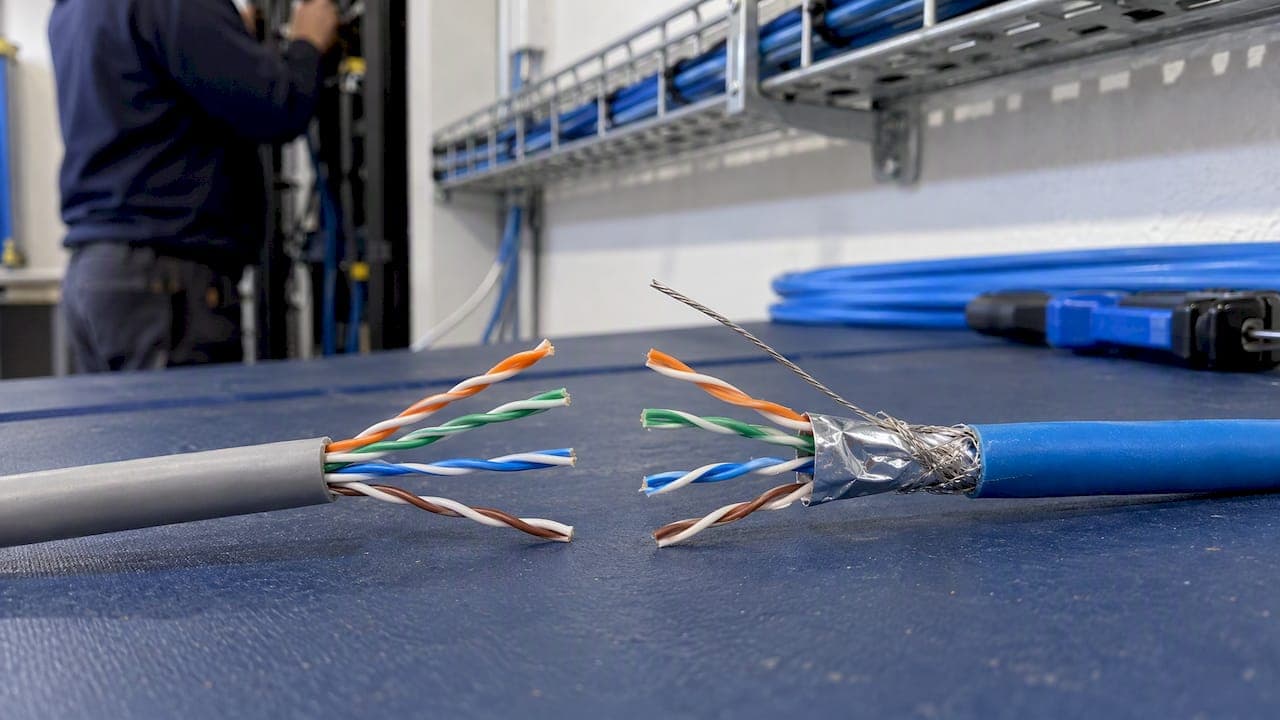
For most Australian homes and offices, unshielded twisted pair (UTP) is the right cable. Shielded twisted pair (STP) earns its extra cost only where there is real electrical interference, where a design specifies it, or where you run 10 Gbps over Cat6A in a bundle. Shielded cable also only works if it is terminated with shielded hardware and grounded properly. Fitted badly, it can perform worse than the unshielded cable it replaced.
This guide covers what the letters mean, how Cat6 and Cat6A change the answer, what grounding involves, and why the copper inside the jacket matters as much as the shield around it.
TL;DR
- UTP has no metal shield and relies on twisted pairs. It suits most homes and clean offices.
- STP adds foil or braid. It helps near heavy electrical noise or in dense Cat6A runs, but only when grounded end to end.
- The shield does not replace correct separation from mains wiring. Pathway rules still apply.
- Whatever the shielding, insist on solid copper. Copper-clad aluminium (CCA) is not compliant for customer cabling in Australia.
- Cat6 and Cat6A are usually sold as UTP, but both come in shielded versions. Check the label, not the category alone.
Table of Contents
- What STP and UTP actually mean
- How shielding helps, and where it does not
- When UTP is the right choice
- When to use shielded cable
- Grounding: the part most guides skip
- Is Cat6 STP or UTP? And Cat6A shielded versus unshielded
- Solid copper versus CCA: the bigger trap
- Australian rules that shape your choice
- A quick decision guide
- Perspective: what we see on site
- Cabling and networking from our team
- FAQ
- Sources
What STP and UTP actually mean
UTP is unshielded twisted pair. Each of the four pairs is twisted along its length, and the twisting cancels most interference the pair picks up or creates. Intel's Ethernet cabling guide explains that twisted copper protects signals from crosstalk and outside disturbance, and that shielding adds protection against alien crosstalk, which is interference from neighbouring cables.
STP is shielded twisted pair. A metal layer wraps the pairs, or each pair, so noise is intercepted before it reaches the conductors. In practice the word "STP" is loose. Cable makers and standards use a more precise code, written as overall shield / pair shield followed by TP.
| Code | What it means | Typical construction |
|---|---|---|
| U/UTP | No shield at all | Four bare twisted pairs in a jacket |
| F/UTP (often called FTP) | Overall foil, pairs unshielded | One foil wrap around all four pairs |
| U/FTP | Foil on each pair, no overall shield | Individually foiled pairs |
| S/FTP (often called SFTP) | Overall braid plus foil on each pair | Braided screen outside, foiled pairs inside |
TechTarget's explanation of shielded twisted pair describes FTP as using a lighter foil shield, while S/FTP uses a thick braided shield with individually shielded pairs for protection against crosstalk and EMI. Intel's guide notes that Cat6A S/FTP has an outer braided screen and foil around each pair.
So when someone quotes "STP" on a job, ask which one they mean. Foil only and braid plus foil behave differently, cost differently and are terminated differently.
How shielding helps, and where it does not
A shield tackles two problems.
External interference (EMI). Motors, variable speed drives, welders, large transformers, fluorescent ballasts and radio transmitters all radiate noise. A shield diverts it to earth rather than letting it couple into the pairs.
Alien crosstalk. At 10 Gbps over 500 MHz Cat6A, tightly bundled cables leak into each other. Shielded construction cuts this, which is why dense Cat6A bundles in comms rooms are often specified shielded.
What a shield does not do:
- It does not make a bad pathway acceptable. Required separation from electrical wiring still applies, and the shield is not a workaround for running data cable alongside mains.
- It does not add speed. A clean Cat6A U/UTP and a clean Cat6A S/FTP both carry 10 Gbps to 100 m. The difference shows up in noisy conditions.
- It does not work if the shield is not continuous. A shielded cable plugged into unshielded jacks has a broken shield, and a broken shield can behave like an antenna.
When UTP is the right choice
UTP is the norm in conventional residential networks, and shielding is generally only considered when significant electromagnetic interference has been identified. That matches what we see on site. A typical house or small office has:
- Short runs from a comms cabinet to wall plates
- Cables kept away from power circuits
- No heavy machinery on the same cable route
In those conditions, good UTP made from solid copper, installed with correct bend radius and separation, tests clean. Unshielded cable is also thinner, more flexible, quicker to terminate and cheaper, which counts when you are pulling forty runs through a roof space.
UTP is also the better choice where a shielded system cannot be grounded properly. If the building has no suitable earthing path to the rack, shielding adds risk and no benefit.
When to use shielded cable
Shielded cable makes sense in a defined set of situations:
- Industrial and workshop environments. Panduit's guide to shielded Ethernet says to use shielded cable in electrically noisy industrial settings or where it is specified. It also points to the MICE rating system in ANSI/TIA-1005-A, which gives guidelines for quantifying environmental stressors, including electrical noise, so the choice rests on measured conditions.
- Dense Cat6A bundles. Large 10GBASE-T runs where alien crosstalk is the limiting factor.
- Specified designs. Hospitals, labs, broadcast rooms and some data centres specify shielded cabling. If the designer or consultant has written it into the spec, you install it and ground it as designed.
- Proven interference. Some commercial sites near lifts, heavy plant or transmitters. Test first, so that you are fixing a measured problem.
The flip side matters: if none of these apply, you are usually paying more for cable, connectors and labour for no practical gain.
Grounding: the part most guides skip
A shield is only as good as its earth path. Siemon's grounding white paper describes the pattern in shielded systems: the outlet bonds to the patch panel, which is grounded to the rack and connected to the telecommunications grounding busbar (TGB). Panduit likewise says shielded installation needs proper infrastructure design, including grounding and bonding.
Practical points:
- Use shielded patch panels, shielded keystones or plugs, and shielded patch leads throughout. One unshielded link breaks the chain.
- Bond the rack to the building earth through the correct route. This is electrical work to be done by a licensed person.
- Test the finished link with a certifier that supports shielded cabling. If you are weighing outlet and panel options, our comparison of patch panels versus keystones covers how termination affects the finished link.
If your site cannot deliver this, choose high quality UTP and fix the noise source or the pathway instead.
Is Cat6 STP or UTP? And Cat6A shielded versus unshielded
The category (Cat5e, Cat6, Cat6A) describes performance, not shielding. Cat6 is most often sold as U/UTP, but shielded Cat6 exists. Intel's guide notes that TIA/EIA-568B specifies at least two twists per centimetre for Cat6, and that Cat6 may include a nylon spline to reduce crosstalk. That spline is how unshielded Cat6 holds crosstalk down without any metal.
Cat6A is where the choice becomes real. Both versions are rated to 500 MHz, so both support 10 Gbps to 100 m.
| Cat6A U/UTP | Cat6A F/UTP or S/FTP | |
|---|---|---|
| Outer diameter | Larger than Cat6, often thick | Similar or slightly larger |
| Flexibility | Stiff, but easier than braid | Stiffer, especially S/FTP |
| Termination | Standard jacks | Shielded jacks, grounding needed |
| Alien crosstalk | Managed by spacing and bundle size | Largely suppressed |
| Best for | Clean homes and offices, moderate bundles | Dense bundles, noisy sites, specified designs |
| Cost | Lower | Higher in cable, parts and labour |
If you are deciding between categories first, read our guide to Cat6 versus Cat6A. For a home, Cat6A U/UTP is already generous future proofing. Add the shield only when conditions or the specification call for it.
Cat6A also helps with Power over Ethernet. Heavier gauge conductors run cooler under load, and Cat6A is the sensible choice for bundled runs carrying high wattage. For cameras and access points, see our notes on matching PoE classes to CCTV and PoE distance limits.
Solid copper versus CCA: the bigger trap
Shielding gets the attention, yet the cheapest way to ruin a network is the conductor. Copper-clad aluminium (CCA) cable has an aluminium core with a thin copper coating. It is sold online as "Cat6" at a fraction of the price of the real thing.
Solid copper has lower resistance. CCA has higher resistance, so it loses more signal over distance, and under PoE it runs hotter. Heat inside walls and ceilings is a safety problem, not just a performance one.

In Australia it is also a compliance problem. The industry association NECA SA published an ACMA warning about CCA cable stating that CCA cannot comply with section 5.6.6 of the mandated customer cabling products standard, so it cannot carry the compliance mark and cannot be used as telecommunications customer cabling.
What that means for you:
- Shielded or unshielded, the cable should be solid copper. A shield around a CCA core is still CCA.
- Be wary of very cheap "Cat6" boxes from overseas marketplaces. Price per metre is the first warning sign.
- Ask your installer to show the cable's printed jacket markings and supplier paperwork.
The cable's weight and a scratch test on a cut end (copper colour all the way through versus silver beneath) are rough checks, but compliance paperwork is the real answer.
Australian rules that shape your choice
Two mandated standards matter. The ACMA's page on Australian cabling standards explains that AS/CA S009:2020 covers fixed or concealed network cabling, while AS/CA S008:2020 applies to customer-side cabling products and connecting hardware. In plain terms, S009 governs how it is installed, and S008 governs what you are allowed to install.
Registered cablers must work to these rules, and fixed customer cabling in many situations has to be done or directly supervised by a registered cabler. We explain the paperwork side in our guides to ACMA cabling rules for on-site cablers and how to verify and hire a licensed cabler. If your business is also moving to a faster uplink, the background on NBN enterprise Ethernet shows why the cabling behind the connection needs to keep up.
Two more specification points are separate from shielding but belong on the same quote: the jacket (see LSZH versus PVC) and outdoor exposure (see UV-rated Ethernet cable).
A quick decision guide
Work down this list and stop at the first yes.
- Is shielded cable written into the design or spec? Install it as specified, with shielded hardware and bonding.
- Is the site electrically noisy, such as workshops, plant rooms or runs near large motors? Measure or assess, and use shielded cable with full grounding if the noise is real.
- Is this a dense 10 Gbps Cat6A bundle? Consider F/UTP or S/FTP.
- Can you not guarantee earthing to the rack? Use UTP.
- Otherwise? Solid copper Cat6 or Cat6A U/UTP, installed with proper separation and tested.
Across all five, the conductor is solid copper and the install is tested. Our article on cabling testing and certification lists the checks to ask for.
Perspective: what we see on site
Most of the cabling problems we are called to fix are not shielding problems. They are CCA cable, poor terminations, runs laid beside mains, cables crushed by staples, or several different trades each blaming the other. Because the same licensed, accredited team designs, scopes, installs and configures the job, with no subcontractors, we can look at the whole system and decide whether a shield will solve anything.
Our view is plain. Do not buy shielded cable as insurance. Pay for it where the environment or the design calls for it, and then pay for the grounding and testing that make it work. In a typical South East Queensland home or office, well installed solid copper UTP delivers everything the network needs, and the money saved is better spent on access point placement, a managed switch and a tidy rack.
— Dylan
Cabling and networking from our team
If you want cabling run once and run right, our data cabling and networking service covers structured cabling, PoE installs, managed switches, comms racks and site-surveyed WiFi for homes, businesses and rural properties across South East Queensland. We scope each job at a fixed scope, tell you whether shielded or unshielded cable suits your site, and hand over a tested system. For a sense of what that involves, see our guide to network cabling costs in Australia.
FAQ
What does STP cable stand for?
STP stands for shielded twisted pair, meaning twisted copper pairs wrapped in a metal foil or braided shield. The term is used loosely: FTP has an overall foil, and S/FTP has an overall braid plus foil around each pair. Always confirm which construction is being quoted.
Can I use shielded Ethernet cable without grounding it?
You should not. A shield only works when it is continuous and bonded to earth through shielded jacks, a shielded patch panel and a grounded rack. An ungrounded or half-terminated shield can pick up noise instead of blocking it, so choose UTP if you cannot ground the system.
Is CCA cable okay for a home network?
No. CCA has higher resistance than solid copper, can overheat under PoE loads, and is not compliant for customer cabling in Australia. Buy solid copper cable with proper markings, whether it is shielded or not.
Is Cat6 STP or UTP?
Cat6 is usually sold as UTP, but the category only describes performance. Shielded Cat6 and Cat6A are both made, so check the jacket marking or datasheet for U/UTP, F/UTP or S/FTP before you buy.
Sources
- Technology Guide: Ethernet Cables and Transceivers Overview (Intel)
- Shielded Cable for Ethernet Applications (Panduit)
- Grounding for Screened and Shielded Network Cabling (Siemon)
- What is shielded twisted pair (STP) and how does it work? (TechTarget)
- Australian cabling standards (ACMA)
- ACMA Warning: CCA Cable (NECA SA)